Engineer explanations so they survive without you—and compound as reusable capital.
Previous · Part 2
Explanations as After-Publication Infrastructure: Trust, Reach, Opportunity

Next · Part 4
Precision as Longevity: How Sharp Thinking Becomes Reusable Capital
This builds on Part 2: Explanations as After-Publication Infrastructure: Trust, Reach, Opportunity
Continue with Part 4: Precision as Longevity: How Sharp Thinking Becomes Reusable Capital
Why Clarity Compounds
Clarity isn’t just a kindness to your reader.
It’s an advantage that keeps paying you back—after the post is gone, after the conversation ends, after you’ve moved on.
The non-obvious mechanism: comprehension → transmission → memory
Most people think “good writing” is about producing pleasure.
But useful explanations create a different outcome: they reduce cognitive friction.
That friction reduction changes what happens next.
- Your reader can process your idea quickly.
- Then they can translate it into their own words.
- Then they can pass it on to someone else without distorting it.
- Over time, that repeatable transmission becomes visibility.
- Visibility becomes proof.
- Proof becomes demand.
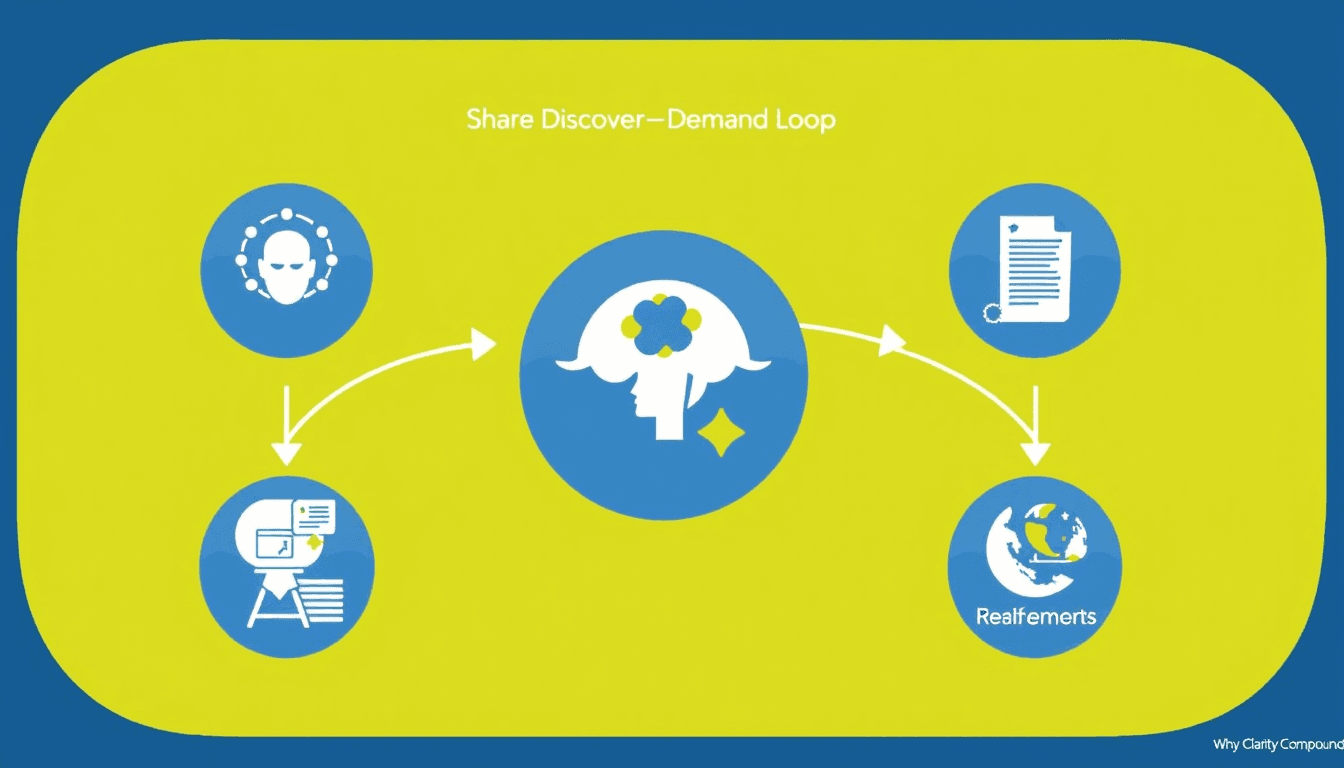
The Share → Discover → Demand → Authority loop
Think of one strong explanation as a small machine. Not a one-time artifact—an ongoing engine.
Diagram: Clarity: reader understands fast leads to B; B leads to Discovery: surfaced by recommendations, mentions, search; Discovery: surfaced by recommendations, mentions, search leads to Demand: used in decisions, purchases, and adoption; Demand: used in decisions, purchases, and adoption leads to Authority: cited, quoted, and remembered; Authority: cited, quoted, and remembered leads to B.
Diagram: Clarity: reader understands fast leads to B; B leads to Discovery: surfaced by recommendations, mentions, search; Discovery: surfaced by recommendations, mentions, search leads to Demand: used in decisions, purchases, and adoption; Demand: used in decisions, purchases, and adoption leads to Authority: cited, quoted, and remembered; Authority: cited, quoted, and remembered leads to B.
1) Sharing: the “sendability” test
You know an explanation is shareable when it survives contact with real life.
Not “shareable” like viral.
Shareable like: someone can forward it to a friend and it still makes sense.
Clarity makes that possible.
- Clear explanations give other people the confidence to endorse.
- They reduce the risk of embarrassment (“this doesn’t hold up”).
- They make quoting feel safe because the meaning stays intact.
2) Discovery: clarity creates multiple entry points
A confusing idea can only be found if someone already knows what to search for.
A clear idea can be found by search, by browsing, by scrolling, by reference chains.
Because it has:
- recognizable terms,
- understandable claims,
- a structure other people can restate.
Clarity turns your writing into a “usable object” in other people’s mental libraries.
3) Demand: clarity reduces decision stress
Demand doesn’t start when people admire you.
It starts when they can use what you wrote.
A clear explanation:
- helps someone diagnose their problem,
- helps them evaluate options,
- helps them justify a next step.
That’s why clarity converts.
Not because you’re “persuasive.” Because you remove ambiguity—the enemy of action.
4) Authority: clarity makes you quotable
Authority compounds when other people can reproduce your thinking accurately.
Clear explanations become:
- quotes,
- frameworks,
- referenced principles,
- “this is what I mean” citations.
And once you’re in the reference layer of a field, you stop auditioning.
You start being retrieved.
What “compounding clarity” actually looks like
You can measure compounding without chasing vanity metrics.
Look for these signals over time:
Incoming shares months later
rising
Inbound questions citing your framing
increasing
Mentions that use your terminology
growing
Requests that reference “how you explain it”
frequent
The key is time. Clarity doesn’t peak on day one.
It peaks when it’s been tested by repetition.
When readers see your explanation still hold up:
- in different contexts,
- for different people,
- and with minimal extra effort.
That’s when an explanation becomes infrastructure.
The anatomy of an explanation that keeps paying you
A compounding explanation usually contains four ingredients.
Ingredient A: a specific promise
Not “this will help you think better.”
A crisp promise:
- what it will enable,
- what it will prevent,
- what it will clarify.
Ingredient B: a structure others can reuse
A reader should be able to restate your explanation as steps, categories, or a rule.
The more reusable it is, the more it will travel.
Ingredient C: a definition that locks meaning
Clarity often comes from one sentence that becomes the anchor.
If you can’t state your central idea cleanly, it won’t compound.
Ingredient D: a boundary that prevents misapplication
Compounding explanations don’t just explain what is true.
They hint at what’s not true—and when the rule breaks.
That protects trust.
The Precision Dividend (without turning it into Precision Theory)
You don’t need to be maximalist to be clear.
But you do need to eliminate the two common clarity killers:
- vague nouns (“system,” “strategy,” “value”)
- soft verbs (“helps,” “supports,” “improves”)
Replace them with:
- nouns that name what’s actually happening,
- verbs that show what changes and for whom.
Build your “clarity asset” in one pass
Use this as a drafting order. Don’t improvise—sequence is part of clarity.
When you do this, you’re not merely writing content.
You’re creating a transferable instrument—something other people can pick up and play.
A practical checklist for compounding clarity
Final takeaway: clarity is a distribution system you can build
Clarity compounds because it upgrades three things simultaneously: transmission, retrieval, and trust.
Write so your reader can understand it fast.
Then write so someone else can share it accurately.
Then write so it keeps being found when the moment arrives.
If this resonates, see how to apply it to your own work with the interactive Dispatch agent.
Be first to like this dispatch