Lasting transformation is ignited by catalysts—specific ideas or tools that compress time and amplify human capability.


Previous · Part 3
The Scientific Method: The Discipline That Taught Knowledge to Correct Itself

Next · Part 5
The Assembly Line as a System That Changed Human Time
This builds on Part 3: The Scientific Method: The Discipline That Taught Knowledge to Correct Itself
Continue with Part 5: The Assembly Line as a System That Changed Human Time
Part 4
The Invention of Nothing
A small mark that changed the shape of thought.
Zero began as a practical placeholder. Then it became a number. From there, it opened the way to algebra, calculus, computing, and the strange modern power of turning absence into structure.
Core Shift
Nothing became usable.
Once absence could be named, positioned, calculated, and encoded, it stopped being empty. It became machinery.
For a long time, mathematics was a language of presence.
One sheep. Two jars. Ten measures of grain. A hundred soldiers. Numbers pointed to things that were there.
Then came a mark for what was not there.
At first, zero was not treated as a number. It was a placeholder: a way to keep columns from collapsing inside a positional numeral system. It told the reader, there is nothing in this place, but this place still matters.
That was already powerful.
But the deeper revolution came later, when nothing was no longer just a gap in notation. It became a quantity in its own right.
To invent zero was to give absence a role inside thought.
Not silence.
Not emptiness.
A working part.
The Placeholder Before the Number
The first step was practical.
In positional systems, the value of a digit depends on where it sits. The difference between 12, 102, and 1002 is not the digits alone. It is the empty spaces between them.
Without a placeholder, numbers become ambiguous. A system can count, but it struggles to scale.
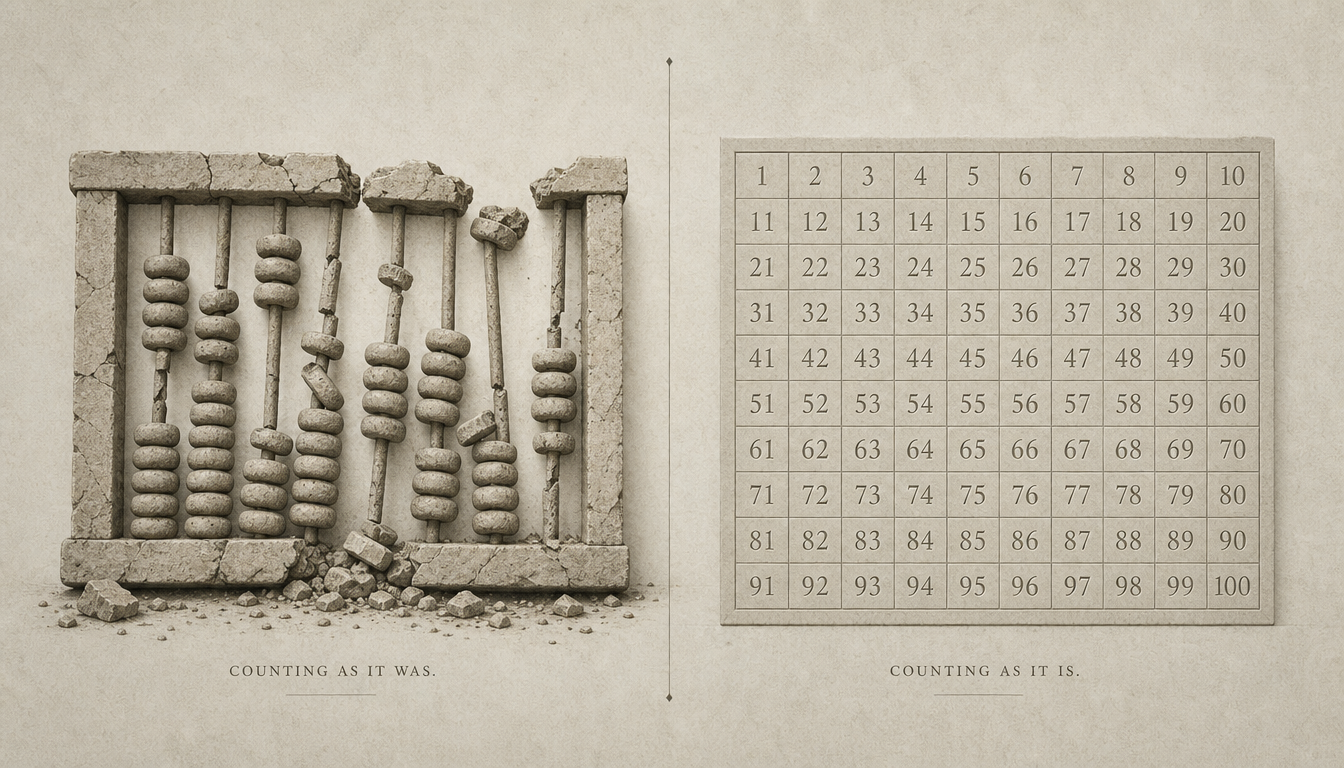
The Babylonians used a placeholder in their sexagesimal system. It marked an empty position. It helped readers see the structure of a number.
But it was still not quite zero as we know it.
It did not yet behave like a number. It did not sit on the number line. It did not take part in arithmetic as a full citizen.
It was a mark for absence, not a quantity of absence.
An empty position had to be inferred, guessed, or marked only as a gap.
The empty position could be written, handled, calculated, and trusted.
This distinction matters.
A placeholder helps you write numbers.
A true zero helps you rethink number itself.
The Indian Leap: Nothing as Something
The decisive move came in ancient Indian mathematics.
By the 7th century CE, the Sanskrit word śūnya — often translated as “void” or “empty” — had become linked to a written symbol and a mathematical idea.
This was the leap: zero was not merely a blank space. It was a number.
A strange number, yes. A boundary number. A number that could unsettle ordinary intuition. But a number nonetheless.
Zero was an invention, not a discovery in the ordinary sense.
People did not simply find zero sitting in nature like a stone or a star. They built a concept that allowed absence to be represented, placed, and manipulated.
- —Placeholder marks existed before zero became a full number.
- —Ancient Indian mathematics gave the void a symbol and arithmetic role.
- —Later algebra, decimals, negatives, limits, and binary systems all depended on zero as an active concept.
Zero is one of humanity’s great abstract technologies: a tool made of thought that made new kinds of thought possible.
This is why the story of zero is not only mathematical.
It is philosophical.
To treat nothing as something requires a mind willing to separate the world from its symbols. It requires trust that a mark can stand not only for objects, but for relationships, positions, and states.
Zero is not a thing.
It is a role.
And once that role existed, the whole architecture of number changed.
The Center of the Line
Before zero, number naturally leaned toward counting.
One, two, three, four.
More things.
Larger piles.
Greater quantities.
Zero changed the geometry.
It created a center.
From zero, numbers could extend in two directions. Positive numbers on one side. Negative numbers on the other. Debt, loss, temperature, direction, balance, charge — all became easier to model once zero served as the point of reference.
Diagram: Negative numbers leads to 0; 0 leads to Positive numbers; 0 leads to Balance point; 0 leads to Algebraic origin; 0 leads to Measurement reference.
Diagram: Negative numbers leads to 0; 0 leads to Positive numbers; 0 leads to Balance point; 0 leads to Algebraic origin; 0 leads to Measurement reference.
Zero made number symmetrical.
It gave mathematics an origin point: a place from which movement, change, distance, and reversal could be described.
A merchant could owe instead of own.
A temperature could fall below freezing.
A coordinate could move left as well as right.
An equation could balance around a neutral point.
Zero did not just fill a gap.
It gave mathematics a hinge.
The Long Journey West
Ideas travel through people, languages, trade routes, arguments, translations, and resistance.
Zero was no exception.
It moved west through Persian and Arab scholars, especially through the mathematical tradition associated with al-Khwārizmī. His work helped carry Hindu-Arabic numerals into broader use.
Later, Latin translations opened the door to Europe. Fibonacci’s Liber Abaci, published in 1202, made a strong case for the new numerals in commercial life.
The system was faster.
Cleaner.
Better suited to calculation.
Yet zero was not welcomed without suspicion. A symbol for absence could feel slippery. It could be linked to fraud, hidden values, or philosophical discomfort. In some places, merchants and officials distrusted the new numerals.
But usefulness has a way of wearing down resistance.
Indian mathematics treats śūnya as a true numerical concept
Persian and Arab scholars develop and transmit Hindu-Arabic numerals
Latin translations bring the system into European scholarship
Fibonacci’s Liber Abaci promotes the numerals for trade and calculation
Algebra, decimals, and symbolic mathematics deepen zero’s role
Calculus turns vanishing quantities into a new science of change
Binary computing makes zero one of the two basic states of the digital world
The old Roman numerals were not useless. They could record quantities.
But they were clumsy for calculation.
Try multiplying large numbers with Roman numerals and the problem becomes clear. The notation fights the mind. It does not invite manipulation.
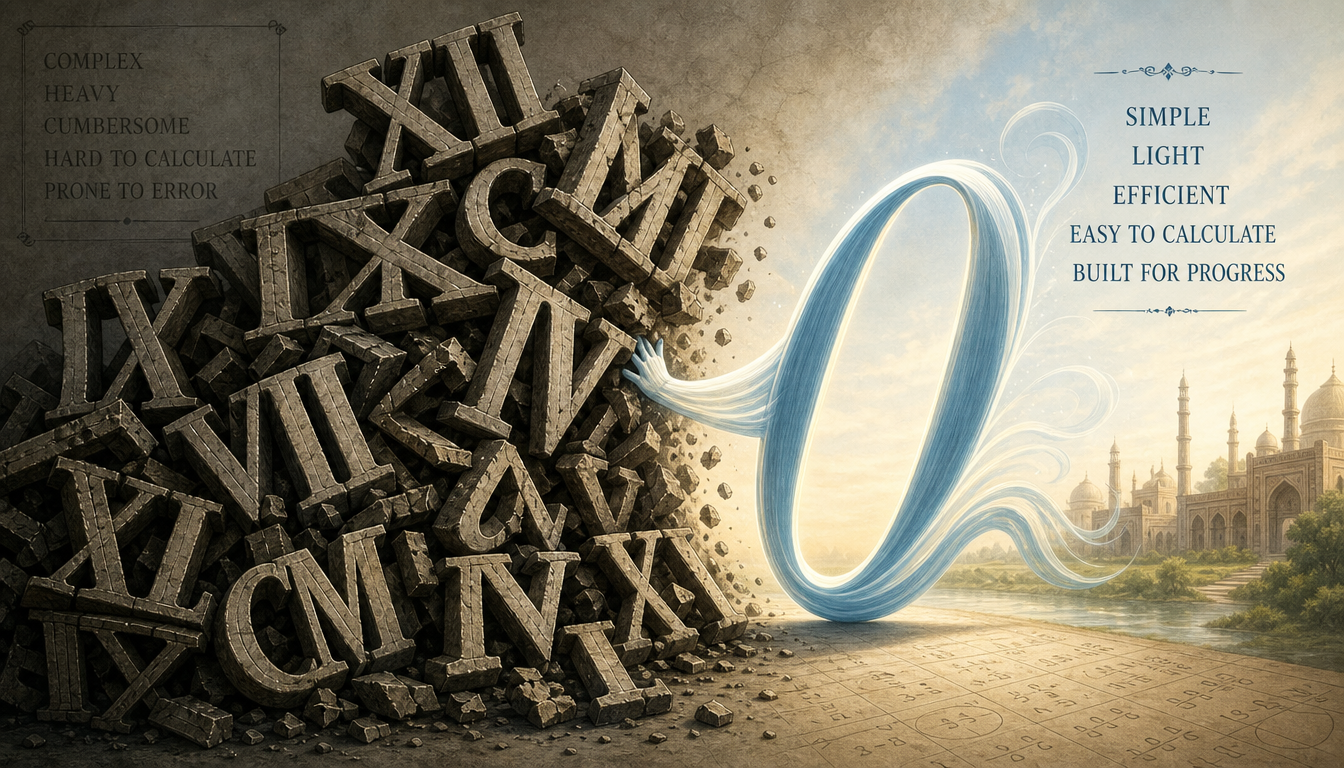
The Hindu-Arabic system, with zero at its core, did something different.
It made numbers portable, compact, and workable.
Numbers record amounts. They answer: “How many?”
Positional System
The place of a digit changes its value. 2, 20, and 200 are related through position.
Zero-Based System
Empty positions can be marked clearly. Absence becomes part of the structure.
Algebraic System
Zero becomes a balance point. Equations can be solved by moving terms toward, away from, and around it.
Zero helped turn arithmetic from recording into operating.
That shift sounds modest.
It was not.
The Decimal Mind
Zero also made scale elegant.
With zero, large numbers can be written without new symbols for every order of magnitude. Ten, one hundred, one thousand, one million: each can grow through position.
The same is true in the other direction.
Decimals allow numbers to move below one with precision: tenths, hundredths, thousandths. Money, measurement, astronomy, engineering, navigation, chemistry — all depend on this ability to place value with care.
Zero is the quiet keeper of that structure.
It says:
This column exists.
This magnitude matters.
There is nothing here, but do not remove the place.
Absence With Position
- ·Positional numerals
- ·Decimal notation
- ·Coordinate systems
- ·Balance sheets
- ·Binary code
A missing value still carries meaning because of where it appears.
This is one of zero’s deepest lessons.
Not all absence is the same.
An empty field in a form is not the same as a field that does not exist. A silent pause in music is not the same as no music. A zero in a database is not the same as missing data.
Zero is meaningful absence.
The Door to Algebra
Algebra needs zero in a special way.
To solve an equation, we often move everything to one side and ask when the expression equals zero.
The zero point tells us where balance occurs.
It reveals roots, intersections, turning points, and solutions. It lets us transform a question about equality into a question about structure.
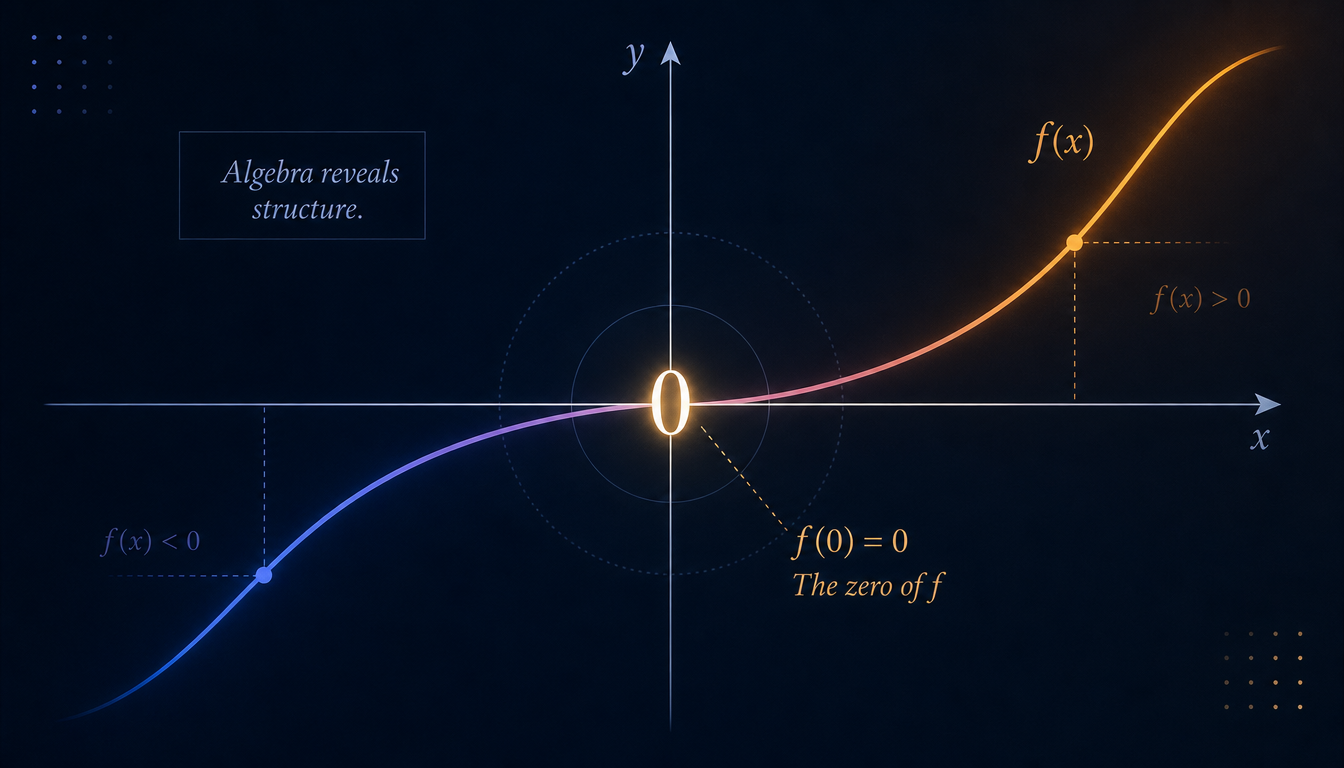
For example:
x + 5 = 12
becomes:
x - 7 = 0
The solution is the value that makes the expression vanish.
That may sound like a trick. It is more than that. It is a way of making absence diagnostic.
When something becomes zero, it tells us we have found a boundary, a balance, or a cancellation.
This is why zero is not passive.
It tests.
It anchors.
It reveals.
The Calculus of Almost Nothing
Then came one of the most powerful turns in the history of knowledge: calculus.
Calculus is the mathematics of change. It gives us the tools to describe motion, acceleration, growth, curvature, flow, and accumulation.
It helped make modern physics possible.
It gave engineering a deeper language.
It allowed humanity to model planets, falling bodies, waves, machines, markets, epidemics, and electric fields with extraordinary precision.
And at the center of it sits a strange idea: the vanishing quantity.
A derivative measures instantaneous change. To find it, we look at a ratio of changes:
change in y / change in x
Then we ask what happens as the change in x gets smaller and smaller, approaching zero.
Not becoming zero in the ordinary sense.
Approaching it.
This is the idea of a limit.
That distinction is everything.
Calculus depends on treating “almost nothing” with discipline. It asks: what does a process tend toward as the interval shrinks? What remains when the gap becomes vanishingly small?
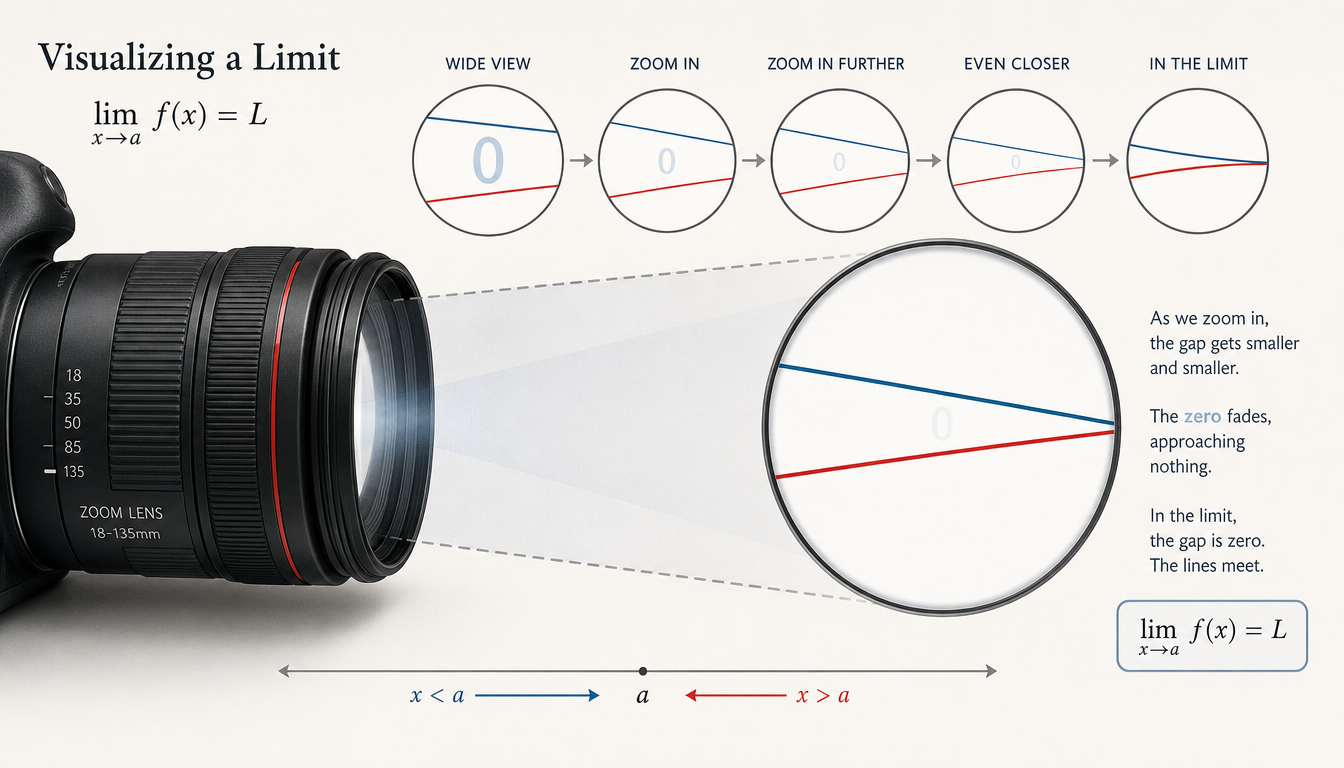
This is not casual emptiness.
It is controlled disappearance.
Without zero, this logic has no natural destination.
Without zero, “vanishing” is hard to formalize.
Without zero, the mathematics of continuous change loses its central doorway.
The Digital Void
Zero’s final transformation may be the most familiar because we live inside it.

Computers run on difference.
On and off.
High voltage and low voltage.
Signal and no signal.
1 and 0.
Binary code is not powerful because it is rich at the smallest level. It is powerful because it is simple, stable, and stackable. Two states can encode anything if they can be arranged at enough scale.
A photograph.
A bank transfer.
A sentence.
A song.
A search result.
A map.
A simulation.
A message crossing the planet in less than a second.
All of it becomes patterns of presence and absence.
Diagram: Physical state leads to On / Off; On / Off leads to 1 / 0; 1 / 0 leads to Bits; Bits leads to Bytes; Bytes leads to Text, images, audio, video; Text, images, audio, video leads to Software, networks, artificial intelligence.
Diagram: Physical state leads to On / Off; On / Off leads to 1 / 0; 1 / 0 leads to Bits; Bits leads to Bytes; Bytes leads to Text, images, audio, video; Text, images, audio, video leads to Software, networks, artificial intelligence.
In this form, zero becomes pure logic.
It no longer needs to mean “nothing” in a human sense. It means one of two possible states inside a machine. A transistor does not ponder emptiness. It switches.
Yet the old idea remains.
Zero marks the absence that can be read.
The gap that can be processed.
The off-state that helps create the world of information.
Every screen is a choreography of zeros and ones.

Every file is structured absence and presence.
Every algorithm depends on the ability to distinguish state from non-state, signal from non-signal, value from no value.
The global mind is built from tiny acts of difference.
Why Zero Changed More Than Mathematics
Zero matters because it changed what humans could represent.
It made absence legible.
It gave scale a structure.
It gave equations a center.
It gave calculus a vanishing point.
It gave computation a second state.
This is the pattern of a true catalyst. It does not simply solve one problem. It opens a new class of problems that can now be solved.
The Catalyst of Abstraction
- ·Zero as placeholder
- ·Zero as number
- ·Zero as origin
- ·Zero as limit
- ·Zero as binary state
A concept becomes powerful because it lets the mind operate on something it could previously only gesture toward.
The invention of zero reminds us that progress often begins with a subtle act of naming.
Not naming what is obvious.
Naming what has been ignored because it appears empty.
A pause.
A gap.
A missing place.
A neutral point.
A threshold.
A void.
Once named, it can be held. Once held, it can be moved. Once moved, it can become part of a larger machine of thought.
Where in your own work or life is there a “zero” hiding in plain sight?
Look for the empty place that still shapes the whole system: a pause, a missing metric, a boundary, a reset point, or an unspoken assumption.
The Space Between
Zero began as a mark.
A dot. A small sign. A way to say: nothing here, but keep the place.
Then it became a number.
Then an origin.
Then a tool for algebra.
Then the silent edge of calculus.
Then the second half of the digital universe.
From manuscript to machine, zero traces the arc of human abstraction. It shows how a concept can begin as a convenience and end as infrastructure.
The most powerful ideas are not always loud. Some do not announce themselves as revolutions.
Some simply define the space between.
And by doing so, they make a new world possible.
Interactive Companion
Zero
If this resonates, see how to apply it to your own work with the interactive Dispatch agent.
Be first to like this dispatch