Engineer explanations so they survive without you—and compound as reusable capital.

Previous · Part 1
Every Clear Explanation Becomes an Asset
Next · Part 3
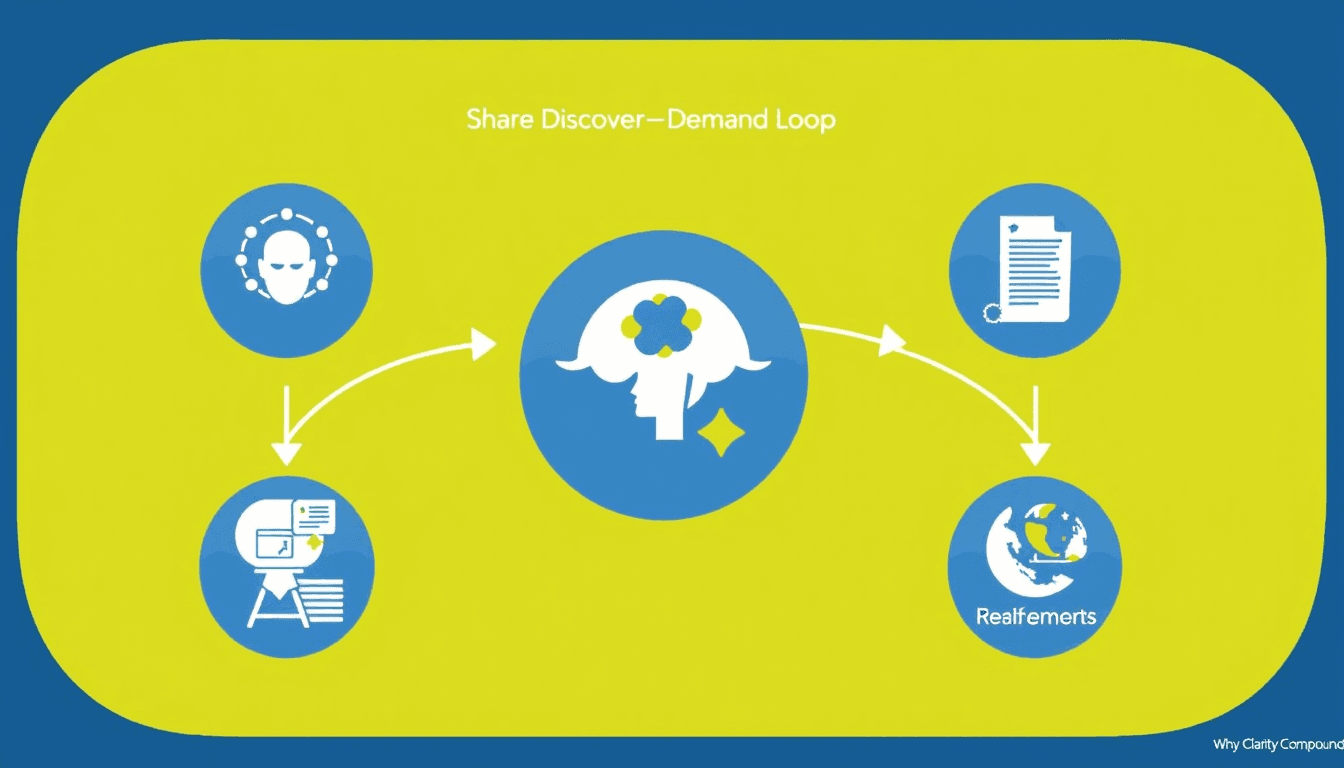
Why Clarity Compounds: The Share–Discover–Demand Loop
This builds on Part 1: Every Clear Explanation Becomes an Asset
Continue with Part 3: Why Clarity Compounds: The Share–Discover–Demand Loop
Thoughts That Work While You Sleep
The writing doesn’t stop when it’s posted.
Good explanations keep doing three quiet jobs long after the initial reader is gone: they earn trust, they earn reach, and they earn opportunity. Not by “going viral,” but by becoming reference material—the thing people return to when they need to think clearly.
The After-Publication Loop
When someone reads a strong explanation, they don’t just learn a point. They borrow your structure for how to think.
That borrowed structure shows up later in the smallest moments:
- Someone cites you internally because your framing makes a discussion easier.
- Someone forwards your piece because it gives them language.
- Someone hires you because they can already predict the quality of your thinking.
- A search query finds your post because the explanation is the answer, not just the commentary.
This is the compounding behavior of explanation: it turns into a reusable asset in other people’s workflows.
Trust That Continues to Accrue
Trust is rarely “felt.” It’s inferred.
A high-trust explanation usually has three traits:
- It is legible under pressure. The reader can re-enter the argument quickly.
- It anticipates objections. The piece treats confusion as normal, not embarrassing.
- It is coherent end-to-end. No dangling claims; no invisible leaps.
The magic is that these traits don’t only affect the first read. They affect what happens when someone returns to the text later—or when someone else reads it through a forwarded link or a citation.
Reach That Isn’t Dependent on You
Most writing relies on a one-time moment: attention, feed placement, timing.
Explanation-based reach works differently. It piggybacks on mechanisms that outlive trends:
- Search behavior: People look for answers, not author branding.
- Citation behavior: People reuse frameworks that shorten their own thinking.
- Selection behavior: Editors and newsletter curators choose what is dependable.
If your explanation is structured like something people can use, it becomes the kind of thing that gets referenced. Reference beats raw reach because it implies relevance.
Opportunity That Arrives as a Result, Not a Pitch
Opportunities don’t always appear as direct invitations.
Often, they arrive as “warm proofs”:
- A manager says, “We should do it like this.”
- A founder thinks, “This is the level of reasoning we need.”
- A collaborator asks, “Can you help us apply this to our situation?”
- A recruiter forwards your writing and writes one sentence: ‘This is the thinking we want.’
That’s what after-publication infrastructure looks like. Your explanation becomes evidence. Evidence is what hiring, partnership, and influence run on.
What “Works While You Sleep” Actually Means
Let’s name the pattern.
Your post becomes an asset when it satisfies two conditions simultaneously:
- It reduces ambiguity. The reader understands the “why,” not only the “what.”
- It stays usable. The reader can apply it later without you present.
That combination turns an explanation into a tool.
The Mechanics: How Explanations Keep Generating Outcomes
Here’s the system, in plain language.
Diagram: Strong explanation leads to Reader trusts the structure; Reader trusts the structure leads to Reader shares it; Reader shares it leads to Search/citation finds it later; Search/citation finds it later leads to New readers enter with less friction; New readers enter with less friction leads to More people experience the same clarity; More people experience the same clarity leads to Trust becomes reputation; Trust becomes reputation leads to Opportunities follow naturally; Opportunities follow naturally leads to You build a larger signal over time.
Diagram: Strong explanation leads to Reader trusts the structure; Reader trusts the structure leads to Reader shares it; Reader shares it leads to Search/citation finds it later; Search/citation finds it later leads to New readers enter with less friction; New readers enter with less friction leads to More people experience the same clarity; More people experience the same clarity leads to Trust becomes reputation; Trust becomes reputation leads to Opportunities follow naturally; Opportunities follow naturally leads to You build a larger signal over time.
The key isn’t that people remember everything. It’s that the experience of clarity becomes a repeatable signal:
- “This person’s reasoning holds up.”
- “This framework is dependable.”
- “This explanation makes my next step obvious.”
That signal becomes your quiet sales team.
Build Explanations That Keep Producing (Even Without New Posting)
This is where most people fall short: they write for the moment instead of the lifecycle.
Use this checklist to upgrade any existing draft or to shape new writing.
A Practical Writing Sprint (30–60 Minutes)
If you want the after-publication effect, don’t rewrite everything. Upgrade the few parts that determine whether people reuse your thinking.
Tabs: When Your Explanation Needs to Serve Different Futures
Sometimes the writing’s future use changes by audience. The structure can stay the same, while the emphasis shifts.
Focus on being un-confusably clear: definitions, one path of logic, and a clean example.
The Hidden Advantage: You Become Legible to Strangers
One of the strangest truths about explanation is that it doesn’t just inform. It makes you legible.
When someone reads your writing, they infer your habits:
- your intolerance for hand-waving,
- your respect for constraints,
- your ability to connect mechanism to meaning.
After publication, those inferences travel. They’re the raw material of trust.
Checklist: Your “Works While You Sleep” Test
Use this before publishing—or when revising something already out in the world.
If this resonates, see how to apply it to your own work with the interactive Dispatch agent.
Be first to like this dispatch