Geometry is not just measurement — it's the hidden architecture behind how humans design, perceive, and reason.

Previous · Part 4
Tessellation: How Constraint Creates Infinite Pattern
This builds on Part 4: Tessellation: How Constraint Creates Infinite Pattern
Most of us trust our eyes. We see a circle and a square as fundamentally different — one curved, one angular, one with corners, one without. We measure, compare, classify. Shape feels like bedrock truth.
Then, in 1736, a mathematician stared at a map of bridges and changed everything.
The Bridges That Broke Geometry
The city of Königsberg sat astride the Pregel River. Two islands. Seven bridges. A popular weekend puzzle: could you walk across every bridge exactly once and return to your starting point?
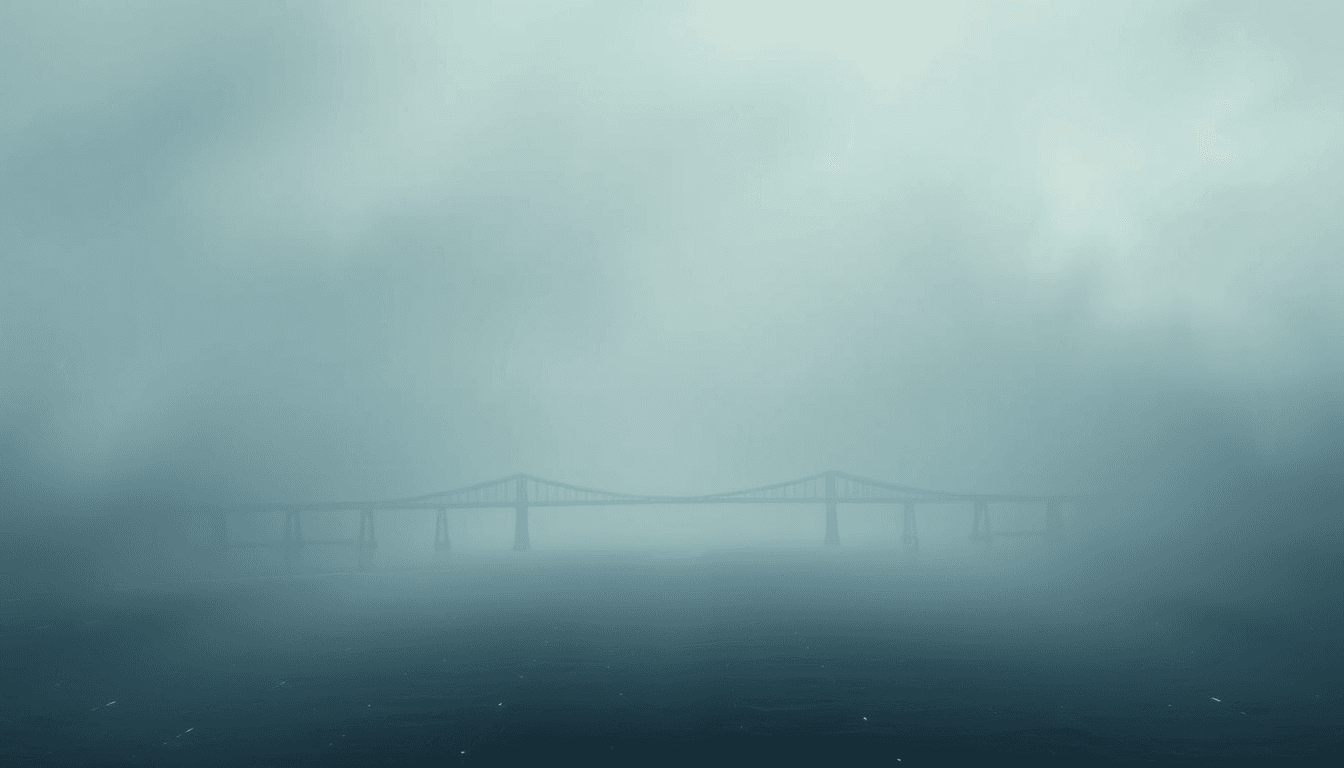
Nobody could do it. But nobody could prove it was impossible — until Leonhard Euler.
Euler didn't solve the problem with measurement. He didn't care about the distance between bridges, the angle of the banks, or the shape of the islands. He reduced the entire city to a drawing of dots and lines — nodes and connections. Landmasses became points. Bridges became edges connecting them.
And then he proved, with elegant finality, that the walk was impossible. Not because of how Königsberg looked, but because of how it was connected.
This was the birth of a new kind of thinking. It wouldn't get its name — topology — until Johann Benedict Listing coined the term in 1847. But the seed was planted: some truths live deeper than form.
Rubber Sheet Geometry
Here's the thought experiment that defines topology.
Imagine every surface is made of infinitely stretchy rubber. You can pull it, twist it, compress it, and deform it — but you cannot tear it, and you cannot glue parts together that weren't already joined.
Under these rules, a coffee mug and a donut are the same object.
A sphere and a cube are different shapes. A donut and a coffee mug are different objects. Shape is identity.
A sphere and a cube are the same object — one continuous, closed surface with no holes. A donut and a coffee mug are the same object — one hole, one continuous surface. Shape is an accident of embedding.
This sounds absurd until you picture it. A skilled potter could reshape a donut into a mug without tearing or gluing. The handle is the hole. The cup is the ring.
What topology cares about is not the surface but the structure beneath the surface — the properties that survive every possible continuous deformation.
Diagram: Donut shape leads to Coffee mug shape (Stretch and reshape); Coffee mug shape leads to One hole, one continuous surface (Same topological type); Sphere leads to Cube shape (Stretch and reshape); Cube shape leads to No holes, closed surface (Same topological type); One hole, one continuous surface leads to No holes, closed surface (Different type).
Diagram: Donut shape leads to Coffee mug shape (Stretch and reshape); Coffee mug shape leads to One hole, one continuous surface (Same topological type); Sphere leads to Cube shape (Stretch and reshape); Cube shape leads to No holes, closed surface (Same topological type); One hole, one continuous surface leads to No holes, closed surface (Different type).
What Survives the Stretch
Mathematicians call the properties that survive continuous deformation topological invariants. They're the things you can't change no matter how wildly you reshape — unless you cut or glue.
A topologist asks: is this object in one piece? A sphere is connected. Two separate spheres are not. No amount of stretching changes this — you'd have to tear or join to alter connectedness.
These invariants matter because they reveal what a shape is at the deepest level — not how it appears from a particular vantage point, not how large it is, not what angle you're viewing it from, but what structural DNA it carries.
From Measurement to Meaning
The classical geometry of Euclid was about rigid objects. Triangles with fixed angles. Circles with precise radii. Distances that mean something. It is the geometry of rulers and compasses — the geometry of engineering.
Topology is something else entirely. It's the geometry of sameness at the level of structure. It doesn't ask "how long is this edge?" but "is this edge connected to anything?" It doesn't ask "what angle do these lines meet at?" but "do these lines meet at all?"
Surface form is the least reliable guide to underlying structure.
Objects that look radically different (a donut and a mug) can be structurally identical. Objects that look nearly similar (a sphere and a torus) can be fundamentally different.
- —Topology classifies objects by invariants that ignore size, angle, distance, and curvature
- —The same topological object can take infinitely many visual forms
- —Two surfaces that look identical from one perspective can have different genus
What something looks like tells you far less than how it is connected.
This is a radical proposition. We are creatures wired to respond to surface. We judge books by covers, arguments by packaging, people by appearance. Topology is a mathematical proof that surface is noise.
The Wider Leap
Bernhard Riemann took topology into the abstract. In the 1850s, he developed the idea of Riemann surfaces — complex, many-sheeted structures that transformed how mathematicians understood functions and space itself. He didn't draw them as physical objects. He reasoned about them topologically: what connected to what, how many sheets existed, where the branch points were.
This was topology becoming a language for thinking — not just about shapes, but about mathematical objects that couldn't be visualised at all.
Henri Poincaré pushed it further. His work in the 1890s launched algebraic topology, replacing visual intuition with algebraic machinery. He translated the question "what shape is this?" into the question "what group does this correspond to?" — turning spatial reasoning into symbolic reasoning.
The famous Poincaré conjecture — posed in 1904, proved by Grigori Perelman in 2003 — asked whether a simply connected, closed 3-manifold must be a 3-sphere. In plain language: if you have a three-dimensional surface with no holes and no loose ends, must it be the three-dimensional equivalent of a sphere? The answer was yes. It took nearly a century and some of the most sophisticated mathematics ever created.
Thinking Topologically
What does any of this mean for someone who isn't a mathematician?
It means there's a mode of thinking that most of us never learn — one that ignores the obvious, the measurable, the surface-level, and asks instead: what is the deep structure here?
Surface → Invariant → Structure
- ·Topology: stripping geometric detail to find what's preserved
- ·Systems thinking: ignoring components to map relationships
- ·Strategy: looking past what competitors do to find what connects their constraints
- ·Design: understanding that a wireframe and a finished page share the same structural skeleton
The visible details are overwhelming, misleading, or distracting from the actual problem.
A topological thinker doesn't ask "what does this look like?" They ask "what can this become without breaking?" They don't ask "what are the features?" They ask "what are the invariants — the things that cannot change?"
This is profoundly useful outside mathematics:
- In strategy: two businesses might look identical but have completely different structural vulnerabilities. The one with no "holes" in its model survives deformation — market shocks, competition, pivots.
- In writing: two essays might cover the same topic but have different logical connectivity. The one with strong structural invariants — clear causal chains, no dangling arguments — survives compression and critique.
- In relationships: two friendships might look the same from outside but have fundamentally different topologies. One is connected at every point. The other has a hole — an area that can't be reached.
The Art of Forgetting
Topology is, at its heart, the mathematics of strategic forgetting. It forgets size. It forgets distance. It forgets angle and curvature and proportion. It strips away layer after layer until only the bones remain.
And what's left is more honest than what you started with.
This is what makes topology feel almost philosophical. It's not describing the world as it appears. It's asking: what is the minimum description that preserves the truth? What can you throw away and still recognise the thing for what it is?
Euler threw away the shape of Königsberg. Riemann threw away visualisability. Poincaré threw away intuition itself — and replaced it with algebra that could see further than any eye.
Each step was an act of forgetting. Each forgetting was a deepening.
Seeing Past the Surface
We live in an age that worships the visible. Interfaces, metrics, appearances, optics — the surface is where attention flows. Topology offers a quiet counter-proposition: what you see is the least important part of what is.
What in your life or work are you evaluating by its surface form — its appearance, its metrics, its packaging — rather than by its deep structure?
Think about something you keep refining cosmetically. What would happen if you ignored the surface entirely and asked only: what is this connected to, and where are the holes?
If this resonates, see how to apply it to your own work with the interactive Dispatch agent.
Be first to like this dispatch