Geometry is not just measurement — it's the hidden architecture behind how humans design, perceive, and reason.

Previous · Part 3
The Vanishing Point: How One Eye Reprogrammed Western Reality

Next · Part 5
Topology: When Shape Stops Mattering
This builds on Part 3: The Vanishing Point: How One Eye Reprogrammed Western Reality
Continue with Part 5: Topology: When Shape Stops Mattering
A single tile is a simple thing. A square, a triangle, a hexagon. It has a fixed shape, a finite area. Yet, when you take that tile and commit to a single, non-negotiable rule—it must fit perfectly with its neighbors, leaving no gaps and no overlaps—you unlock something profound. You get a mosaic, a floor, a honeycomb. You get a system that can cover an infinite plane.
This is the magic of tessellation. It is the art of the repeat, governed by absolute geometric law. And it offers a masterclass in how creative constraint is not the enemy of complexity, but its most fertile ground.
The Rule That Builds Worlds
The core constraint is deceptively simple: edge-matching. Every side of your tile must be able to mate perfectly with another copy of itself, or with a compatible tile, in a way that fills space completely. This rule immediately eliminates most shapes. A regular pentagon, for instance, cannot tessellate. Its angles refuse to cooperate.
But within this strict boundary, a universe of possibility emerges. The three regular polygons that can tessellate alone—the equilateral triangle, the square, and the hexagon—each create a distinct visual rhythm and structural logic. The hexagon, for example, is nature’s choice for maximum efficiency with minimal material, seen in honeycombs and basalt columns. The constraint dictates the form, and the form dictates the function.
From Monotony to Marvel
The true leap occurs when we move beyond a single tile. By introducing a second tile, or by allowing for rotation and reflection, the constraint becomes a generative engine. Suddenly, you can create patterns of staggering intricacy and beauty.
Consider the work of M.C. Escher. His tessellations are not just mathematical exercises; they are narratives in motion.
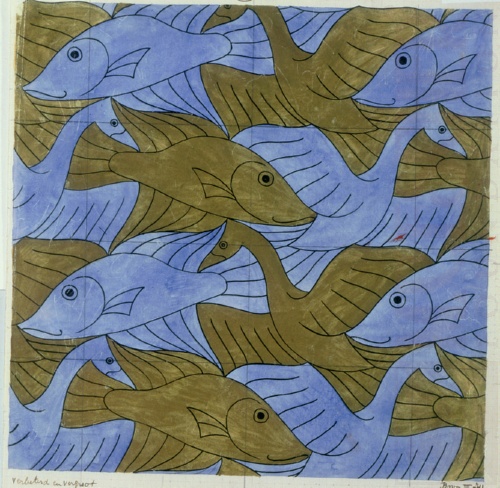
Birds morph into fish, angels lock hands with demons. This is not achieved by breaking the rules, but by exploiting them with supreme ingenuity. The rigid edge-matching rule forces a continuous, seamless transformation. The constraint is the very thing that makes the metamorphosis possible and visually coherent. The pattern is infinitely complex, yet it is built from a finite, repeatable set of decisions.
The Paradox of Creative Freedom
This is the central lesson: infinite possibility is not born from total freedom, but from intelligent limitation.
A blank canvas is paralyzing. A sonnet’s 14-line iambic pentameter is liberating. The tessellation’s rule—"fit perfectly"—is the same. It provides a clear problem to solve, a boundary against which to push. Within that boundary, creativity is not diffused; it is focused and amplified. You are not wondering what to do, but how to do it brilliantly within the given form.
This principle extends far beyond geometry. It is the logic of the poetic meter, the musical scale, the programming language, and the brand guidelines. The constraint is the catalyst. It forces novel connections, reveals hidden symmetries, and demands a rigor that ultimately produces work of greater depth and resonance than unfettered improvisation ever could.
Your Own Plane to Cover
So, the next time you face a creative block, think like a tessellator. Do not seek to remove all constraints. Instead, define one clear, non-negotiable rule for your project. It could be a word limit, a color palette, a single repeated motif, a specific format.
Then, begin to tile. See how your single idea, repeated and adapted under your rule, begins to interact with itself. Watch for the emergent patterns, the unexpected rhythms, the complex whole that arises from the disciplined repetition of a simple part.
The infinite is not found in the absence of rules. It is found in the beautiful, relentless logic of their application.
Try This: Take a simple shape—a letterform, a leaf, a gear. Trace its outline. Now, using only rotations and reflections, see if you can make it tessellate. The struggle to make it fit is where the insight lives.
Interactive Companion
Tessellation — The Art of the Repeat
If this resonates, see how to apply it to your own work with the interactive Dispatch agent.
Be first to like this dispatch