Geometry is not just measurement — it's the hidden architecture behind how humans design, perceive, and reason.


Previous · Part 1
The Geometry of Thought: The Seductive Myth of Phi
Next · Part 3
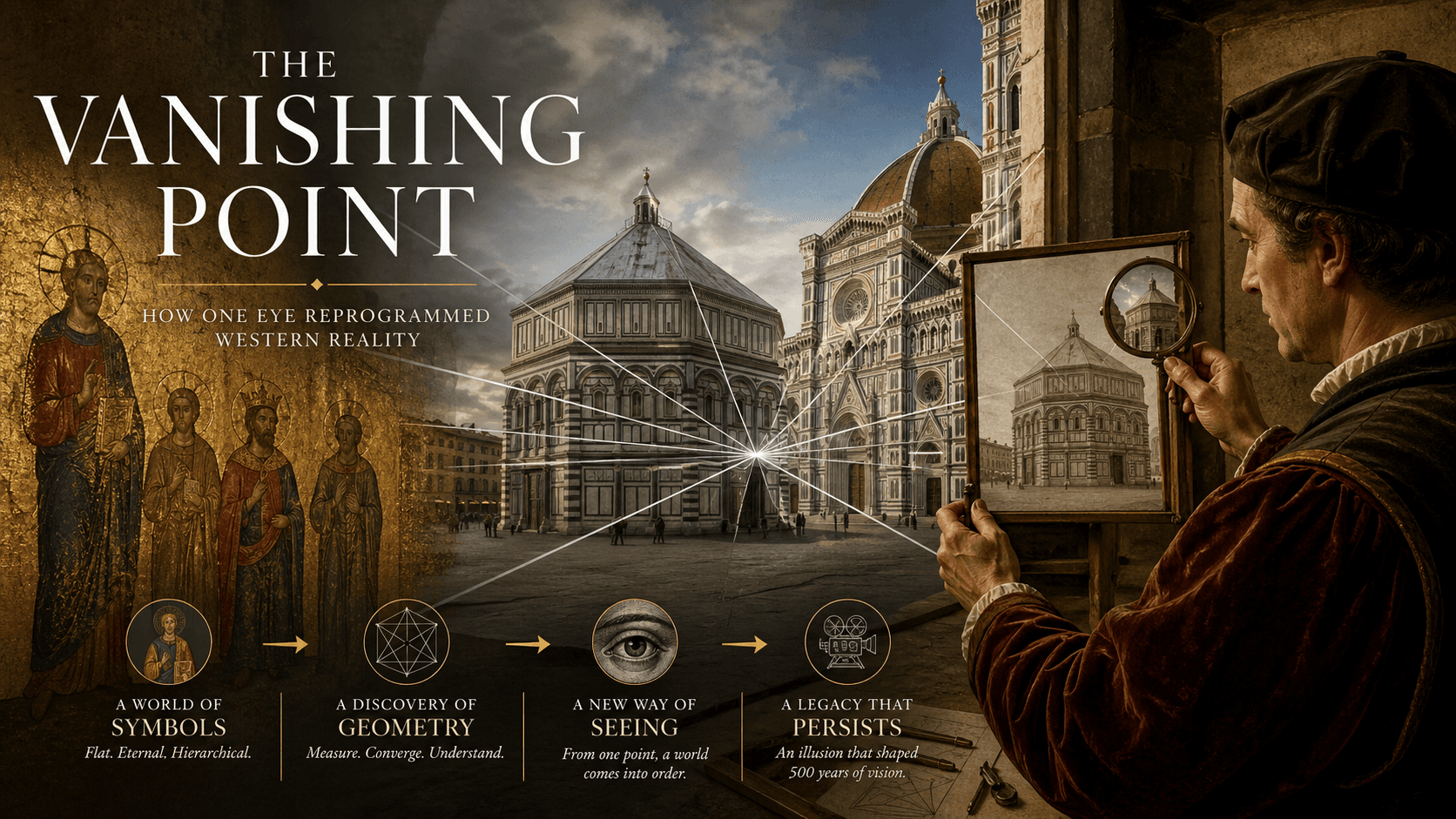
The Vanishing Point: How One Eye Reprogrammed Western Reality
This builds on Part 1: The Geometry of Thought: The Seductive Myth of Phi
Continue with Part 3: The Vanishing Point: How One Eye Reprogrammed Western Reality
We are born into a world of chaos, and our first, most urgent task is to find signal in the noise. From the very beginning, the human brain develops a powerful, silent shortcut: it treats symmetry as a proxy for truth. A symmetrical face suggests health. A balanced structure suggests stability. A mirrored pattern suggests order. This is not a learned preference; it is a cognitive heuristic, a rule of thumb etched into our neural architecture by millennia of survival.
The logic is evolutionary. In nature, symmetry is often a reliable indicator of developmental stability. A flower with perfectly matched petals, an animal with bilateral form—these are signs of robust genetic health and a lack of parasitic or environmental damage. Our ancestors who found such symmetry attractive, who trusted it, were more likely to choose healthy mates and safe environments. The preference for balance became a survival instinct, a quick way to assess safety and fitness without conscious analysis.
This instinct extends far beyond biology. We project it onto our world. We build temples, palaces, and city grids with symmetrical facades to convey power, permanence, and divine order. In art, from the perfect bilateralism of a Rorschach inkblot to the radial balance of a rose window, symmetry creates a sense of harmony and intentionality that feels inherently pleasing. It satisfies a deep-seated craving for a world that is knowable and controlled.
The Uncanny Valley of Symmetry
The heuristic’s power is most evident in its failure. When symmetry is imposed too rigidly or in the wrong context, it doesn’t feel true—it feels eerie. A perfectly symmetrical human face, digitally altered to flawless bilateral balance, often reads as artificial, lifeless, or unsettling. This is the "uncanny valley" of geometry. The brain, expecting the subtle, organic asymmetries of a living being, registers the perfection as a lie. The proxy breaks down, revealing that our trust in symmetry is conditional, not absolute.
This breakdown is the heuristic’s most important feature. It shows that symmetry is not a fundamental law of beauty or truth, but a proxy—a stand-in for deeper, more complex qualities like health, integrity, and coherent design. When we encounter a beautifully asymmetrical Japanese garden, a lopsided but charismatic face, or a dynamic, off-kilter composition in a painting, we are not rejecting order. We are recognizing a different, more nuanced kind of order—one that acknowledges the vitality of imperfection and the narrative of growth.
Our minds are not passive receivers of geometric fact. They are active interpreters, using the simple, powerful language of balance to make rapid judgments about a complex world. The geometry of thought, in this case, is not about finding a perfect number, but about understanding the shortcuts our perception takes—and knowing when to look beyond them.
If this resonates, see how to apply it to your own work with the interactive Dispatch agent.
Be first to like this dispatch