Geometry is not just measurement — it's the hidden architecture behind how humans design, perceive, and reason.

Previous · Part 2
Symmetry and the Mind: Why Balance Feels True

Next · Part 4
Tessellation: How Constraint Creates Infinite Pattern
This builds on Part 2: Symmetry and the Mind: Why Balance Feels True
Continue with Part 4: Tessellation: How Constraint Creates Infinite Pattern
The Vanishing Point: A New Operating System
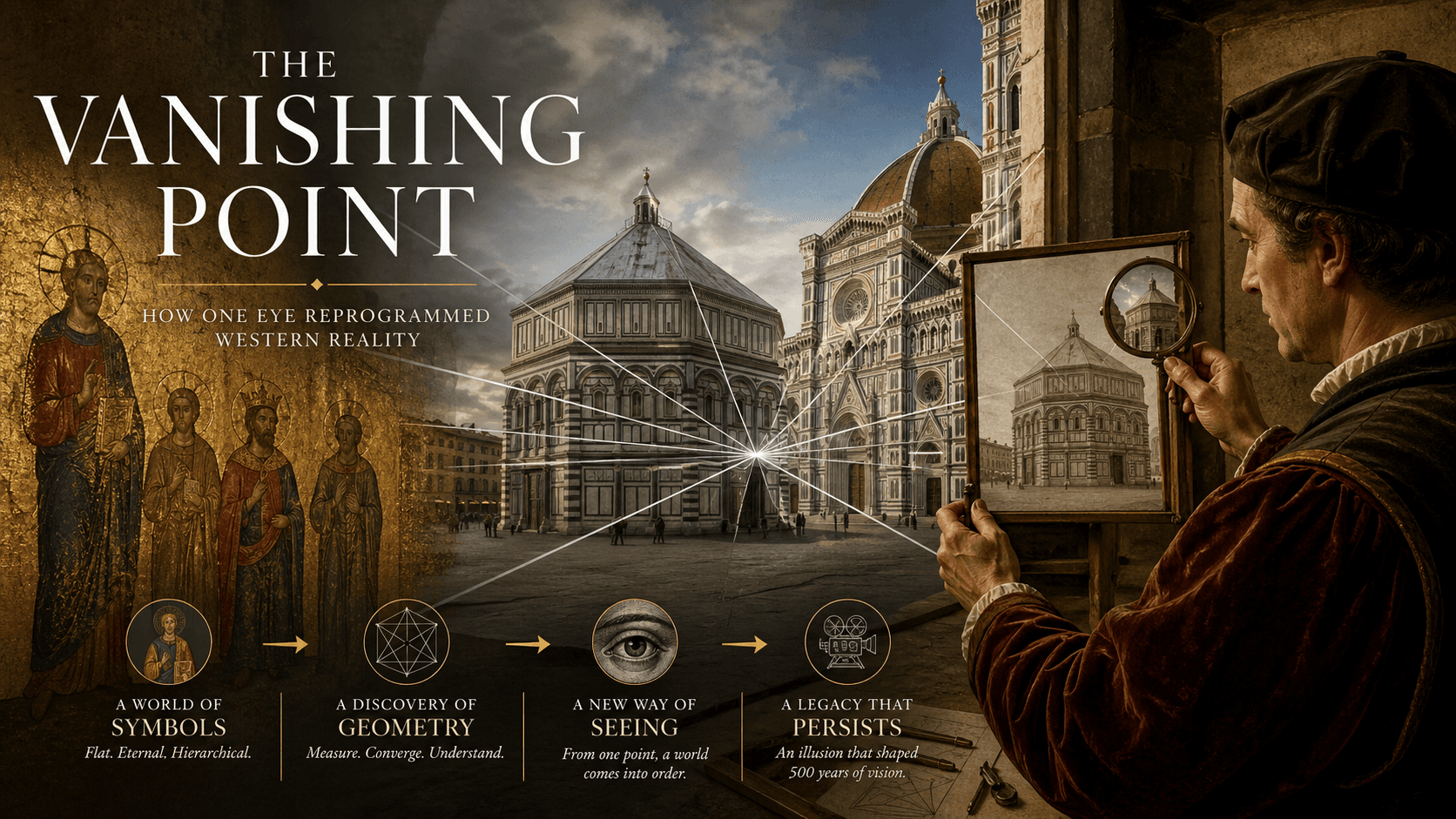
Before perspective, painting behaved like myth. The world stayed flat because meaning mattered more than distance. Saints didn’t loom because of optics; they towered because the image was a spiritual hierarchy laid across gold. Scale was an argument, not a measurement.
Then, in 1420, Filippo Brunelleschi did something audacious in the doorway of Florence Cathedral. With a mirror and a painted panel, he demonstrated that the Baptistery across the piazza could be reconstructed with mathematical certainty—its lines converging on a single invisible point. He didn’t merely render a place. He engineered a way for the mind to accept a geometry of seeing.
What followed—codified later by Leon Battista Alberti—was more than technique. It was the philosophical claim that reality could be organized from one fixed standpoint, and that order could be proven through construction.
Why This Trick Felt Like Truth
The vanishing point is deceptively simple: a destination for lines, a “pull” that makes space behave. But psychologically, it does something deeper.
It gives the viewer an anchor: a coordinate for where the world is “supposed” to go. Every edge now participates in a single system. The painting becomes coherent, measurable, and—crucially—step-able in imagination. Art shifts from symbolic representation to simulation of experience.
This is why perspective feels intuitive once you’ve been trained by it. The system teaches the brain to treat space as if it were orderly from one station point, like a stage seen through a proscenium.
And once you treat space that way, you stop noticing the frame.
Why It Took So Long: Centuries of Flatness
If perspective seems obvious in retrospect—if converging lines feel like “how space really is”—the delay is instructive.
The ancient world could foreshorten. Romans did crude versions. But technique isn’t enough. Perspective demands an intellectual framework: not just the ability to draw depth, but the willingness to organize the world around a single, mortal viewpoint.
Medieval visual culture leaned outward toward the eternal and the divine. A system that privileges one temporary eye—one mortal standpoint—quietly contradicts the premises of an omniscient cosmos. If God sees from everywhere, why build a geometry that assumes only one place can hold meaning?
Perspective also required a confluence of forces. Humanism re-centered the human subject. Classical geometry returned with prestige and rigor. And Florence wasn’t an abstract refuge—it was a merchant city with practical pressures. Architecture and engineering needed precision. Measuring the world became culturally respectable, even morally aligned with progress.
Perspective arrived when a society began to believe the world could be mastered by being measured.
The Legacy: A Cultural Lens We Can’t Remove
Perspective became the operating system for Western visual culture for roughly five hundred years. It governed painting, architecture, stage design, and later photography and cinema. It trained audiences to expect that meaningful space is framed, staged, and readable—like a scene set for someone seated at the correct seat.
Yet its dominance is so complete that we mistake construction for nature.
Perspective flattens what our real bodies know. Binocular vision doesn’t collapse the world into a single geometric story. Peripheral awareness refuses the discipline of a monocular snapshot. Movement in space brings shifting depth cues that no vanishing point can fully capture.
Perspective doesn’t merely omit information. It reorganizes attention—compressing a living, enveloping world into a stable image with one destination and one viewpoint.
And perhaps that’s the real transformation. The invention of perspective didn’t just change how we draw space; it changed how we think space works, how we imagine selfhood inside it, and how we treat reality as if it were waiting to be captured from one angle.
Perspective is a trap made of clarity: a constructed truth that feels inevitable once your vision learns its rules.
A Quiet Reframe
Consider the vanishing point not as a feature of the world, but as a proposal about how the world should be interpreted. It’s an agreement—between geometry and attention, between culture and perception—to treat space as something that converges cleanly on a single logic.
The geometry is real. The world is not obligated to behave that way.
But once we learn that agreement, we can also notice when we’re living inside it.
Interactive Companion
The Invention of Perspective
If this resonates, see how to apply it to your own work with the interactive Dispatch agent.
Be first to like this dispatch