Podcast · Episode 4
Setup and Payoff: Why the Quiet Work Matters
Alex and Sam examine why memorable payoffs depend less on spectacle than on the quality and variety of the preparation. They discuss planted clues, emotional readiness, character choices, false leads, deliberate irrelevance and the difference between answering a question and changing what the answer means.
Alex & Sam · About 9 min
Listen here and keep browsing. Your place is saved. Autoplay continues through this programme; switch it off in the player.
Building on earlier episodes
Read the conversation
Alex
A spectacular payoff can fail without meaningful setup
Have you ever reached the big reveal in a story and thought, “That was it?” Not because the reveal was small, but because the story had done so little beforehand to make it matter. A firework can be impressive and still leave you cold.
Sam
Yes. The odd thing is that we often blame the payoff. We say the twist was predictable, or the confession was melodramatic. But sometimes the real weakness is earlier: the story never taught us what to feel, fear, or hope for.
Alex
That’s our subject today: setup and payoff. Not the rigid version where every teacup must conceal a murder weapon, but the larger relationship between preparation and consequence.
Sam
And “preparation” can be quiet. A character repeatedly avoids answering a question. A room is described as carefully arranged, except for one chair. A person wants something, but keeps choosing the safer thing instead. None of that is a plot alarm bell. It is pressure accumulating.
Alex
So the first useful distinction is this: setup does not simply predict an event. It creates an expectation. The eventual payoff then answers, redirects, deepens, or sometimes deliberately frustrates that expectation.
Sam
Setup creates expectations beyond plot prediction

Imagine a story spends twenty pages making us notice a locked desk drawer. If, at the end, it contains a secret document, that is one kind of payoff. If it contains an old birthday card, the drawer can still pay off—because the question may have been, “What is this person unable to discard?”
Alex
Exactly. The drawer’s importance might be factual, emotional, or even atmospheric. The mistake is assuming that payoff means an object has to trigger an explosion. Often it changes our understanding of the person standing beside it.
Sam
This connects with our earlier conversation about Chekhov’s Gun. Emphasis creates a promise, but the promise is not always “this will fire.” It might be “look more closely at this character,” or “your first interpretation is incomplete.”
Alex
And there’s a practical danger here. If a writer highlights every detail with the same intensity, the audience starts auditing the furniture. They stop inhabiting the story and begin asking which lamp has a future in act three.
Sam
Which is a shame, because real attention is uneven. Some details matter later. Some matter only because they make a place feel inhabited. Some invite a suspicion that turns out to be ours, not the story’s.
Alex
But then how does a writer make a payoff feel earned without making everything obvious? One answer is to prepare several things at once: the event, the character’s desire, and the choice that will make the event consequential.
Sam
Character patterns prepare emotional payoffs
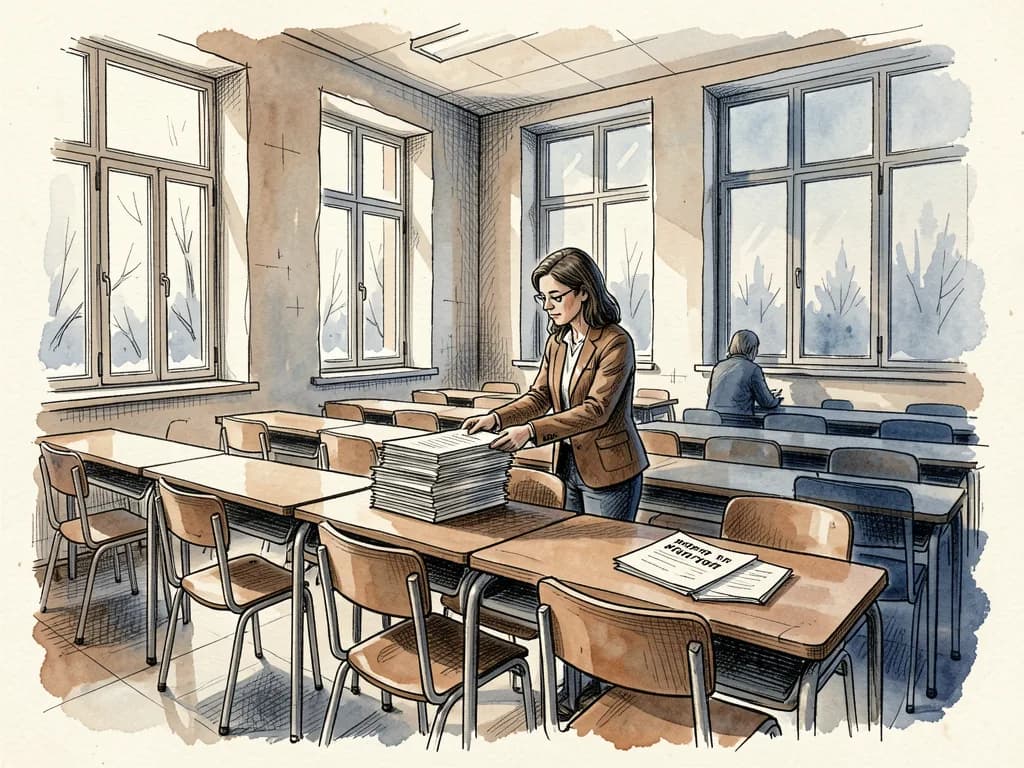
Take an imagined story about a teacher offered a prestigious job in another city. The obvious setup is the application and the interview. The richer setup is that she keeps correcting everyone’s work, because control feels safer than trust. When she finally accepts—or refuses—the payoff concerns more than geography.
Alex
The job offer is the visible mechanism. The deeper setup is her pattern of behaviour. If she refuses because she cannot leave her students, that can be moving. If she refuses because she cannot bear a situation she cannot manage, the same action becomes revealing in a different way.
Sam
That is why a surprising payoff can still feel inevitable in retrospect. Not inevitable because the audience guessed the event, but because the character’s choice belongs to the person we have been watching.
Alex
That phrase—surprising but inevitable—can sound like a slogan, though. It becomes useful only if we ask: inevitable from what? From the clues? From the emotional pattern? From the character’s habits? Those are different kinds of preparation.
Sam
And they can conflict. A mystery may prepare us to suspect one person, while a family drama prepares us to understand why another person lies. The final scene can resolve the factual question and leave the emotional one open.
Alex
That recalls the dramatic question we discussed before. A story may begin with “Will she make the call?” and gradually become “Can she speak honestly once the call is answered?” The payoff is not merely contact. It is a changed condition for the relationship.
Sam
Which also means a payoff can be an action that looks tiny from outside. Someone stays at the table. Someone tells the truth without defending it. Someone listens instead of producing the clever reply they have rehearsed for years.
Alex
A payoff can be a small changed action

Those moments need setup too. If the character has always escaped through jokes, the payoff might be one unfunny sentence. The sentence lands because the story has shown us all the occasions when it could have been avoided.
Sam
There’s a challenge, though. If we prepare too heavily, the payoff can feel assembled. The audience sees the author tightening bolts. A childhood photograph, a repeated phrase, three meaningful glances—at some point the story is waving from inside the machinery.
Alex
Absolutely. Setup should create pressure, not announce a future exam question. One way to avoid overbuilding is to let a detail serve its immediate scene first. The photograph can belong to the room before it becomes evidence of attachment.
Sam
Overbuilding can expose the machinery
And sometimes the detail should not pay off in the expected way. A character may spend the story fearing a neighbour, only to discover that the fear has exposed their own need for a villain. The false lead still mattered because it changed how they behaved.
Alex
That is not the same as abandoning a thread. Deliberate ambiguity leaves a meaningful remainder. Accidental abandonment leaves the audience wondering whether the writer forgot. The difference is whether the unresolved detail continues to shape the ending.
Sam
A useful revision test might be: what expectation does this setup create, and what kind of answer does the ending provide? Factual? Emotional? Moral? Atmospheric? If the answer is none, perhaps the detail is ornamental—or perhaps it needs more context.
Alex
I’d add another question: what changes because of the payoff? If the revelation merely supplies information, the story may stop. If it changes a choice, a relationship, or our interpretation of an earlier scene, it has somewhere to travel.
Sam
Revision asks what changes because of the payoff
And we should be careful with the word “earned.” It does not mean the audience receives what it predicted. It means the ending has a relationship with what came before. A contradiction can be earned if the story prepared us for the character’s self-deception.
Alex
Nor does a quiet ending need to apologise for being quiet. The payoff might be the removal of an old possibility. She does not call her brother; instead, she deletes the message and finally admits she was waiting for him to solve the past.
Sam
That closes one question—what will she do now?—while leaving another open—what happens between them? Resolution is not the same as total explanation. Sometimes the most honest payoff changes what uncertainty means.
Alex
So setup is not a row of breadcrumbs leading to a single correct answer. It is the shaping of attention, desire and consequence. Payoff is the moment those pressures meet, whether in a confession, a decision, an image, or a refusal.
Sam
And the spectacle comes last, if it comes at all. Before asking whether the ending is bigger, cleverer, or more shocking, ask whether the story has made us ready to understand its significance.
Alex
That may be the simplest working rule: prepare the meaning, not just the event. Give the audience enough to form an expectation, enough character to complicate it, and enough freedom for the payoff to surprise.
Sam
Then the final moment does not need to shout. It can arrive softly and still feel large, because the story has been quietly enlarging it all along.
Still open
- What happens between them?