Your identity is the byproduct of evidence you repeatedly make true.

Previous · Part 2
The Identity Lag: Why Your Actions Don’t Feel Like “You” Yet

Next · Part 4
Environment Writes Identity Faster Than Intention
This builds on Part 2: The Identity Lag: Why Your Actions Don’t Feel Like “You” Yet
Continue with Part 4: Environment Writes Identity Faster Than Intention
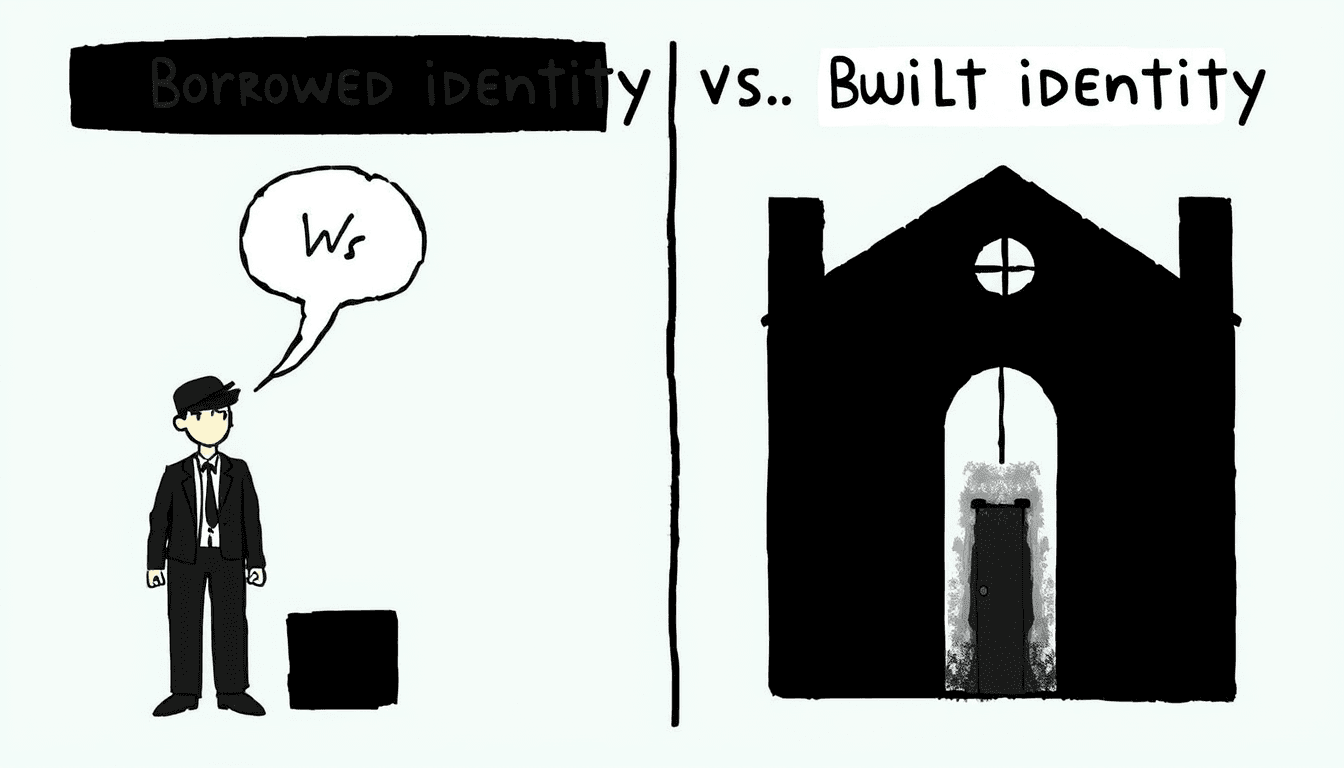
Borrowed Identity vs Built Identity
There’s a subtle trap in how we use identity.
You can borrow traits—wear them like a costume, claim them like a label. Or you can build them—earning them through repeated lived behaviour until they become your automatic settings.
Both feel like “being yourself.” Only one actually changes what you do.
The borrowed version: traits as declarations
Borrowed identity starts with language like:
- “I’m the kind of person who…”
- “I’ve always been…”
- “That’s just my personality.”
It’s not automatically false. The problem is the mechanism.
Borrowed traits don’t require you to become more consistent. They require you to stay aligned with the story you’re telling. That means behaviour becomes optional—something you do when it proves the claim.
So when you slip, you have two options:
- Edit the story (“I’m just not in my zone.”)
- Retreat from the behaviour (“Maybe that’s not really me.”)
Borrowed identity is loyal to narrative. It’s less loyal to results.
The built version: traits as byproducts
Built identity also begins with intention—but it behaves differently.
Instead of “I am X,” it starts with “I will practice the behaviours that produce X.”
Over time, the trait isn’t declared. It’s revealed.
You don’t wake up one day and suddenly have discipline. You accumulate proof: decisions you kept, discomfort you processed, promises you honored. Eventually your nervous system stops treating the behaviour as an outsider.
At that point, identity becomes a shorthand for your track record.
A useful test: what happens when you fail?
Borrowed identity collapses when reality gets messy. Built identity gets messy, then corrects.
Ask yourself:
- After a missed workout, do you relabel yourself (“I’m not consistent”)?
- Or do you re-enter the loop (“What schedule makes this easier to repeat?”)?
This is not about optimism. It’s about where your system puts the blame:
- Narrative blame (“That’s not me.”)
- Process blame (“The process didn’t hold yet.”)
The invisible cost of borrowed traits
Borrowed identity often looks motivational at first.
It can even feel energizing: crisp labels, confident posture, clear self-definition.
But it carries a hidden tax:
- You need more “proof” to maintain confidence.
- You avoid behaviours that threaten the story.
- You spend energy defending how you see yourself rather than upgrading how you act.
Built identity, in contrast, spends energy on craft—fine-tuning the conditions under which the behaviour is likely to happen again.
Where adoption fits (and where it doesn’t)
There’s a middle path that many people miss.
Borrowing can be a temporary bridge—a way to get traction before the behaviour is stable. Adoption helps when it’s treated as training wheels, not a verdict.
The key is time horizon.
- If you’re adopting a trait as a current practice (“I’m practicing being decisive in meetings”), it can be useful.
- If you’re adopting a trait as a final assessment (“I’m decisive, so I shouldn’t need prep”), it becomes fragile.
Diagram: the two loops
Diagram: Borrowed Identity Loop leads to Declare trait; Declare trait leads to Act only to match the story; Act only to match the story leads to Disconfirming event?; Disconfirming event? leads to Protect narrative / revise identity (Yes); Disconfirming event? leads to Keep performing the image (No); Built Identity Loop leads to Choose behaviour; Choose behaviour leads to Repeat with feedback; Repeat with feedback leads to Disconfirming event?; Disconfirming event? leads to Adjust process / reduce friction (Yes); Disconfirming event? leads to Accumulate evidence of the trait (No).
Diagram: Borrowed Identity Loop leads to Declare trait; Declare trait leads to Act only to match the story; Act only to match the story leads to Disconfirming event?; Disconfirming event? leads to Protect narrative / revise identity (Yes); Disconfirming event? leads to Keep performing the image (No); Built Identity Loop leads to Choose behaviour; Choose behaviour leads to Repeat with feedback; Repeat with feedback leads to Disconfirming event?; Disconfirming event? leads to Adjust process / reduce friction (Yes); Disconfirming event? leads to Accumulate evidence of the trait (No).
A decision you can make today
Instead of asking, “Am I the type of person who…?” ask:
- “What behaviour would prove this to me this week?”
- “What would I do even if I didn’t feel like ‘that person’ yet?”
- “What conditions make the behaviour easier to repeat?”
That’s how adoption turns into building.
Practical: Convert a trait label into a lived proof
Choose one trait you want to embody. Then run it through this conversion.
What to write down (so it becomes real)
Use this prompt as your “identity engineer” log.
Choose one trait you’re trying to claim (e.g., confident, focused, courageous).
Write one behaviour that would demonstrate it this week. Then write: What will I do even if I don’t feel like it on that day?
Checklist: Borrow less, build more
Closing thought
Borrowed identity can make you feel coherent for a moment. Built identity makes you coherent over time—because your life becomes the proof.
If you want the trait, don’t audition for it. Build it.
If this resonates, see how to apply it to your own work with the interactive Dispatch agent.
Be first to like this dispatch