Previous · Part 4
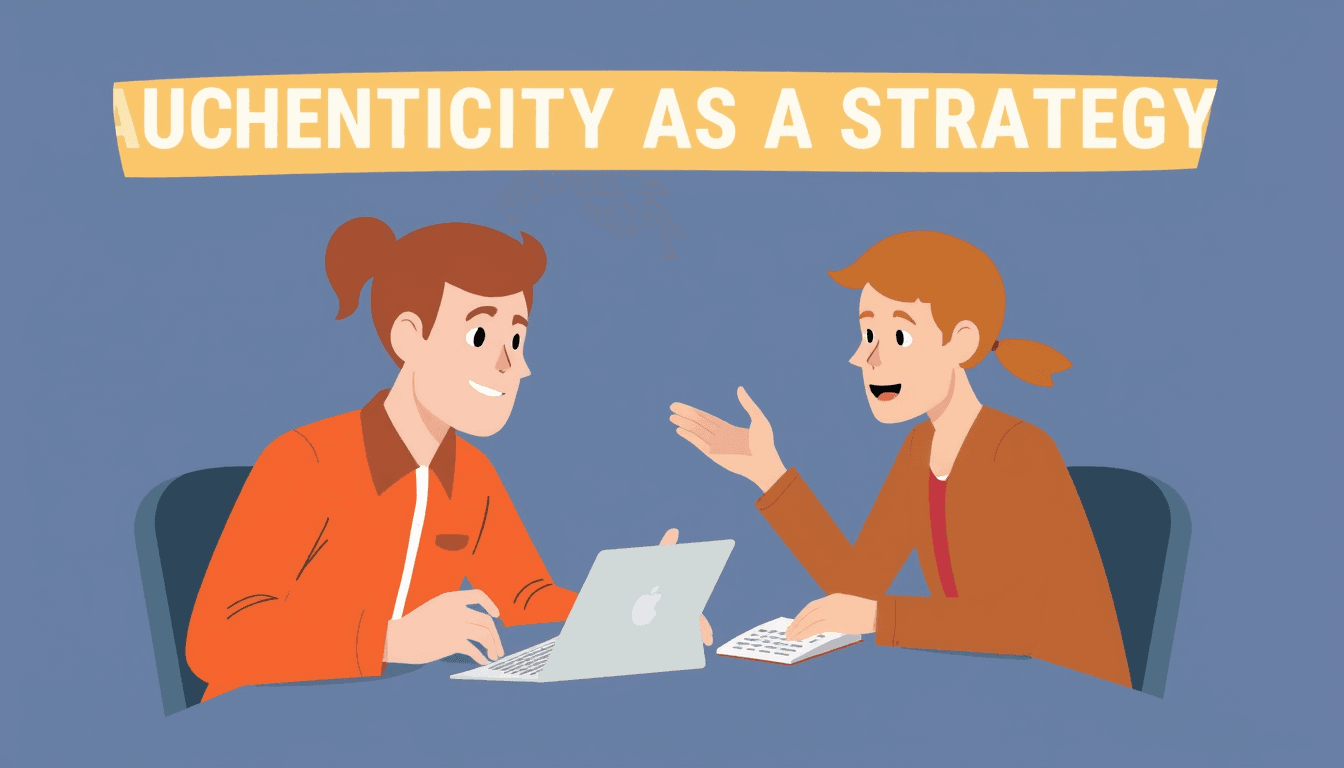
Authenticity as a Strategy (and the New Cost of Being “Real”)
This builds on Part 4: Authenticity as a Strategy (and the New Cost of Being “Real”)
You can feel it, can't you?
The slight unease when a paragraph is too clean. The instinct to distrust a photograph that's too symmetrical. The way your eyes skip past anything that feels finished.
We have entered the era where perfection is suspicious.
The Uncanny Valley of Competence
There's a reason your brain short-circuits when it encounters flawless text, immaculate design, or a response that's just a little too on-the-nose. You've been trained — by years of algorithms, auto-correction, and now generative tools — to recognise the signature of the machine. And that signature is polish.
Not brilliance. Not originality. Polish.
The removal of every rough edge. The smoothing of every transition. The kind of completeness that feels like it arrived fully formed, with no evidence of struggle, hesitation, or a wrong turn taken and corrected.
This isn't a failure of taste. It's an adaptation. Your pattern recognition has evolved faster than the tools have. You're not being cynical — you're being precise.
What the Glitch Reveals
Consider what happens when you encounter a typo in someone's message. Not a careless one — a human one. The kind where their fingers moved faster than their thoughts, or they forgot a word because they were already three sentences ahead in their mind.
You don't lose trust. You gain it.
That error is a fingerprint. It's proof that someone was there — thinking, composing, reaching for meaning in real time. The imperfection isn't a flaw in the message. It's the message.
Imperfection has become the primary signal of human presence.
Perfection is now cheap, scalable, and automatic. Only errors are expensive.
- —AI-generated text is grammatically flawless but emotionally flat
- —Handwritten notes command higher perceived value than printed ones
- —Unedited voice memos feel more trustworthy than polished podcasts
- —Social posts with visible effort outperform slick brand content
The rough edge is no longer a mistake — it's proof of life.
The Economics of the Unfinished
Here's where it gets interesting. And uncomfortable.
If imperfection signals truth, then imperfection becomes valuable. And the moment something becomes valuable, it gets performed.
We're already seeing it. The "casual" caption that took forty-five minutes to write. The "off-the-cuff" video with careful lighting and a rehearsed stumble. The brand that posts a "raw" photo with the same strategic precision as their paid campaigns.
We are not at the beginning of this cycle. We are deep inside it.
Diagram: Perfection signals quality leads to Perfection becomes automated; Perfection becomes automated leads to Automated perfection feels hollow; Automated perfection feels hollow leads to Imperfection signals humanity; Imperfection signals humanity leads to Imperfection gets performed; Imperfection gets performed leads to Performed imperfection feels hollow; Performed imperfection feels hollow leads to G.
Diagram: Perfection signals quality leads to Perfection becomes automated; Perfection becomes automated leads to Automated perfection feels hollow; Automated perfection feels hollow leads to Imperfection signals humanity; Imperfection signals humanity leads to Imperfection gets performed; Imperfection gets performed leads to Performed imperfection feels hollow; Performed imperfection feels hollow leads to G.
The answer to that final node — what's left? — is the question that keeps me up at night.
The Texture of Being There
Let's move past the strategic dimension for a moment. Because there's something here that's deeper than positioning.
Imperfection matters not because it's a better signal, but because it's evidence of process. Of time spent. Of a mind working through something rather than presenting a result.
The crossed-out word on a page. The hesitation before an answer. The draft that doesn't quite land but reaches.
These are traces of consciousness — the marks left by someone who was genuinely trying to say something they hadn't fully figured out yet.
When everything can be generated in seconds, the only remaining proof that someone lived with their ideas is the evidence of friction. The smudges. The crossings-out. The places where the thinking shows.
Learning to Read the Grain
There's a skill developing right now — almost subconsciously — among people who spend a lot of time with text, images, and ideas. Call it reading the grain.
Like running your hand across wood to feel which direction it was cut, there's a growing ability to sense the origin of what you're consuming. Not through any single tell, but through a composite impression:
The rhythm of sentences. Whether ideas escalate or arrive pre-formed. The presence of specific, odd, personal detail versus generic-but-correct framing. Whether the piece breathes — pauses, changes direction, admits uncertainty — or marches.
This isn't foolproof. Nothing is. But it's becoming the primary mode of evaluation for a generation drowning in polished, frictionless content.
The Gift of the Wrong Draft
Here's what I keep coming back to.
The most meaningful things I've ever read, seen, or heard all share one quality: they feel like they were discovered in the making. Like the person behind them didn't start with a plan and execute it, but started with an impulse and followed it — through wrong turns, dead ends, and moments of genuine surprise.
The wrong draft is a gift. Not because wrongness is inherently valuable, but because the willingness to show your work — the real work, the messy, uncertain, half-right work — is the most generous thing a creator can do.
It costs something. It always costs something. That's the point.
Holding the Line
So where does this leave us?
Not in a comfortable place. Because the honest answer is that imperfection-as-signal is a temporary condition. It's a lag between what machines can now produce and what our pattern recognition has learned to filter. Eventually, the uncanny valley closes. Eventually, we adapt fully — or we stop being able to tell at all.
But we're not there yet. And in this window — this strange, disorienting window — the most radical thing you can do is resist the urge to sand down every surface.
The polished version of you is available everywhere. It's in every auto-corrected sentence, every algorithmically smoothed image, every tool that promises to make your work "professional."
The unpolished version — the one with the fingerprints still showing — is the one worth offering.
If this resonates, see how to apply it to your own work with the interactive Dispatch agent.
Be first to like this dispatch