When visibility becomes value, recognition stops telling us what is worth trusting.

Next · Part 2
When Visibility Beats Ability
Continue with Part 2: When Visibility Beats Ability
There is a particular kind of modern frustration that is hard to admit without sounding bitter.
You see mediocre work travel far.
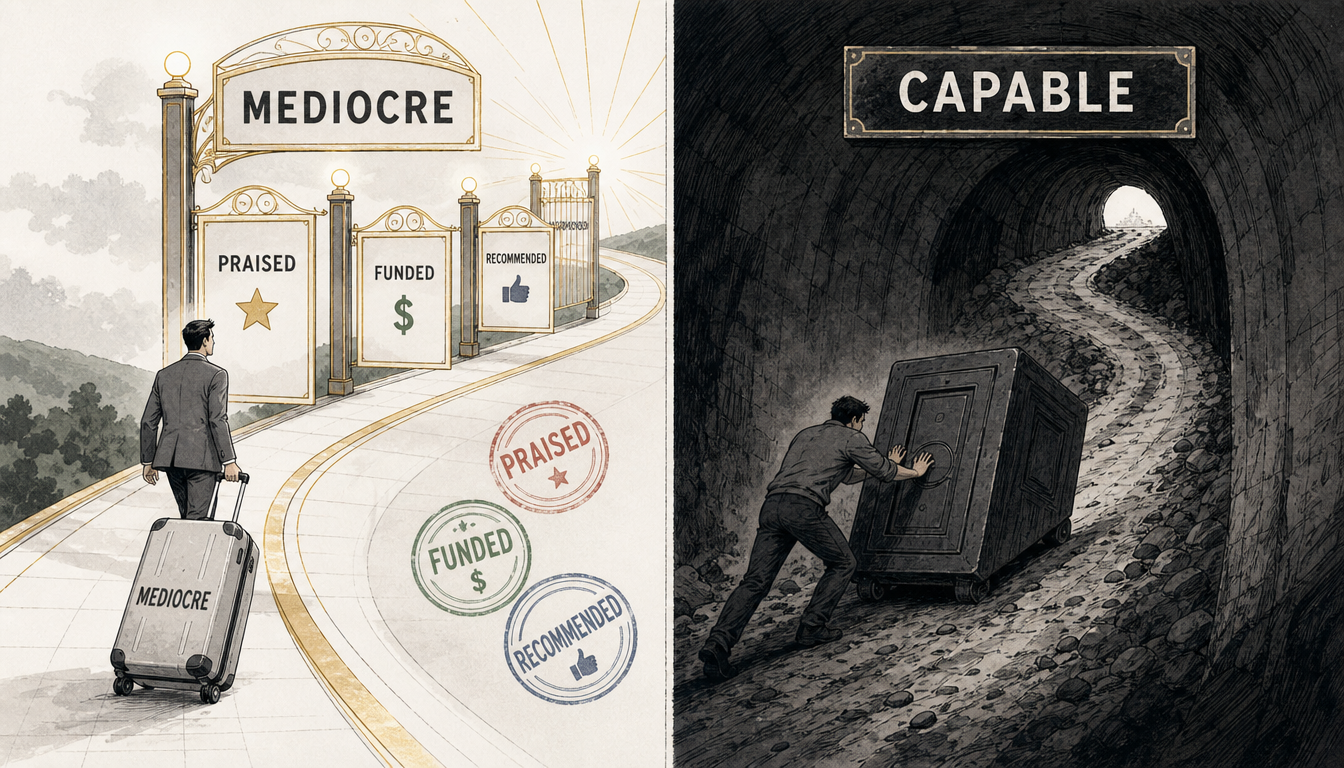
It gets praised. Funded. recommended. hired. reposted. invited into rooms. Wrapped in language that makes it seem inevitable.
Meanwhile, someone unusually capable keeps making excellent things in relative silence.
No scandal. No conspiracy. No dramatic injustice.
Just a quiet, grinding mismatch between quality and reward.
For a long time, many of us inherited a simple moral equation:
Get good enough, and the world will notice.
The equation was never perfectly true. But it was believable enough to organise a life around. Learn the craft. Sharpen the judgement. Make better work. Develop taste. Earn trust. Let quality compound.
Now the equation feels unstable.
Not because excellence has vanished.
Because excellence increasingly lives inside systems that do not automatically know how to find it.
The old bargain has broken
Interactive Companion
pm-value-audit
The old bargain sounded like this:
If the work is good, it will rise.
That belief shaped how people learned, built, trained, wrote, designed, studied, practised, and waited. Quality was treated as a kind of gravitational force. Maybe slow, maybe uneven, but ultimately reliable.
Make something good enough and, eventually, it would pull attention toward itself.
But the modern environment does not work like a calm marketplace of merit. It works like a stack of filters.
Before work can be valued, it has to be seen.

Before it is seen, it has to be surfaced.
Before it is surfaced, it has to be legible to the systems and people deciding what deserves attention.
And before any of that happens, it often has to be packaged in a way that signals value before the value has been experienced.
Diagram: Create value leads to Communicate value; Communicate value leads to Distribute value; Distribute value leads to Become visible; Become visible leads to Be perceived as valuable; Be perceived as valuable leads to Receive opportunity, money, trust, influence.
Diagram: Create value leads to Communicate value; Communicate value leads to Distribute value; Distribute value leads to Become visible; Become visible leads to Be perceived as valuable; Be perceived as valuable leads to Receive opportunity, money, trust, influence.
That is the new terrain.
Not a world where quality is irrelevant.
A world where quality is only one part of the route.
Quality no longer travels alone
The hard truth is this:
Creating value, communicating value, distributing value, and being perceived as valuable are no longer the same thing.
They used to be closer together. A brilliant product could spread through word of mouth. A talented person could be discovered through proximity, reputation, apprenticeship, institutions, referrals, or visible outputs in smaller ecosystems.
Those routes still exist.
But they are no longer sufficient for many kinds of work.
Today, a person can create enormous value and fail to communicate it. They can communicate it clearly and fail to distribute it. They can distribute it widely and still be misread. They can be perceived as valuable without being especially good.
Each layer has become its own discipline.
The Four Layers of Modern Value
- ·Creative careers
- ·Startups and independent businesses
- ·Expertise-based work
- ·Public intellectual life
- ·Online reputation and professional identity
You are trying to understand why good work is not receiving the response you expected.
Let’s separate the layers.
1. Creating value
This is the work itself.
The depth of thought. The usefulness. The craft. The insight. The taste. The technical ability. The care behind the thing.
This is where serious people tend to spend most of their time.
They improve the product, the essay, the service, the code, the performance, the analysis, the offer, the body of work. They assume that better work will create better outcomes.
Often, it does.
But not automatically.
2. Communicating value
This is whether other people can understand what is valuable about the work.
It is positioning. Framing. Naming. Explanation. Context. The ability to make the invisible labour visible without cheapening it.
Many excellent people are weak here because they mistake explanation for vanity.
They think the work should speak for itself.
Sometimes it can.
Often, it whispers in a room built for noise.
3. Distributing value
This is how the work reaches people.
Platforms. Networks. relationships. search. recommendations. timing. publishing rhythm. partnerships. referrals. communities. media. algorithms. access.
Distribution is not the same as quality, but it can decide whether quality gets a chance to matter.
A strong idea with no route to people remains private.
A mediocre idea with excellent distribution can become culturally unavoidable.
That asymmetry is one of the defining tensions of the moment.
4. Being perceived as valuable
This is the most psychologically dangerous layer.
Perceived value is not the same as actual value. It is the social reading of value.
It includes status, polish, confidence, aesthetics, affiliations, follower counts, pricing, credentials, narrative, momentum, and the subtle herd instinct that says: if other people are paying attention, there must be something here.
None of this is inherently fraudulent.
Signals exist because people need shortcuts. Nobody has time to investigate everything from first principles.
But when signals become too powerful, they start replacing judgement.
Being good is no longer enough on its own.
Modern success depends not only on the quality of the work, but on whether that quality can move through systems of visibility, interpretation, and trust.
- —Excellent work can remain unseen if it lacks distribution.
- —Useful work can be ignored if its value is poorly communicated.
- —Mediocre work can spread if it is highly legible, timely, or well-positioned.
- —Public attention often becomes evidence of quality before quality has been examined.
Skill still matters, but it now operates inside a wider value system that can amplify, distort, or erase it.
Discovery now shapes the meaning of quality
Interactive Companion
pm-visibility-loop
Here is the deeper inversion:
In the past, quality often led to discovery.
Now discovery often determines what gets perceived as quality.
That does not mean people are stupid. It means people are overloaded.
When attention is scarce and options are infinite, visibility becomes a proxy for evaluation. We assume the thing in front of us deserves to be there. We assume repeated exposure means significance. We assume popularity contains information.
Sometimes it does.
Sometimes it only contains momentum.
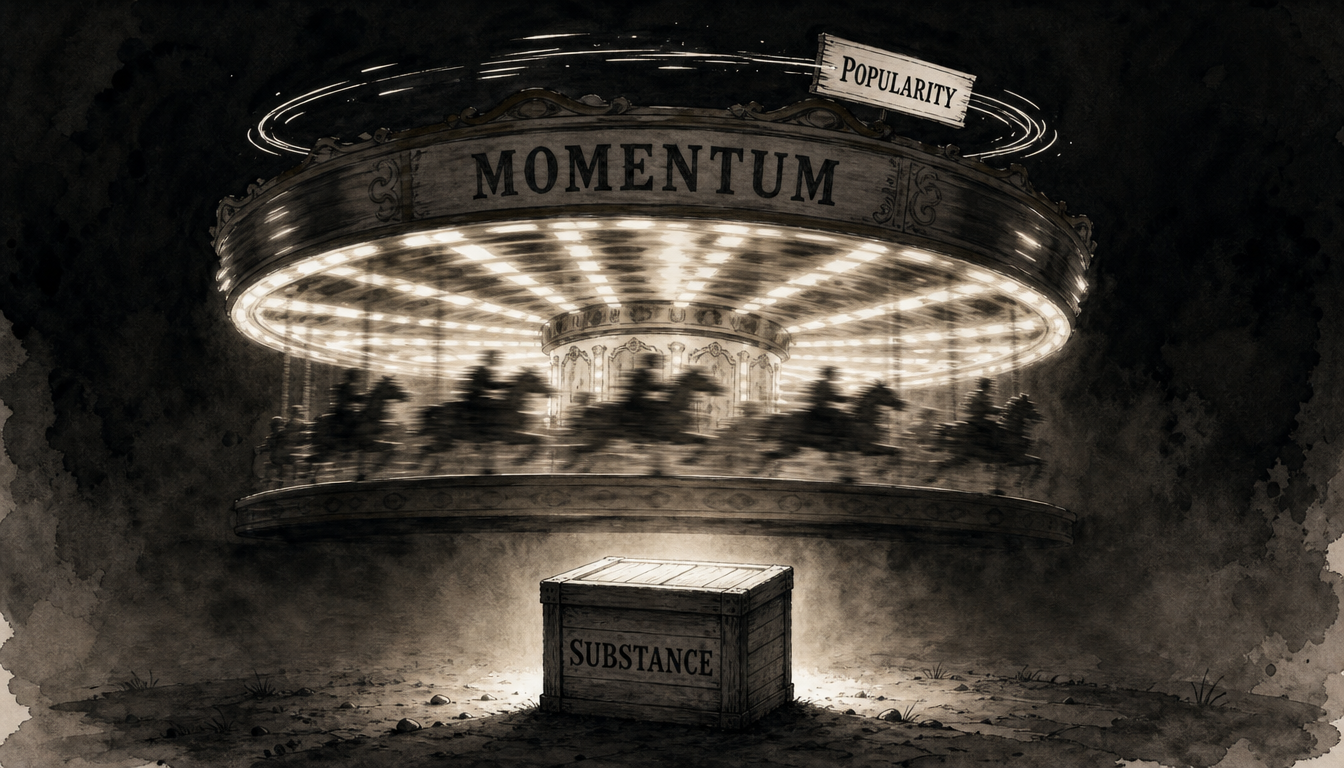
This is why mediocre work can feel strangely authoritative when it is everywhere. Its ubiquity creates a halo. The more visible it becomes, the more valuable it appears; the more valuable it appears, the more visible it becomes.
A loop forms.
Diagram: Visibility leads to Perceived credibility; Perceived credibility leads to More attention; More attention leads to More opportunities; More opportunities leads to More public proof; More public proof leads to Visibility.
Diagram: Visibility leads to Perceived credibility; Perceived credibility leads to More attention; More attention leads to More opportunities; More opportunities leads to More public proof; More public proof leads to Visibility.
And on the other side, excellent work can suffer from the opposite loop.
Low visibility becomes low perceived value. Low perceived value reduces opportunity. Fewer opportunities produce fewer public signals. Fewer signals keep the work obscure.
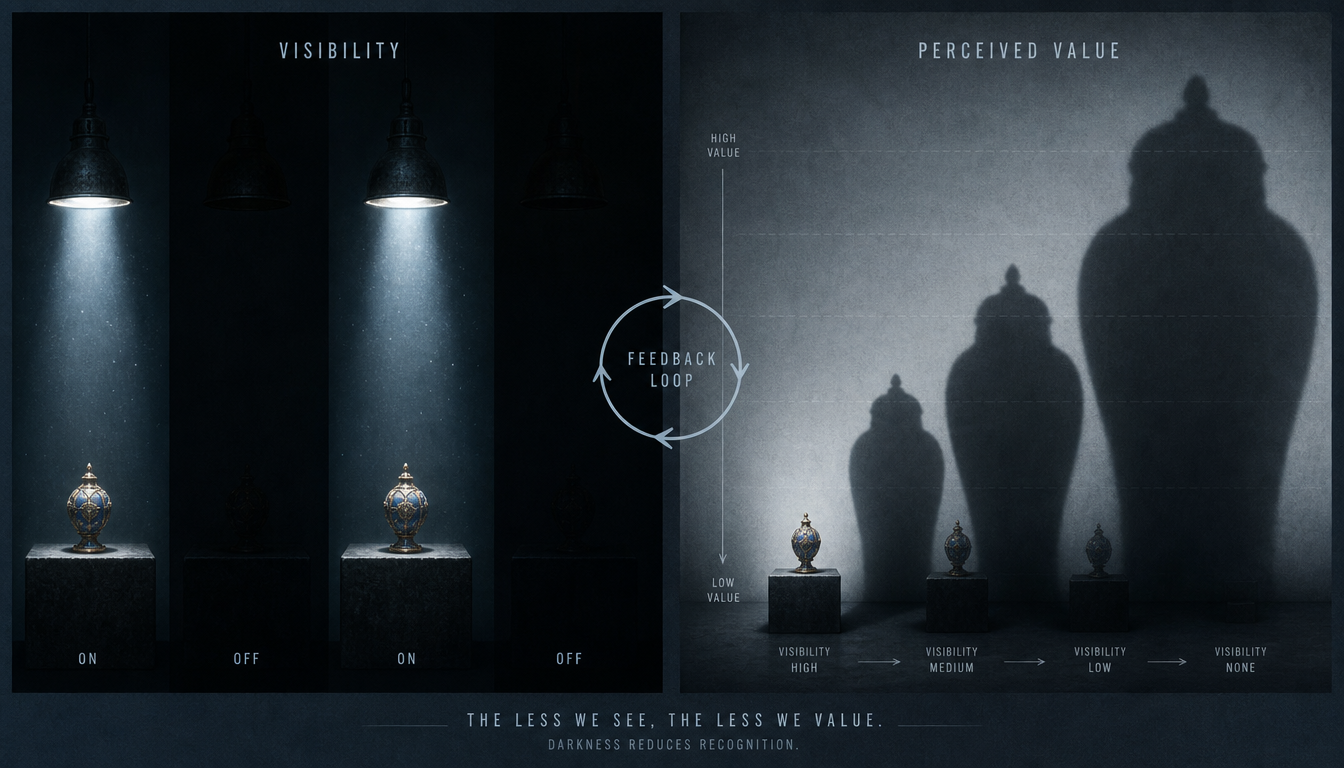
No one has to reject the work.
The system simply never properly encounters it.
This is why effort feels emotionally unstable
The psychological cost is not just professional. It is existential.
People improve their craft expecting the world to become more responsive. They study harder. Build more carefully. Refine their taste. Raise their standards. Become more capable.
Then they look around and see weaker work travelling faster.
It creates a disorienting question:
What exactly am I supposed to be optimising for?
Better work?
Better signalling?
Better packaging?
Better networks?
Better timing?
Better performance of confidence?
The old answer was cleaner. Improve the thing. Become undeniable.
The new answer is less comforting. Improve the thing, yes — but also understand the conditions under which the thing becomes visible, legible, and trusted.
That answer feels morally untidy.
It offends the part of us that wants quality to be sovereign.
Where have you been expecting quality to speak for itself?
Look for the place where your effort is real, but your value is not yet legible to others.
The mistake is thinking this makes talent meaningless
It does not.
Talent still matters. Skill still matters. Taste still matters. Depth still matters. The work still matters.
In fact, the more artificial the environment becomes, the more real quality matters over time. Thin work can attract attention. It struggles to sustain trust. Visibility can create a first impression; it cannot indefinitely compensate for emptiness.
But there is a difference between saying quality matters and saying quality is enough.
Quality is the foundation.
It is not the entire structure.
Be excellent and assume recognition will eventually follow.
Be excellent, then make that excellence visible, understandable, and reachable.
This distinction is easy to resist because it sounds like a surrender to marketing.
It is not.
It is an acknowledgement that value has a journey.
A thing can be meaningful and still fail to move. A person can be brilliant and still be overlooked. A body of work can be exceptional and still remain trapped behind poor explanation, weak distribution, bad timing, or absent signals.
The tragedy is not that the world hates quality.
The tragedy is that the world is often too distracted to notice it unaided.
The new competence stack
The uncomfortable demand of this moment is that people now need more than ability.
They need a competence stack.
Not because everyone should become a brand.
Not because every thought needs packaging.
Not because all work should be performed in public.
But because value that cannot be recognised has limited force in the world.
The order matters.
If you begin with visibility and have no substance, you are building a façade.
If you begin with substance and ignore visibility entirely, you are building a locked room.
Neither is enough.
How to read your own frustration
When you feel that familiar irritation — when someone less capable seems to be winning — it is worth slowing down before turning cynical.
Ask a more precise question.
What are they doing that the system can recognise?
They may be clearer. Faster. Better positioned. More consistent. More socially legible. More willing to repeat themselves. Better connected. Easier to understand. More native to the platform. More direct about the value they offer.
That does not make their work better.
But it may explain why it travels.
You likely have a distribution or legibility problem. The task is not to lower your standards. It is to build clearer routes between the work and the people who would value it.
This is not a call to admire the mediocre.
It is a call to study the machinery without losing your standards.
Bitterness wastes information. It turns observation into self-protection.
A better response is colder and more useful:
What layer of value is missing?
The four-layer audit
Use this when effort and outcome feel disconnected.
The point is not to become obsessed with optics.
The point is to stop pretending optics have no consequences.
Interactive Companion
pm-value-audit
The dignity of being good
There is still dignity in doing the thing well.
Maybe more than ever.
In a culture full of shortcuts, competence is not outdated. It is rarer, quieter, and often slower to reveal itself. Real quality still compounds. Real skill still creates options. Real depth still survives contact with reality.
But the modern world has added a brutal condition:
Excellence must be discoverable.
Not loud.
Not fake.
Not theatrical.
Discoverable.
That is the shift.
Being good still matters. It may matter more than the market can immediately understand.

But invisibility can now cancel out excellence.
And that means the work is no longer only to become better.
It is to make what is better impossible to miss.
Interactive Companion
pm-value-route
If this resonates, see how to apply it to your own work with the interactive Dispatch agent.
Be first to like this dispatch