The most interesting thing about The Cully Hill Boys is not that it is made with generative AI.
It is that Higgsfield has released the film as both a finished work and an inspectable production system.
You can watch the action-comedy. You can also examine the prompts, character sheets, references, workflows, discarded generations, and final outputs behind it. The film is not merely presented as a spectacle. It is presented as evidence. (higgsfield.ai)
That distinction matters.
For years, AI filmmaking demos have shown polished fragments: a dramatic shot, a surreal transition, a convincing face. The Cully Hill Boys attempts something more demanding—a sustained narrative with recurring characters, locations, props, dialogue, music, action, and editorial rhythm.
The question is no longer whether an AI model can make an impressive shot.
The question is whether a team can make a coherent world.
Start Here
The film is only half the release
A feature-length experiment in visible production
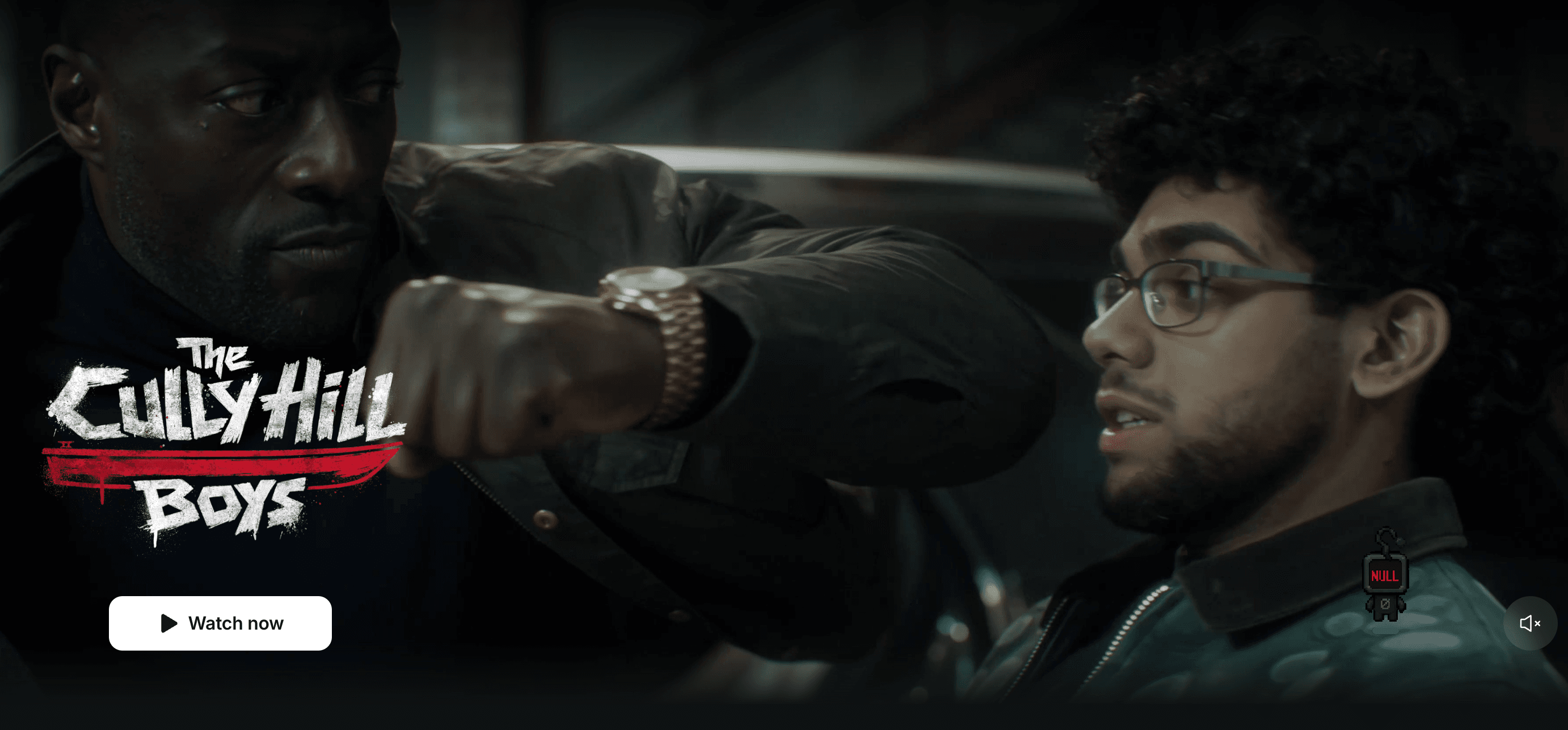
The Cully Hill Boys is an action-comedy about three underachieving London rappers who stumble into a drug war. Its more consequential release is the production build behind it: a browsable record of how an AI-native film is planned, generated, corrected, and assembled.
The real subject
Continuity
The film tests whether generative tools can hold a world together across hundreds of shots.
A crime comedy built as a systems problem
The premise is deliberately commercial: three struggling London rappers try to make a name for themselves and accidentally become entangled in a messy drug war. Higgsfield describes it as fast, funny, beat-driven, and centred on loyalty, friendship, and the desire to stop being invisible. (higgsfield.ai)
That is a useful choice.
A film like this does not depend on one grand visual conceit. It depends on the accumulation of small agreements:
- The same character must remain recognisable.
- The same object must remain the same object.
- A location must feel continuous from one cut to the next.
- A joke must land at the right moment.
- A performance must remain legible beneath the generated imagery.
- The world must obey its own time period and visual logic.
In other words, the film is less a test of isolated generation than a test of coordination.
The central breakthrough in AI filmmaking is not image generation; it is continuity management.
A narrative film is made from repeated visual and sonic commitments. Characters, props, locations, gestures, voices, and historical details must survive across cuts.
- —Higgsfield exposes character sheets, references, prompt chains, workflows, and intermediate generations behind the film.
- —The project documentation emphasises identical characters, props, and environments across shots.
- —The film uses recurring motifs to connect otherwise separate scenes and worlds.
The filmmaker's emerging role is not simply “prompt writer.” It is continuity designer, editor, and world manager.
The production logic behind the spectacle
Higgsfield’s own project description highlights several techniques used to structure the visual language:
- Rule of thirds and the golden ratio
- Motivated camera movement from the first frame
- Staged depth across foreground, midground, and background
- Consistent characters, props, and environments
- Recurring visual motifs, including an elephant hawk-moth and a red lifeboat (higgsfield.ai)
None of these techniques is new to cinema.
That is precisely the point.
The film’s most instructive quality is not that it abandons traditional filmmaking grammar. It shows how familiar cinematic principles become even more important when the underlying image-making process is unstable.
A model may produce a striking composition by accident. It is much less reliable at preserving a visual system across dozens of shots. Composition, blocking, depth, and recurring motifs therefore become forms of control.
Diagram: Story premise leads to Character sheets; Character sheets leads to Locations and props; Locations and props leads to Shot plans and visual rules; Shot plans and visual rules leads to Generations; Generations leads to Continuity review; Continuity review leads to Editing and sound; Editing and sound leads to Finished film; Continuity review leads to Generations (Reject or revise).
Diagram: Story premise leads to Character sheets; Character sheets leads to Locations and props; Locations and props leads to Shot plans and visual rules; Shot plans and visual rules leads to Generations; Generations leads to Continuity review; Continuity review leads to Editing and sound; Editing and sound leads to Finished film; Continuity review leads to Generations (Reject or revise).
The important step is not the generation itself.
It is the loop between generation and rejection.
The hidden labour is in the “almost right”
AI filmmaking is often described as fast because a shot can be generated in seconds.
That description leaves out the expensive part.
The difficult work begins when a shot is nearly right:
- The face is recognisable, but the expression is wrong.
- The character is correct, but the jacket has changed.
- The camera movement works, but the hand has become distorted.
- The room matches the previous shot, but the lighting has drifted.
- The dialogue is technically present, but the performance has no rhythm.
- The action is legible, but the edit has no energy.
The production build matters because it makes those failures visible. The release materials include intermediate and discarded generations, not only the successful outputs. Higgsfield frames this as a way for directors, students, and sceptics to see how a sequence was actually constructed. (higgsfield.ai)
That is a healthier model of creative technology.
Instead of presenting the output as magic, it presents the work as iteration.
Why the real cast matters
The film uses licensed digital likenesses of public figures including Israel Adesanya, Quinton “Rampage” Jackson, N3on, and Matt Kiatipis. Higgsfield and its representatives have presented the project as an early example of turning fighters, influencers, and online creators into movie performers through generative production. (higgsfield.ai)
This changes the creative and legal conversation.
The characters are not simply fictional faces invented by a model. They are built around recognisable public identities. That creates a new kind of performance arrangement: the person may provide the likeness, the cultural presence, or the commercial audience, while the film constructs the performance digitally.
The arrangement is also why licensing cannot be treated as an afterthought.
The release is governed by Higgsfield’s HOL-RO-1.0 Study Only licence. It permits viewers to study and discuss the film and its production materials, but prohibits copying, downloading, reuse of prompts or workflows, derivative works, model training, and generative use of the released materials. Short excerpts may be used for genuine review or commentary within specified limits and with credit. (higgsfield.ai)
That is an important distinction for anyone working with AI-generated media.
A public prompt is not automatically a free prompt. A visible character sheet is not automatically a reusable character. A downloadable-looking interface is not necessarily a licence to reproduce the underlying work.
The film as a product demonstration
There is another layer to the project.
The Cully Hill Boys is a film, but it is also a demonstration of Higgsfield’s platform. The company premiered it alongside an early look at Cinema Studio 4.0 and positioned the project as evidence of what its creative tools can support. (linkedin.com)
That does not make the film less interesting.
It makes its function clearer.
The project is designed to show potential users what happens when generation tools are embedded inside a larger production environment—one that includes assets, references, prompts, editing, continuity, and collaboration.
The commercial message is not simply:
Look what AI can generate.
It is closer to:
Look what becomes possible when generation is organised into a production pipeline.
That is a much more consequential claim.
Generation → Continuity → Editorial Meaning
- ·Character-driven films
- ·Commercial campaigns
- ·Animation pipelines
- ·Generative video systems
A single impressive image is not enough. The work must remain coherent across time, scenes, and decisions.
What the project reveals about the new filmmaker
The traditional production model divides responsibilities into departments: writing, directing, cinematography, production design, editing, sound, visual effects.
AI-native production does not eliminate those responsibilities.
It rearranges them.
The filmmaker now has to manage a stack of interdependent systems:
- The narrative system: what happens and why.
- The character system: who remains recognisable across scenes.
- The visual system: how the world looks and moves.
- The generation system: which tools, references, and parameters produce the material.
- The continuity system: what must remain unchanged.
- The editorial system: what survives the cut.
- The rights system: who owns or controls the faces, voices, music, and source materials.
The director’s job becomes less about commanding a single camera and more about maintaining coherence across a field of possible images.
That is a different kind of authorship.
The limits are still visible
The film should not be treated as proof that AI has solved feature filmmaking.
It demonstrates progress, not completion.
Long-form generated cinema still faces familiar weaknesses: facial subtlety, physical continuity, naturalistic interaction, emotional timing, and the difference between technically accurate dialogue and convincing performance.
A generated feature can sustain a premise while losing pressure. It can maintain visual continuity while flattening character. It can contain action without producing suspense.
These are not minor defects. They are the difference between a sequence of competent images and a film with dramatic life.
The presence of a human-written script is instructive here. Public descriptions of the project identify Timothy Planagan as the screenwriter, while Higgsfield’s team handled the AI-native production process. (linkedin.com)
The lesson is not that human writing has become unnecessary.
It is that generative production still benefits from strong upstream decisions. The better the story, the clearer the characters, and the more disciplined the visual rules, the more useful the models become.
What to study when you watch it
Do not watch The Cully Hill Boys only as a prediction of what Hollywood might become.
Watch it as a production document.
Look for the moments where continuity holds. Notice how recurring objects orient you. Pay attention to whether camera movement feels motivated or merely decorative. Watch the relationship between music and cutting. Ask when the film feels like a world and when it feels like a sequence of generated fragments.
Then compare the finished scene with the materials behind it.
The most valuable lesson may not be a particular prompt. It may be the structure of the decision-making:
- What was established early?
- What was repeated?
- What was rejected?
- What was fixed manually?
- Which details carried meaning across scenes?
- Where did the system require human judgement?
That is where the craft is.
When you watch an AI-generated film, which matters more to you: visual novelty, narrative coherence, believable performance, or emotional impact?
Name the moment that most influenced your answer.
The larger shift
The important transition is not from live action to AI.
It is from closed production to inspectable production.
A conventional film gives the audience the final artefact. An AI-native project can expose much more of the path: the references, failed images, prompt structures, character logic, shot plans, and revision history.
That creates a new kind of educational object.
The film is no longer only something to watch. It becomes something to reverse-engineer—within the limits of its licence, and without confusing visibility for ownership.
For creators, this changes the learning curve. You no longer have to infer every production decision from the finished frame. You can study the scaffolding.
For platforms, it creates a new form of credibility. Instead of asking audiences to trust a demo reel, they can show the production trail.
For filmmakers, it raises a sharper question:
If the tools become abundant, what will distinguish one film from another?
The answer will probably be the same as it has always been:
Taste. Structure. Restraint. Performance. And the ability to know which possibilities to refuse.
The Cully Hill Boys is not the finished form of AI cinema.
It is something more useful: a visible prototype of how AI-native cinema might actually be made.
https://higgsfield.ai/original-series/cully-hill-boys/full-film
If this resonates, see how to apply it to your own work with the interactive Dispatch agent.
Be first to like this dispatch