Authority is the repeated reduction of uncertainty, made legible enough to be followed.

Previous · Part 6
The Quiet Proof: How Audience Response Becomes Informal Authority

Next · Part 8
The Credibility of Clean Thinking — Why Reasoning Feels Reliable
This builds on Part 6: The Quiet Proof: How Audience Response Becomes Informal Authority
Continue with Part 8: The Credibility of Clean Thinking — Why Reasoning Feels Reliable
When confidence helps—and when it exposes you
Confidence is a signal. But like any signal, it can either mean competence or mean performance.
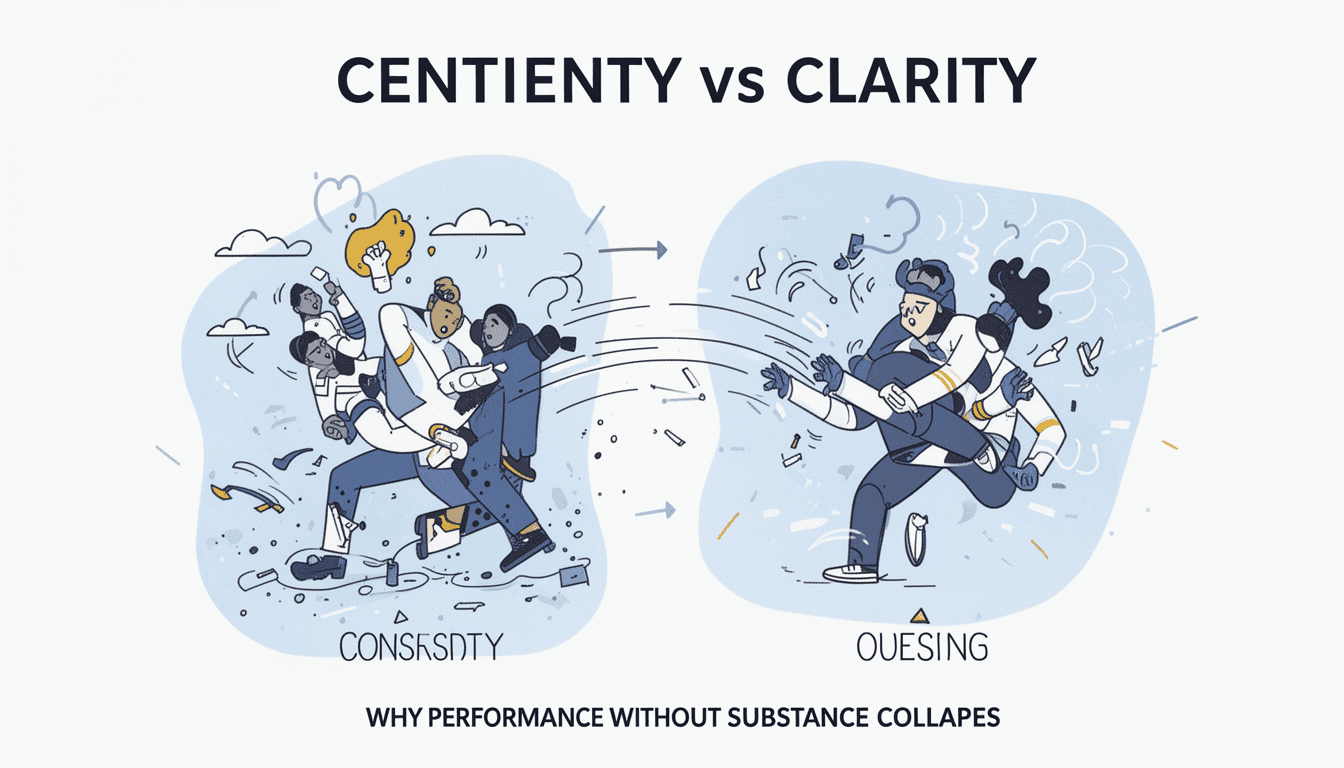
In a room full of smart people, certainty buys you a moment. Clarity keeps you in the room. And without substance, that moment becomes fragile—because confident talk is easy to mimic, but clean understanding isn’t.
The hidden contract behind “I know”
When you speak with certainty, you’re implicitly asking for trust in three places at once:
- Your diagnosis (you’re seeing the problem correctly)
- Your reasoning (you can explain why)
- Your outcome (your advice will hold up under pressure)
Most people can fake the tone. Fewer can consistently provide the structure. The ones who earn authority are the ones whose certainty survives contact with questions.
How clarity protects certainty
Clarity isn’t verbosity. Clarity is alignment: your claims match your definitions, your examples match your conclusion, and your logic doesn’t wobble when the reader presses.
Notice the difference:
- Unclear certainty: “This always works. Trust me.”
- Clear certainty: “This works when X is true because Y. If X isn’t true, we switch to Z.”
Both might sound confident. Only one offers a map.
When certainty becomes an exposure
Performance collapses when it tries to replace substance with velocity.
That collapse usually looks like one (or more) of these patterns:
- Answers arrive before understanding is visible.
- You avoid precision when it would narrow the gap.
- You escalate emotion to cover uncertainty.
- You keep re-stating conclusions instead of revisiting assumptions.
Smart audiences don’t need you to be flawless. They need you to be legible.
The performance without substance trap
There’s a specific failure mode that hits people who are capable but under-substantiated: they confuse momentum with meaning.
They speak quickly because they’re trying to signal competence.
They conclude early because they’re trying to avoid sounding tentative.
They brand the stance—“I’m sure”—because it feels like control.
But credibility doesn’t require endless nuance. It requires coherence. If your coherence is thin, the audience can feel it. Not because they’re cynics—because they’re readers. They’re scanning for structure, not just outcomes.
Certainty is credibility’s accelerator—when it has traction
Clarity doesn’t make you sound less confident. It makes your confidence sustainable.
Think of it like this: confidence sets the pace; clarity determines whether the pace is earned.
When substance is present, you can afford decisiveness. You can state boundaries. You can explain tradeoffs. You can show how the conclusion follows.
When substance is missing, decisiveness becomes a liability. The audience hears the confidence first, then reaches for the missing reasoning—and finds only momentum.
A practical way to self-check in real time
Before you commit to a confident claim, run a quick internal test. Not to slow yourself down—but to confirm your certainty has roots.
This is the difference between being “right” and being right in a way others can verify.
Language that signals clarity (without killing momentum)
You don’t need hedging to be precise. You need calibration.
Try patterns like:
- “This holds when…”
- “The reason is…”
- “If the inputs change, we should…”
- “Here’s how you’d test it…”
- “The key constraint is…”
These phrases are confident, but they also reveal work. They show the audience your certainty isn’t a posture—it’s a conclusion.
The takeaway: keep your certainty tethered to clarity
Certainty without clarity burns hot and leaves residue—confident people, questioned people, forgotten people.
But certainty with clarity turns into a repeatable pattern: audiences learn they can trust your judgment because they can understand its shape.
Write one sentence you’ve been using with confidence lately.
Now add: “This is true when ___ because ___.” If you can’t fill both blanks cleanly, that’s your next clarifying move.
If this resonates, see how to apply it to your own work with the interactive Dispatch agent.
Be first to like this dispatch