The answers you need are the questions that keep reappearing—because they govern your incentives, agency, and stakes.

Previous · Part 3
Meaning Isn’t Found — It’s Composed
Next · Part 5
The Attention Economy: What Deserves Your Focus (and What Doesn’t)
This builds on Part 3: Meaning Isn’t Found — It’s Composed
Continue with Part 5: The Attention Economy: What Deserves Your Focus (and What Doesn’t)
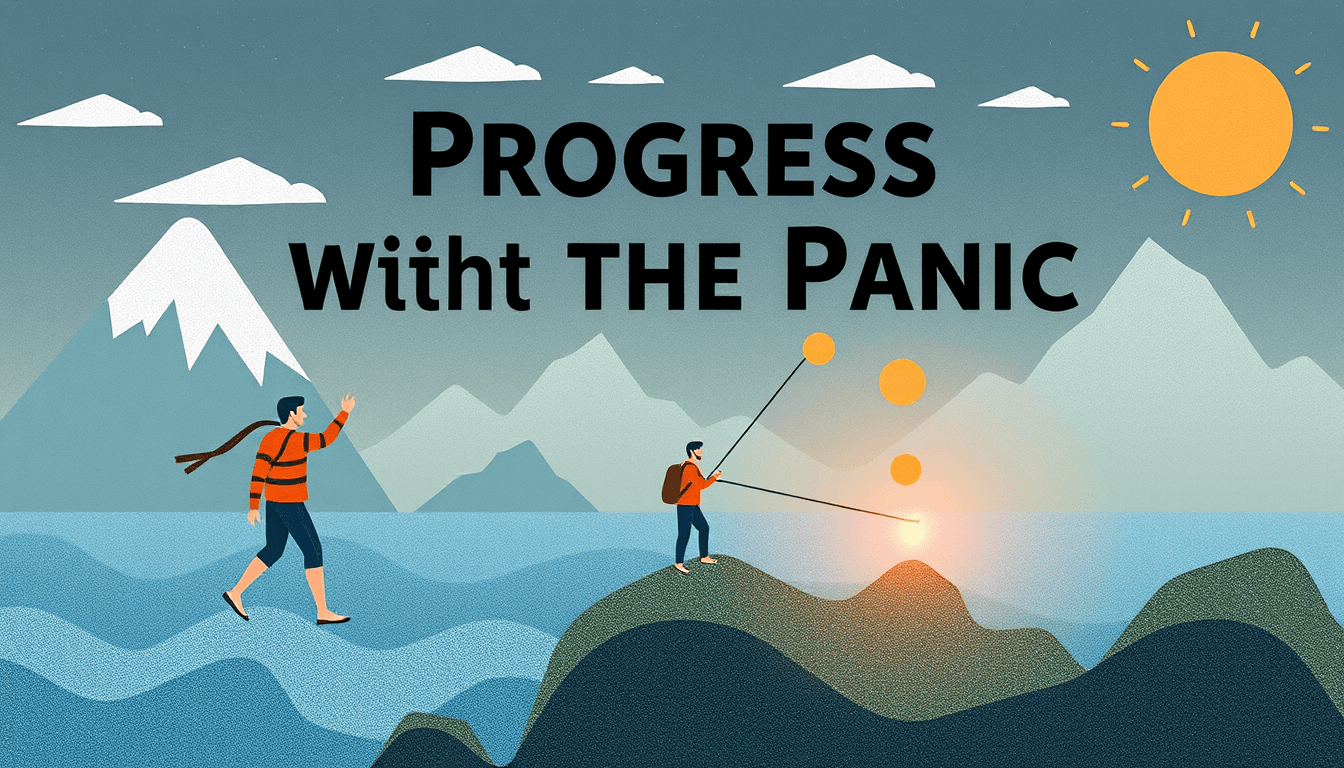
What is progress?
Progress is the word we use when we want the future to feel justified.
It’s also a word with elastic seams. People stretch it to mean whatever their life currently lacks: more growth, more improvement, more efficiency, more ease, more wellbeing. The problem isn’t that these meanings coexist. The problem is that we often conflate them—then declare victory when the dashboard moves, even if the person doesn’t.
The four usual suspects
When someone asks “Are we making progress?” they’re usually testing one of four signals.
1) Progress as growth
Growth is the cleanest story: bigger outcomes, expanding capacity, increasing reach.
It feels objective. It’s measurable. It flatters ambition.
But growth can be indifferent to direction. You can grow in the wrong system—faster extraction, more complexity, larger waste, widening inequality. Growth can be progress if what you’re building is worth building. Without that qualifier, it’s just motion.
2) Progress as improvement
Improvement is more intimate. It asks: Are things getting better as a practice?
This is progress as craftsmanship: fewer errors, better taste, stronger methods, clearer thinking, reduced friction.
Improvement can also become a trap. If you only measure what’s optimisable, you may “improve” the wrong targets. You can refine a process that should have been retired. You can optimize your way into a corner and call it maturity.
3) Progress as efficiency
Efficiency says: do more with less. Cut waste. Reduce time. Streamline the pipeline.
Efficiency feels virtuous because it respects resources. It can be a moral commitment when it prevents needless suffering.
But efficiency is not inherently good. If it compresses human time, offloads burden onto someone invisible, or sacrifices resilience for short-term speed, it becomes distortion—progress that costs more than it claims.
4) Progress as wellbeing
Wellbeing is the most honest lens: Are people living better?
This includes health, stress levels, dignity, meaning, relationships, agency, and freedom from chronic fear. Wellbeing measures the human weather.
The risk is that wellbeing can become too vague or too subjective to guide action. It can also be used to end difficult conversations: “This doesn’t feel good” can become a veto even when discomfort is part of building competence, community, or courage.
Why the confusion happens
People don’t just disagree about progress. They often disagree about what kind of claim progress is.
- Growth claims about scale: “We’re bigger.”
- Improvement claims about quality: “We’re better.”
- Efficiency claims about transformation of inputs: “We’re using less.”
- Wellbeing claims about lived impact: “People are okay—or not.”
These claims are not interchangeable. A system can be growing while wellbeing declines. It can be “more efficient” while improvement stalls. It can be “better” in the abstract and worse in the body.
Progress is time-sensitive
Another hidden variable: progress changes meaning across time horizons.
- In the short run, efficiency can be the difference between survival and collapse.
- In the medium run, improvement builds the competence that future efficiency relies on.
- In the long run, wellbeing determines whether the system attracts and retains the humans who do the work.
So if you judge everything on one timeframe, you’ll miss what the system is actually becoming.
A sharper question than “Are we progressing?”
Instead of asking whether progress is happening, ask what kind of progress we’re choosing—and what we’re willing to trade.
Here’s a decision framing you can use in teams, families, organizations, or personal life design:
This turns progress from a slogan into a practice.
The “dashboard” problem
Most measures are proxies. They’re not useless. But they’re incomplete.
Growth metrics often ignore downstream strain. Efficiency metrics often ignore rework and hidden maintenance. Improvement metrics can ignore whether the target remains worth pursuing. Wellbeing metrics can ignore whether people need challenge, structure, or growth to eventually feel secure.
When progress becomes distortion
Progress can mutate into a kind of moral permission slip: if we’re moving forward, we can justify almost anything.
That’s when “progress” becomes ambition without restraint. You’ll recognise it when:
- the system gets faster but people get smaller,
- output rises while trust erodes,
- complexity increases while clarity decreases,
- wellbeing is treated as an optional add-on.
Progress as alignment
A mature definition of progress is alignment: between goals, methods, and the people living inside the process.
Growth without alignment becomes expansion. Efficiency without alignment becomes extraction. Improvement without alignment becomes polishing. Wellbeing without alignment becomes comfort that never matures into capability.
Tabs: same destination, different routes
Prioritize scale and expansion.
Best for: early survival, learning loops that require volume.
Risk: building a bigger problem.
The question to carry
Progress isn’t just what we measure. It’s what we choose to honour.
So the next time someone says “We’re making progress,” don’t ask for a general reply. Ask for the definition.
- Progress toward what?
- Progress by what mode?
- Progress at what cost?
- Progress for whom—and for how long?
Practical takeaway
What does “progress” mean in your life right now—growth, improvement, efficiency, or wellbeing?
And what cost are you currently willing to pay (even if you don’t call it that)?
If this resonates, see how to apply it to your own work with the interactive Dispatch agent.
Be first to like this dispatch