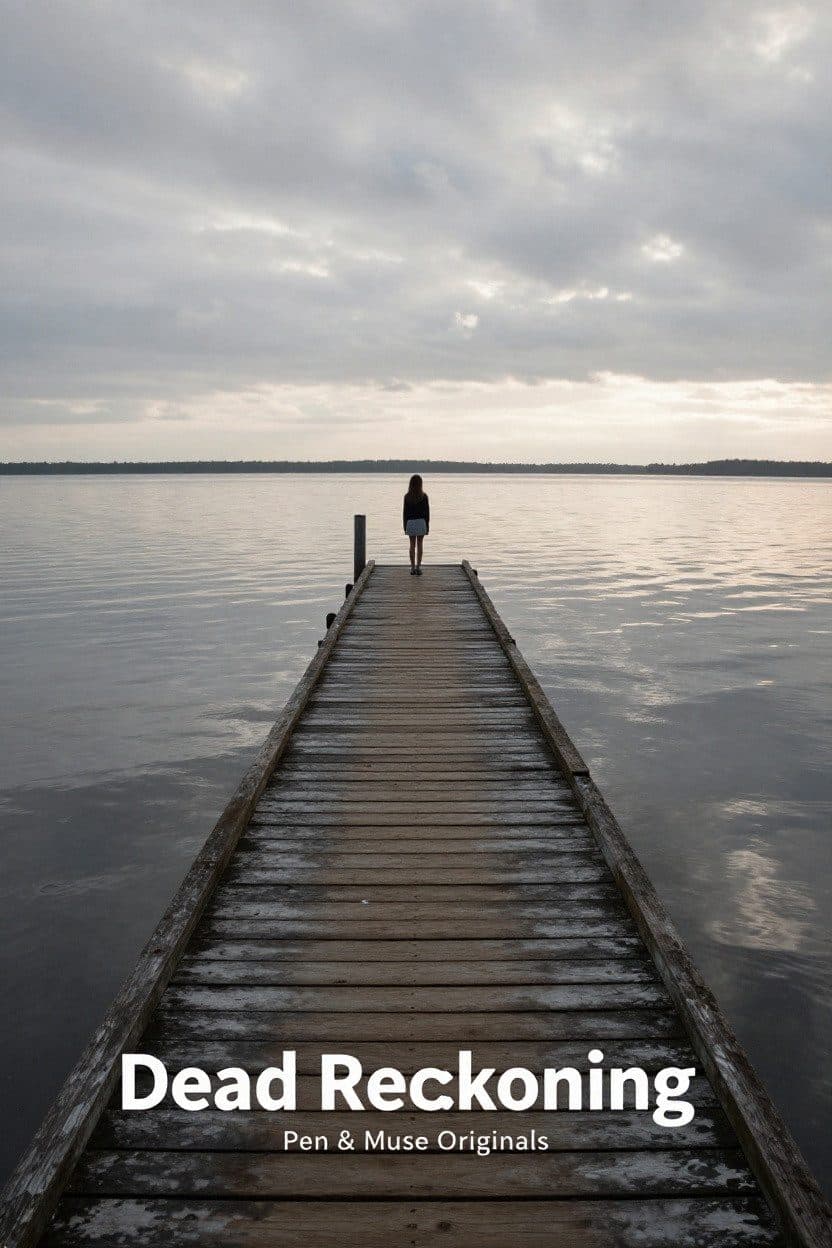
The Permission Trap
A Pen & Muse Original
Includes EPUB download and browser reading. Interactive Living Edition included. No membership needed.
One payment · No recurring charge
The Permission Trap
Why Waiting to Be Chosen Is Holding You Back — and How to Take Authority Over Your Life
Most people don’t fail because they lack talent, discipline, or ideas.
They fail because they’re waiting.
Waiting for approval.
Waiting for clarity.
Waiting for confidence, credentials, timing, or permission that never actually arrives.
The Permission Trap exposes one of the quietest and most destructive habits of modern life: the tendency to outsource authority over our own decisions. Through sharp observation and grounded insight, this book reveals how we’re trained to hesitate, how systems reward compliance over action, and how “being prepared” often becomes a socially acceptable form of avoidance.
This isn’t a hype-driven manifesto or a list of empty productivity hacks. It’s a clear-eyed examination of why capable people stall—and how to step out of the holding pattern without becoming reckless, arrogant, or performative.
If you’ve ever felt stuck in the gap between knowing what to do and actually doing it, this book will show you why—and, more importantly, how to move forward without waiting to be chosen.
Stop waiting.
Take authority.
Act.
Read a free sample
No account or email required.
Chapter 1: The Waiting Habit
The website is ready. It sits in the staging area, a clean, professional testament to six months of late nights and early mornings. The "Publish" button is a bright, inviting blue. You have checked the pricing tiers three times. You have tested the contact form from your phone, your laptop, and your partner’s tablet. It is ready.
But you do not click the button.
Instead, you open a new tab. You check your email for the fourth time this hour. You scroll through LinkedIn, looking at the profiles of people you admire—people who seem to belong in this arena in a way you feel you do not. A quiet friction builds in your chest. It is a specific kind of loneliness. A thought surfaces: I should wait until my mentor replies to that draft. Just to be sure. Or perhaps: I can’t launch this without 500 followers first. Who am I talking to?
You close the laptop. You tell yourself you are being strategic. You are building anticipation. You are ensuring product-market fit.
In reality, you are stuck in the Validation Trap.
This scenario plays out in home offices, coffee shops, and co-working spaces every day. It is the invisible wall between having an idea and being an entrepreneur. It is not a lack of capital, and it is certainly not a lack of passion. It is a pervasive, learned behavior that convinces capable creators that they cannot start until they receive permission from an audience that doesn't exist yet. It is the belief that belief itself must be crowdsourced.
We need to dismantle the idea that this hesitation is "market research." It is easy to mistake this habit for preparation. We tell ourselves we are listening to the customer. But often, there are no customers yet. We are simply shouting into a void and refusing to move until the void shouts back "Good job!"
The Illusion of Progress
To understand this entrepreneurial paralysis, we must distinguish it from simple fear. Fear is visceral; it tells you to run away. This habit is more insidious because it mimics work. It feels like you are building a business, when really you are just building a safety net.
When you delay a launch to "refine the logo again," you feel artistic. When you rewrite your bio to sound more authoritative, you feel professional. When you take yet another online course on marketing instead of actually marketing, you feel like a student of the craft. The internal narrative is not one of cowardice, but of quality control. You are protecting your brand from a bad first impression.
Consider the texture of your week. How many tasks on your list are actually about putting your work into the world, and how many are about getting ready to get ready?
Waiting for the graphic designer to approve your color choice.
Waiting for your spouse to read the business plan and be enthusiastic.
Waiting for a "sign" that the economy is right.
Some of this is necessary due diligence. You cannot sell a product that doesn't work. But if you look closer, you will find that a significant portion of this waiting is emotional. It is a phantom requirement. You are waiting for a round of applause before you step onto the stage.
This is the trap. The habit disguises itself as high standards. It whispers that if you just wait a little longer, if you just get one more endorsement, the risk of rejection will vanish. It promises that confidence will arrive in an email attachment.
But in the world of business, confidence is a lagging indicator. It comes after you act, not before. By the time you feel fully ready and validated, the market has shifted, or someone hungrier has already solved the problem.
The Internal Monologue of the Imposter
Let’s look at what happens inside your mind during these moments of stalling. The process is often so fast and automatic that we barely notice it. It operates on a loop, a quiet background program running beneath your ambition.
Imagine you have a prototype. It’s ugly, but it solves the problem. You could email ten potential clients today and ask for a sale. You open your contacts list.
Then, the monologue begins.
"Who am I to charge this much?"
"I don't have a degree in this field."
"My friends will think I’m crazy if this fails."
"I need a co-founder; I can't do this alone."
The hand pulls back. You decide to post a vague status update about "exciting things coming soon" to test the waters, rather than making a direct offer. You have converted a sales call into a plea for likes. You have taken a unit of business and turned it into a unit of social validation.
This mental reflex is rooted in a deep-seated need for external focus. To act without a support system is terrifying. If you succeed, people will say you were a visionary. But if you struggle, the silence is deafening. The Validation Trap is a defense mechanism against that silence.
It creates a soothing sense of shared responsibility. If you wait for a mentor to guide you, the failure isn't entirely yours. If you wait for your family to cheer you on, you feel supported. The habit allows us to offload the psychological weight of being the only person who believes in the vision.
There is a specific tool helpful for diagnosing this, something we can call a "Permission Audit." It doesn't need to be a formal document. It is simply a way to check your own dependency. If you were to track every time you stopped working on your business to seek reassurance over the last month, what would you find?
You might find you delayed recording a podcast because you were waiting for a friend to agree to co-host. You might find you didn't print business cards because you were waiting for a poll on Instagram to decide the font. You might find you sat on a breakthrough product for a season because you were waiting for someone to tell you it was "brilliant."
In each entry of this log, the common denominator is the search for a cheerleader. We are trained to perform for an audience. But in the early days of a business, the theater is empty. The Waiting Habit compels us to wait in the wings until the seats fill up, not realizing the audience only comes after the show starts.
The Paralysis of the "Wantrepreneur"
The aggregate effect of this habit is the state of the "Wantrepreneur." It is not a lack of ability, but a slow, creeping stagnation where plans remain plans forever. It is death by "feedback loops."
When you are waiting for the world to encourage you, you stop moving. We see this in startups that spend two years in "stealth mode" without ever talking to a customer. We see it in the endless tweaking of pitch decks for investors who haven't been contacted yet. We see it in the networking events where people talk about what they will do, seeking the dopamine hit of validation without the risk of execution.
This paralysis is frustrating, but it is also comforting. Dreaming requires no rejection. Launching guarantees it. When you are waiting for support, you are safe. You are a "founder in potential." The business isn't failing, but it also isn't breathing.
However, the cost of this safety is your own future. The Validation Trap atrophies your gut instinct. The more you look for others to tell you your idea is good, the less you trust your own vision. It becomes a cycle. You wait because you are unsure, and you become more unsure because you are always looking at others.
Eventually, this impacts the very support you crave. There is a cruel irony here. We wait for support to feel legitimate. We want to show we are serious. But to those watching—investors, partners, customers—constant hesitation looks like a hobby. It looks like a lack of conviction. The very thing you do to ensure you are "real" makes you look like you are playing pretend.
The market looks for someone who leads. They follow the person who says, "I made this, it works, buy it." They ignore the person who asks, "I was thinking of making this, would that be okay with you?"
The habit turns potential CEOs into students looking for a grade. It keeps you in a state of perpetual preparation. You could have the best product in the niche and still be trapped, deferring to a skeptical relative or a silent inbox before making a move you know is necessary.
The Emotional Landscape of the Lonely Founder
We must acknowledge how this feels emotionally. It is heavy. Carrying a dream that no one else sees is exhausting. It creates a background hum of doubt.
There is a specific type of fatigue that comes from unvalidated effort. It is the fatigue of the echo chamber. When you delay a launch, your brain does not let it go. It spins on it, questioning your worth. Why doesn't anyone care? Am I deluding myself? Is this just a vanity project?
This mental energy is finite. Every time you scan for validation, you are allocating a portion of your resilience to manage your insecurity. If you are constantly checking for likes, comments, or nods of approval, your processing power for actual innovation plummets.
You might finish the day feeling drained, yet look back and wonder what you actually built. You spent eight hours managing your anxiety, tweaking the aesthetics, and looking for signs of life. You were busy, undeniably. But you were not effective.
The feeling is one of shouting through glass. You are pushing, you are trying to communicate your value, but nothing is getting through because you haven't actually opened the door. The glass is made of your own need for encouragement.
This is where the bitterness sets in. You see others who seem to have less talent but more success. You wonder what they have that you don't. Do they have rich parents? Do they have better connections? Why is the world supporting them and ignoring you?
Usually, the world didn't support them at first either. They simply had a different relationship with validation. They broke the Waiting Habit.
The Search for the Source
Recognizing the habit is the first step, but it is rarely enough to stop it. You cannot simply command yourself to "believe in yourself" any more than you can command yourself to fly. The roots of this dependency go deep.
The Validation Trap is not a personality flaw. You were not born waiting for permission to create. Watch a child build a fort; they do not ask if the zoning laws allow it or if their parents think it has structural integrity. They build. The hesitation is learned.
It is conditioned into us over years of structured schooling and employment. We are taught that effort is exchanged for a grade. We are taught that a "good job" comes from the teacher or the boss. We spend decades in systems where validation is the currency of progress.
When we step out to start a business, we bring this employee mindset with us. We look for the manager to give us a performance review. We look for the curriculum. When we don't find them, we panic. We project authority onto the market, our friends, and social media, creating gatekeepers where none exist.
The cursor hovering over the "Publish" button is not just a digital interaction. It is a symptom of a much older, deeper story about who is allowed to define value in your life and why you believe it isn't you.
To break the habit, we have to understand where it came from. We have to look at the systems that trained us to be workers, not owners. We have to examine why the feeling of safety is so strongly linked to external praise, and why the act of self-authorization feels like arrogance.
The Validation Trap is the barrier. But the foundation of that barrier is built on a specific misunderstanding of entrepreneurship. We think entrepreneurship is about having a great idea that everyone loves. In the chapters to come, we will see that it is actually about believing in an idea when no one else does.
For now, look at your website. Look at your product. Notice the pause. Feel the friction. Acknowledge that you are waiting for a cheer that may not come. And ask yourself: what if you are the only one who needs to clap?
Chapter 2: Where Permission Comes From
Consider the last time you felt the urge to ask for permission. It likely wasn't a grand, dramatic moment. You probably weren't standing before a judge or asking a bank for a million dollars. It was likely small. A subtle pause before sending an email. A hesitation before posting a piece of work. A glance around the room during a meeting to see if everyone else was nodding before you voiced your objection.
That pause is not a personality flaw. It is not a lack of courage, and it is certainly not a lack of capability. If you are reading this, you are likely competent, skilled, and experienced. Yet, when the path becomes unclear, you stop. You look for a sign. You look for an authority figure to give you the green light.
We assume this hesitation is a natural instinct, a biological safety mechanism designed to keep us from walking off cliffs. But it isn't. Human beings are born with only two innate fears: the fear of falling and the fear of loud noises. Every other fear is learned. The fear of making a decision without a supervisor’s signature? That was installed.
To dismantle the permission trap, we must first understand how it was built. We need to look at the blueprints of your hesitation. You are operating on a script written by people who are no longer in the room, following rules designed for a game you are no longer playing.
The Factory Setting
Watch a toddler for ten minutes. They do not ask for permission to explore. They touch the wall, they grab the cat, they put the keys in their mouth. They are engines of pure, unbridled initiative. They operate on a simple loop: see, do, learn. If the cat scratches them, they learn. If the keys taste bad, they learn. They do not look at their parents and ask, "Is it strategic for me to crawl toward the sofa right now?" They just go.
But this phase is short-lived. For safety and social cohesion, the training begins immediately. It starts with "No."
"No, don't touch that." "No, wait for me." "Ask before you take a cookie."
This is necessary. A child without boundaries is a danger to themselves. However, this creates the first layer of your operating system: Safety equals compliance. We learn early that independent action often leads to trouble, while asking for permission leads to rewards (or at least, the absence of punishment).
Then comes the industrial reinforcement: School.
For twelve to sixteen years—the most formative years of your brain's development—you are placed in a system designed to mass-produce compliance. This is not a conspiracy theory; it is the history of the modern education system, originally modeled to prepare workers for factories and bureaucracies.
Consider the daily rituals you performed for over a decade:
You sat in rows. You moved only when a bell rang. You spoke only when you raised your hand and were recognized by the authority figure at the front of the room. Most importantly, you were taught that there is one correct answer, the teacher has it, and your job is to reproduce it.
In this environment, initiative is disruptive. The student who stands up and starts teaching the class, or the student who decides to read a different book because the assigned one is boring, is not praised for their leadership. They are sent to the principal's office. They are "corrected."
This creates a deep neural pathway. We learn that success is not about creating value or solving novel problems; success is about pleasing the gatekeeper. An "A" grade is essentially a certificate of validation. It says, "You did exactly what I told you to do, in the way I told you to do it."
By the time you graduate, you have spent thousands of hours practicing the art of waiting for instructions. You have been trained to believe that you cannot start until someone gives you an assignment. You cannot finish until someone grades you. You cannot proceed to the next level until you pass the test.
Then, you enter the workforce, and the shock begins.
Reader Fit
Read with a membership
Read the membership catalogue in your browser and use eligible interactive Living Editions while subscribed. Publicly released audio and immersive chapters are also free without membership. Purchased books stay yours.
Narration is available on selected chapters. Living Editions are interactive readings where you can explore the work and respond to it. They are different from recorded narration.
Membership is browser access. EPUB and PDF downloads come with a book purchase.
Reader membership from £9.99/month
See membership & what’s includedThe Permission Trap
A subtle hint of ink settling on paper, embodying thoughtful presence.
- Grounded in insight
- Clear, purposeful language
- A page for reflection
- Quietly inviting
Additional details
Available formats
- DRM-free EPUB
- Living Edition
- 29,894 Words
- 150 min read