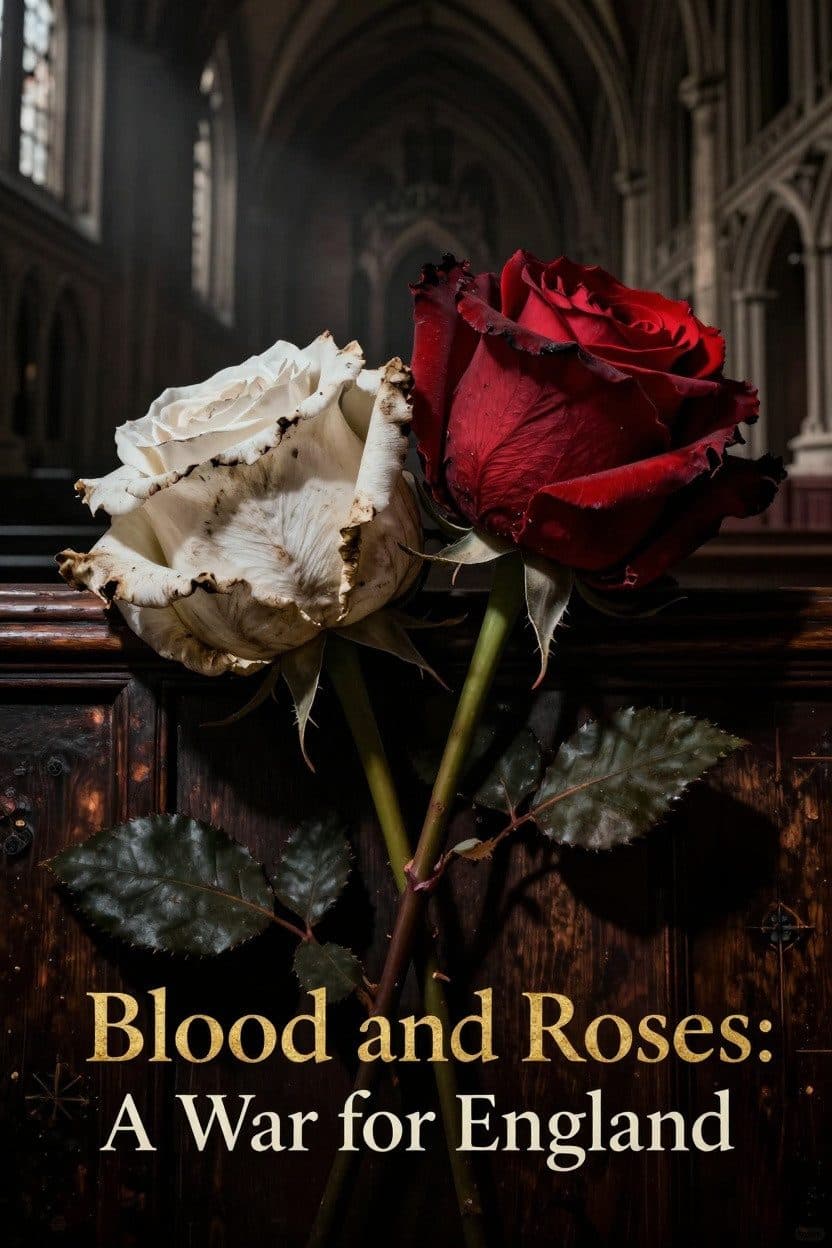
Blood and Roses
A War for England
A Pen & Muse Original
Includes EPUB download and browser reading. Interactive Living Edition included. No membership needed.
One payment · No recurring charge
In the decaying court of King Henry VI, ambition and anxiety fester in the shadows, as courtiers whisper of the king's failing health and grip on power. Amidst the heavy grandeur and unspoken tensions, a single white rose is discovered – a dying symbol of the House of York, an omen of the kingdom's sickness. Meanwhile, across the land, Richard, Duke of York, sharpens his own ambitions, viewing power as a falcon's eye, capable of seeing weakness and striking with precision. Queen Margaret of Anjou, a formidable force in a world of men, recognizes the threats posed by York and the grasping nobles like Somerset. As alliances shift and loyalties fray, she faces the brutal reality of a kingdom on the brink, where she must become a creature of cunning and strength to protect her son's inheritance, even if it means staining the Lancastrian rose with blood.
Read a free sample
No account or email required.
The light was dying. Not just outside, where a bruised November sky pressed down on the slate roofs of Westminster, but within the Great Hall itself. Here, a hundred torches fought a losing war against the cavernous dark. From iron sconces the torches spat and hissed, their flames stretching thin and desperate, casting more shadow than illumination. The light caught on the gilded rafters high above, making them gleam like the bones of some great, fallen beast, but left the corners of the hall to drown in a gloom thick as river mud. The torchlight danced and flickered, a restless energy that played across the faces of the assembled courtiers, highlighting the sharp angles of their features and the gleam of their expensive velvets. No face found mercy in that light. It carved new lines of ambition and anxiety into the faces of the men who stood in tight, whispering clusters. “The King’s health is not what it was,” one murmured, his voice barely audible. “Nor his grip,” another replied, a sharp, knowing nod accompanying his words. This was the court of King Henry VI, and it breathed an atmosphere of somber grandeur, the kind of heavy, perfumed air that hangs in a sealed tomb. Unspoken words pressed against the lungs, thickening every breath, each flicker of flame a punctuation mark in the ongoing drama of power. At the heart of it all, a still point in the turning world of whispers, sat the King. Henry sat like a statue, prayer-creased hands locked upon his knees, every breath shallow, as if movement itself might crack the stone of him. Enthroned upon the King's Bench, he was less a ruler and more a holy relic put on display. His robes were a masterpiece of the needle-worker’s art, the deep crimson velvet so heavily worked with gold thread that it seemed to possess a life its own. Lions of England, stitched with meticulous fury, ramped and roared in silent heraldry across his chest, their bullion manes catching the torchlight. Interspersed between them were the serene, suffering faces of saints, their halos a brilliant corona of spun gold, their expressions promising a divine peace that was nowhere to be found in this hall. But the man within the robes was absent. His eyes, a pale, watery blue, were fixed on some point beyond the stone walls, beyond the failing light, beyond the world of men entirely. His lips moved, a constant, silent flutter, shaping prayers that drifted from him like fog, unheard and unanswered. They were not prayers for his kingdom, nor for his queen, nor for the son who was the fragile vessel of their line. They were formless, private devotions, a shield of piety he held up against the crushing weight of a crown he had never been built to wear. This was the source of the rot, the quiet, hallowed epicentre of the realm’s decay: the waning of the crown, embodied in the vacant devotion of its king. The courtiers, like wolves sensing a weakness in the herd, moved with a predatory grace. They had long since learned that power no longer radiated from the throne. Instead, it pooled in the shadows, collected in the spaces between men. It was a currency traded in curt nods, in smiles that never reached the eyes, in the subtle turning of a shoulder that could include one man in a conversation and exile another. Allegiances were not sworn here; they were rented, the lease renegotiated with every rustle of expensive fabric, every shared glance across the hall. The movement of bodies was a constant, silent negotiation, a ballet of ambition and self-preservation. Near the great hearth, where a fire battled the chill with little success, stood the Duke of Somerset, his hand resting possessively on the shoulder of a younger lord whose lands bordered the vast estates of the Nevilles. It was a gesture of casual ownership, a public branding. As he spoke, his broad hand swept out, encompassing the space around them, a silent declaration of his influence. Not far off, the Earl of Wiltshire laughed, a sharp, barking sound that cut through the murmur, his eyes fixed on Somerset with an expression of pure, unadulterated contempt. Men shifted, their orbits realigning around these twin suns of influence, their loyalties as fluid as mercury. They were all followers of power, and in a court with a hollow centre, they were forced to seek its heat elsewhere. The very air seemed to crackle with the tension between them, each gesture and glance a carefully calibrated move in a high-stakes game. This pageantry, once the bedrock of royal authority, now felt brittle, a theatrical performance staged for an audience that had forgotten its lines. The bows were just as deep, the titles spoken with the same reverence, but the substance had been hollowed out, leaving only a fragile, echoing shell. The velvet curtains, heavy with embroidered crests, swayed slightly in a draft, their movement a ghostly echo of a more vibrant past. At a long trestle table to the side, where the clerks and scribes did their work, a young man named Walter was trying to bring order to the day’s chaos. His fingers were stained with ink, his face pale from too many hours spent indoors. He gathered loose parchments, his movements neat and unobtrusive, a skill necessary for survival in a place where notice was often a prelude to ruin. As he reached for a heavy, leather-bound book of household accounts, its spine cracked from use, a servant brushed past him, sending a ripple of movement through the papers. In the same instant, a nearby scribe, engrossed in his own task, accidentally splashed a drop of ink onto a nearby document, and Walter’s own hand slipped as he tried to steady the falling parchment. It was amidst this small flurry of domestic disruption that something small and pale was dislodged from behind the book, tumbling onto the dark wood of the table with a whisper-soft thud. It was a rose. A white rose. Walter froze, his hand hovering over the flower, the ink stain on his finger suddenly feeling like a brand. It was not a fresh bloom, plucked in defiance and placed as a bold statement. This one was a ghost. Its petals, once pristine, were bruised at the edges, turning the colour of old parchment. The outer layers were limp, curling inward in a gesture of final surrender. The stem was bent and sapped of its strength. It was a flower caught in the precise moment of decay, its life seeping away, leaving behind a husk of what it once was. A symbol of York, yes, but a dying one. An omen. A spike of ice drove into his chest, stealing his breath. He darted a look around the hall. No one seemed to have noticed. The great lords were still consumed by their slow, dangerous dance, their gestures grand and meaningful in the flickering light. The king was still lost in his ethereal conversation with God, his lips moving in silent supplication. But the rose lay there, a stark, silent accusation on the polished oak. Who had put it there? A servant with loyalties to the absent Duke? A disgruntled knight? Or, a more chilling thought, was it a trap? A test of allegiance for whoever found it? The air grew thick in his lungs. This was not a challenge; it was a lament. It spoke not of York’s strength, but of the fragility of the peace that held men like him in its thrall. It was a whisper of decline, a tangible piece of the kingdom’s sickness. With a movement that was almost a spasm, Walter snatched the flower. He did not dare crush it. Instead, he slipped it into the sleeve of his tunic, the wilting petals clammy as a fevered touch. He pushed the heavy book back into place, his hands trembling slightly. The wilting petals, cool and damp against his skin, were a small, leaden weight of treason that made his spine lock. From across the hall, she saw it. Not the rose itself, but the boy’s reaction. The sudden stillness, the furtive glance, the sharp, panicked motion. Queen Margaret of Anjou stood near a tapestry depicting a grim-faced saint slaying a rather unconvincing dragon, and her eyes missed nothing. Forged in the fires of a foreign court, she had been hammered into shape by the brutal realities of this one. She had learned to read the subtle currents of this hall, to interpret the language of silence and shadow, her gaze sweeping over the shifting alliances and veiled threats. To the casual observer, she was the image of regal composure. Her gown was of a deep blue, the colour of a twilight sky, her headdress a delicate construction of pearl and silver wire that framed a face that was still beautiful, though hardened by a constant, grinding vigilance. She held her head high, her posture unyielding. Her smile, usually a shield, felt like a sheet of ice cracking across her teeth. It was a fine web of cracks, invisible to most, but they crept outward, tightening her jaw, knotting in the muscles of her neck with every passing day. She ruled a kingdom through a man who could not rule himself. She fought for a son whose inheritance was threatened not by foreign armies, but by the circling predators within his own court. Every smile she offered was a calculation. Every kind word was a carefully aimed weapon. The strain of it was a physical weight, settling in her shoulders, tightening the muscles in her jaw. She felt less like a queen and more like a dam holding back a flood, and she could feel the stones beginning to shift. Her gaze swept the hall, cataloging the threats. Somerset, bloated with his own importance, a necessary but unreliable bulwark, his hand still resting on the young lord’s shoulder. The Percys, simmering with ancient hatreds. Every man here was a potential enemy, his ambition a spark that could ignite the dry tinder of this fragile peace. And then there was the great, unspoken threat. The one whose symbol the clerk had just hidden. York. Richard, Duke of York, currently cooling his heels in Ireland, but his influence reached across the sea, a chilling draught that found its way through every crack in the court’s facade. She watched the clerk, Walter, scurry away, his face a mask of false calm. What had he found? A note? A dropped coin? Or something more? The boy’s panic was a cold, sharp note that Margaret instantly absorbed, tightening her grip on her pearl rosary. This was the nature of her reign: a constant battle against whispers, against symbols, against the slow, creeping tide of factionalism that threatened to pull her under. Her eyes moved from the clerk to her husband. The King. A faint, beatific smile now touched his lips, as if he had just received some private, divine assurance. The sight of it, once a comfort, now filled her with a cold fury. He was safe in his sanctuary of the mind, while she was left to stand guard at the gates, armed with nothing but her wits and a ruthless determination to survive. He was the saint, and she, she was forced to be the sinner who kept his kingdom from shattering into a thousand pieces. The torchlight wavered, and for a moment the King's golden lions seemed to writhe in the shifting shadows, their silent roars lost in the vast, indifferent dark. The murmur of the court continued, a low hum of ambition and conspiracy. Queen Margaret drew a slow, steadying breath, the scent of beeswax and damp stone filling her lungs. The boy was gone, the rose was hidden, but the omen remained. A seed of unease had been planted, and in the decaying soil of this court, she knew it would find fertile ground in which to grow.
Reader Fit
Read with a membership
Read the membership catalogue in your browser and use eligible interactive Living Editions while subscribed. Publicly released audio and immersive chapters are also free without membership. Purchased books stay yours.
Narration is available on selected chapters. Living Editions are interactive readings where you can explore the work and respond to it. They are different from recorded narration.
Membership is browser access. EPUB and PDF downloads come with a book purchase.
Reader membership from £9.99/month
See membership & what’s includedBlood and Roses
In the decaying court of King Henry VI, ambition and anxiety fester in the shadows, as courtiers whisper of the king's failing health and grip on power.
- A War for England
- Tense · Political · Grandiose
- A work made to reward attention and return.
Additional details
Available formats
- DRM-free EPUB
- Living Edition
- 84,840 Words
- 425 min read