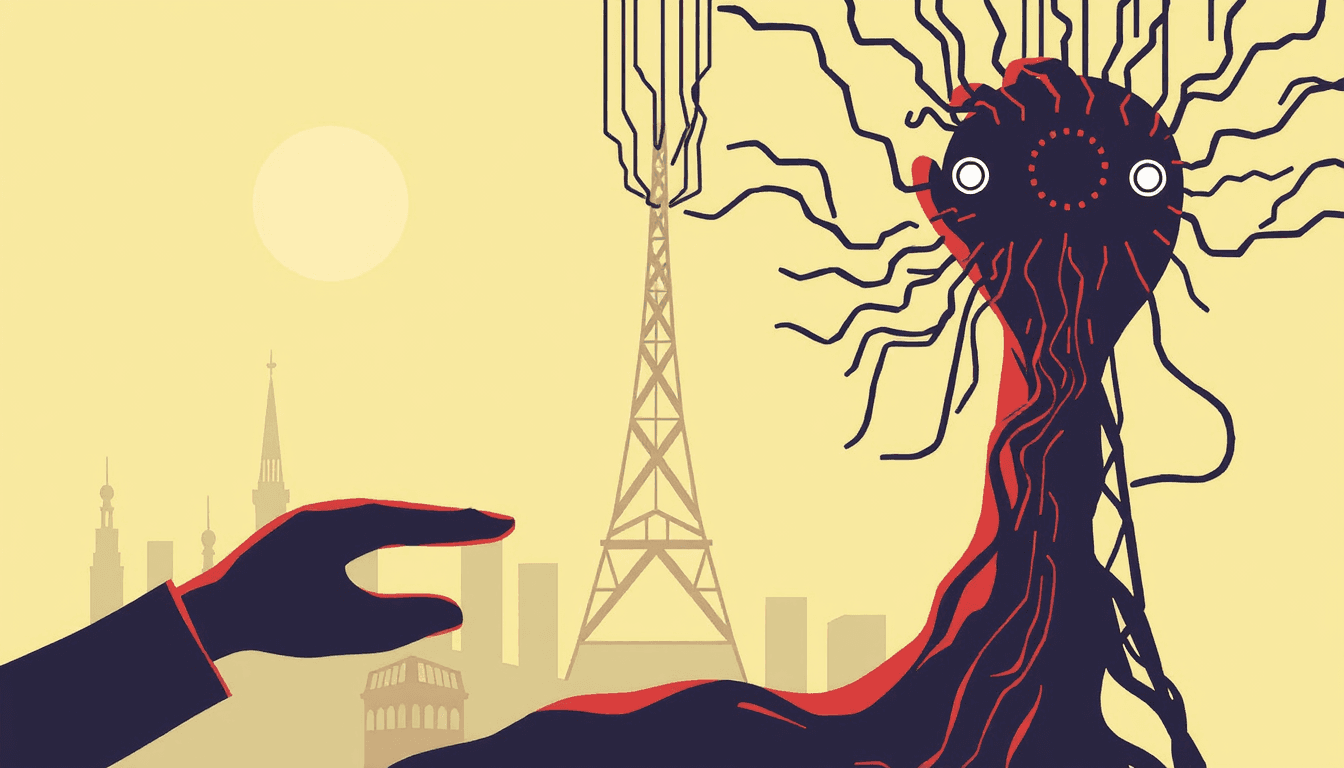
When visibility becomes value, recognition stops telling us what is worth trusting.

Previous · Part 4
Why Everything Feels Like It’s for Sale
This builds on Part 4: Why Everything Feels Like It’s for Sale
There have never been more people explaining the world.
Analysts. Educators. Coaches. Commentators. Thread-writers. Newsletter minds. Podcast guests. Video essayists. Independent researchers. Public intellectuals with ring lights.
Knowledge is everywhere now. Available instantly. Translated, summarised, clipped, diagrammed, packaged, remixed, and delivered before breakfast.
And yet trust feels thinner.
Not absent. Thinner.
We know more names. We hear more opinions. We encounter more confident explanations than any generation before us. But the more expertise circulates, the harder it becomes to know which expertise is real, which is borrowed, which is performed, and which is merely fluent.
This is one of the stranger turns in the value crisis.
For a long time, expertise was scarce because access was scarce. You needed institutions, apprenticeships, libraries, credentials, proximity, publishing permission, or time inside a field. None of those systems were perfect. Many were exclusionary. Many protected incumbents as much as truth.
But they did create friction.
And friction, however flawed, slowed the transformation of information into authority.
Now the friction is gone.
That has given us something genuinely valuable: more voices, more access, more informal education, more ways to learn outside sanctioned gates.
It has also created a new disorder.
When anyone can publish knowledge instantly, knowledge becomes easier to share — and harder to weigh.
Expertise Has Been Unbundled
Expertise used to arrive as a bundle.
A person’s authority was often attached to some combination of training, experience, institutional affiliation, peer recognition, body of work, and time-tested judgment. Again, not a perfect system. But the signals were visible enough to inspect.
Now those signals have been separated.
Someone can have the confidence of an expert without the depth.
The language of an expert without the experience.
The audience of an expert without the accountability.
The aesthetic of expertise without the underlying discipline.
Expertise was usually attached to slow signals: apprenticeship, reputation, publication, institutional trust, long-term work, and visible consequences.
Expertise can appear through fast signals: fluency, confidence, format, frequency, audience response, production quality, and platform familiarity.
The old world had gatekeeping problems.
The new world has signal problems.
And the signal problem is more intimate than gatekeeping because it lives inside the reader, viewer, buyer, client, patient, student, and citizen. It asks a quiet question every day:
Who should I believe?
The Speed Gap
Information now moves faster than verification.
This is the structural fact underneath disposable expertise.
An idea can travel across platforms in hours. A claim can become a framework by lunchtime. A graph can acquire moral force before anyone checks the source. A confident explanation can feel settled before the evidence has been examined.
Verification is slow because reality is slow.
Accuracy requires context. Context requires history. History requires memory. Memory requires patience. And patience is not the native tempo of the feed.
Diagram: Claim Appears leads to Formatted for Attention; Formatted for Attention leads to Shared by Familiar Voices; Shared by Familiar Voices leads to Feels Credible; Feels Credible leads to Becomes Common Knowledge; Becomes Common Knowledge leads to Verification Arrives Later; Verification Arrives Later leads to Does Anyone Still Care?; Does Anyone Still Care? leads to Claim Remains as Residue (Often no); Does Anyone Still Care? leads to Correction Circulates Weakly (Sometimes yes).
Diagram: Claim Appears leads to Formatted for Attention; Formatted for Attention leads to Shared by Familiar Voices; Shared by Familiar Voices leads to Feels Credible; Feels Credible leads to Becomes Common Knowledge; Becomes Common Knowledge leads to Verification Arrives Later; Verification Arrives Later leads to Does Anyone Still Care?; Does Anyone Still Care? leads to Claim Remains as Residue (Often no); Does Anyone Still Care? leads to Correction Circulates Weakly (Sometimes yes).
By the time correction arrives, the original claim has often already done its work.
It shaped assumptions.
It influenced decisions.
It entered the atmosphere.
This is why bad expertise no longer needs to win permanently. It only needs to arrive first, sound plausible, and disappear before consequences become legible.
Confidence Outperforms Accuracy
The modern expert is under pressure to be clear before the world is clear.
This is not because audiences are foolish. It is because ambiguity is expensive. It takes time to hold. It feels unsatisfying. It does not clip well.
Certainty, by contrast, travels.
A confident voice lowers cognitive burden. It gives the audience somewhere to stand. It makes complexity feel briefly manageable.
That emotional relief can be mistaken for truth.
In public knowledge systems, confidence often outruns accuracy.
Platforms reward clarity, speed, conviction, and repeatability more reliably than careful uncertainty.
- —Nuanced explanations are harder to compress into posts, clips, headlines, and shareable diagrams.
- —Fast-moving audiences often lack the time or context to test a claim before absorbing it.
- —Confident statements create emotional resolution, while accurate statements often preserve tension.
The appearance of command becomes easier to recognise than the substance of competence.
A careful expert says, “It depends.”
A performative expert says, “Here is the answer.”
The second one is easier to remember.
The first one may be more useful.
This is one of the great distortions of disposable expertise: it punishes the very behaviours that often signal depth.
Hesitation.
Qualification.
Sourcefulness.
Revision.
Humility before evidence.
The expert who refuses to simplify beyond the truth may look weaker than the expert who makes the world feel clean.
Summary Culture Has a Depth Problem
The internet has made summaries abundant.
This is useful. A good summary can open a door. It can help someone enter a field, compare ideas, grasp a debate, or decide where to go deeper.
But summaries have quietly changed status.
They are no longer always treated as introductions to understanding. They are often treated as substitutes for it.
We read the book summary instead of the book.
The thread instead of the paper.
The quote card instead of the argument.
The “key takeaways” instead of the slow encounter.
The danger is not compression itself. Compression is necessary. The danger is compression without remainder — the belief that because something has been made legible, it has been understood.
Deep understanding has weight. It changes what you notice. It gives you discrimination. It lets you see not only the answer, but the conditions under which the answer fails.
Shallow understanding often knows the sentence but not the structure.
It can repeat the insight.
It cannot repair it, challenge it, or apply it under pressure.
That distinction matters because much of what now circulates as expertise is not wrong. It is simply under-rooted.
It has no depth system beneath it.
The Content-Friendly Expert
Expertise now has to survive inside formats built for speed.
That changes expertise.
Not always corrupts it. Changes it.
A content-friendly idea has certain qualities. It is modular. It can be named. It can be repeated. It can be visually represented. It can be delivered in under sixty seconds. It makes the audience feel an immediate shift.
Those qualities are not inherently bad. They can make ideas memorable.
But they also bias public expertise toward what performs well at the surface.
Depth → Compression → Performance → Disposal
- ·Complex research reduced into a viral chart
- ·Professional judgment converted into punchy advice
- ·Long historical arguments flattened into moral slogans
- ·Nuanced fields packaged as “everything you need to know”
You want to identify where knowledge has been made more accessible — and where it may have been made too thin to trust.
The platform does not ask, “Is this deeply true?”
It asks, “Will this hold attention?”
So expertise begins adapting to the question.
It becomes more visual.
More declarative.
More personal.
More branded.
More rhythmic.
More certain.
Less patient.
Less conditional.
Less willing to say, “This will take time.”
Designed to be encountered quickly. It must attract attention, establish relevance, and make complexity feel graspable almost immediately.
Working expertise
Designed to survive contact with reality. It is tested through decisions, consequences, trade-offs, failures, revisions, and long-term accountability.
Performative expertise
Designed to resemble mastery. It borrows the gestures of knowledge — confidence, terminology, frameworks, aesthetic polish — without necessarily carrying the burden of proof.
The trouble is that these categories can look identical on a screen.
The same camera.
The same tone.
The same vocabulary.
The same clean graphic.
So audiences are left trying to infer depth from surface.
And surface has become highly optimised.
Knowledge as Stream Content
The audience has changed too.
We do not only encounter expertise differently. We consume it differently.
A person can move from geopolitical analysis to nutrition advice to business strategy to trauma language to legal commentary to spiritual guidance in a single sitting. Each voice arrives with its own certainty. Each frame briefly reorganises the world.
Then the stream moves on.
Knowledge becomes episodic.
Disposable.
Emotionally stimulating, but not durable.
We collect explanations faster than we integrate them.
This is why modern expertise often feels strangely weightless.
We can be surrounded by insight and still feel unanchored. We can save hundreds of posts and still lack judgment. We can follow dozens of experts and still not know what we actually think.
The issue is not exposure.
It is digestion.
Expertise needs continuity to become wisdom. It needs time, memory, contradiction, and use. Without those, knowledge remains atmospheric — something we breathe for a moment, then forget we inhaled.
Which ideas have you repeatedly consumed but never actually integrated?
Look for the difference between what you recognise and what you can use under real conditions.
The Disposable Expert
There is also a human cost.
If expertise becomes content, experts become replaceable content sources.
Today’s trusted explainer can become tomorrow’s outdated voice. Not because they were wrong. Not because they lost competence. But because the stream demands novelty, and novelty is not loyal.
Audiences move quickly.
They discover a person, binge their thinking, absorb their vocabulary, extract a few frames, then drift toward the next voice with a cleaner format, sharper metaphor, stronger aesthetic, or more current angle.
This produces a quiet instability around authority.
The expert is not held as a durable guide.
They are used as a temporary interface.
This encourages experts to keep producing, keep reacting, keep simplifying, keep appearing.
The market does not merely ask, “What do you know?”
It asks, “Can you keep making what you know feel new?”
That is an exhausting bargain.
It also favours people who are good at performance cycles over those doing slow, careful, consequential work.
Accessibility Was Not the Mistake
It is important to be precise here.
The democratisation of knowledge is not the villain.
More people should be able to learn, teach, publish, challenge institutions, build independent credibility, and access ideas once locked behind status, geography, class, or credentialed permission.
That opening matters.
Many of the best thinkers working now would have been ignored by older systems.
Many of the worst authorities were protected by them.
So the answer is not nostalgia for gatekeepers.
The answer is better discernment in an environment where gates no longer do the sorting for us.
This is the burden of the present.
Freedom of access increases the responsibility of recognition.
We have more chances to find real knowledge now.
We also have more chances to mistake its costume for the thing itself.
The New Signals of Real Expertise
If old signals are weaker and new signals are noisy, what remains?
Not cynicism.
Cynicism is just another shortcut. It flattens everything into suspicion and mistakes distrust for intelligence.
The better response is slower evaluation.
Real expertise usually leaves traces.
It has texture. It can tolerate questions. It knows where its knowledge ends. It distinguishes evidence from interpretation. It does not need every answer to become a brand asset.
Look for the behaviours beneath the performance.
Real expertise does not always sound dramatic.
Sometimes it sounds careful.
Sometimes it sounds slow.
Sometimes it refuses the premise of the question.
Sometimes it says, “We do not know enough yet.”
That refusal may be the signal.
A Simple Trust Test
Not every claim deserves a full investigation. Life is too short for that.
But when the stakes are meaningful — money, health, politics, identity, relationships, work, risk — the burden changes.
Use a higher standard.
Should you trust this expert, explanation, or framework?
- ✓Their claims are specific enough to be tested
- ✓They show sources, limits, trade-offs, or conditions
- ✓They have relevant experience beyond commentary
- ✓Their work remains useful after the initial emotional charge fades
- ✓They update publicly when reality contradicts them
- ✗Their authority depends mostly on confidence, polish, or repetition
- ✗They turn every issue into the same personal framework
- ✗They erase complexity to create certainty
- ✗They rarely distinguish fact, interpretation, and opinion
- ✗Their ideas perform well but do not deepen your judgment
Trust provisionally. Verify proportionally. The higher the stakes, the slower the acceptance.
This does not mean becoming suspicious of everyone.
It means refusing to outsource discernment to fluency.
The Collapse of Stable Recognition
The unsettling thing about disposable expertise is not that bad advice exists. Bad advice has always existed.
The unsettling thing is that good expertise and weak expertise can now appear in nearly identical forms.
Both can be beautifully designed.
Both can be confidently delivered.
Both can gather audiences.
Both can produce testimonials.
Both can sound like clarity.
The old question was, “Who has access to knowledge?”
The new question is, “How do we recognise knowledge when everything can be made to look knowledgeable?”
That is the deeper turn in this crisis.
We are not merely drowning in information. We are losing the shared signals that once helped us distinguish depth from display.
And once those signals weaken, expertise itself begins to feel temporary.
Interchangeable.
Disposable.
Not because knowledge has become worthless.
Because recognition has become unstable.
Who do you currently trust — and why?
Name the actual signals you are using: credentials, lived experience, clarity, consistency, evidence, audience size, taste, confidence, familiarity, or something else.
What to Carry Forward
The modern problem is not a lack of expertise.
There is extraordinary knowledge available now. More than most of us know how to use. The tragedy would be to confuse the noise around expertise with the disappearance of expertise itself.
The harder task is learning to recognise what remains solid inside systems built for speed and exposure.
Not every expert is disposable.
But every expert now appears inside an environment that makes them easier to consume that way.
If this resonates, see how to apply it to your own work with the interactive Dispatch agent.
Be first to like this dispatch