
Previous · Part 1
The Emotional Weight of Unfinished Things: How to Close Loops Without Burning Out

Next · Part 3
Outgrowing Without Losing Yourself
This builds on Part 1: The Emotional Weight of Unfinished Things: How to Close Loops Without Burning Out
Continue with Part 3: Outgrowing Without Losing Yourself
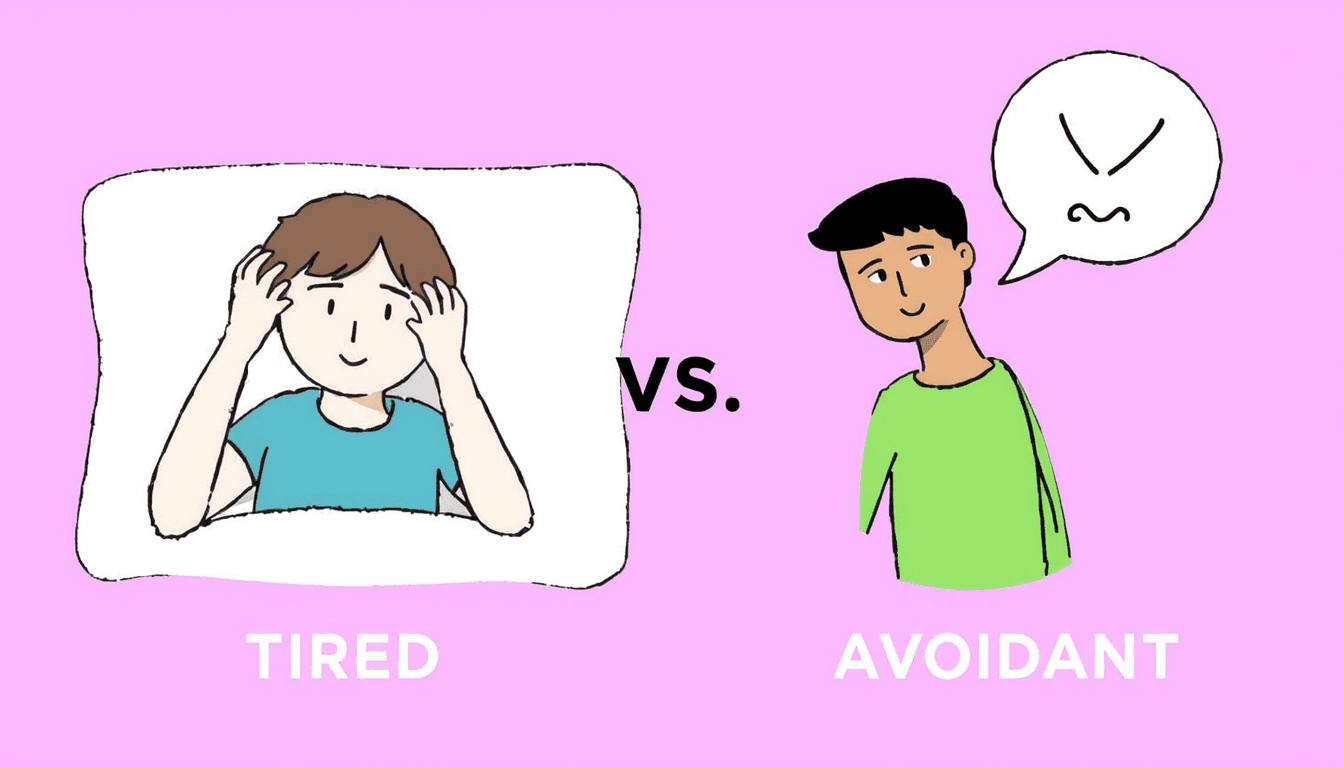
The Difference Between Being Tired and Being Avoidant
You’ve felt it—usually late afternoon, sometimes right before you sit down to write, pitch, or start. The brain says, “I’m too tired for this.” And it might be true.
But more often than we want to admit, you’re not tired.
You’re avoiding.
Most people treat both as “I should rest.” Sometimes rest is exactly the medicine. Other times, it’s anesthesia.
So let’s learn the difference—fast—so you can choose the right response.
The tell: what changes when you “only do a little”?
Try this tiny diagnostic. Promise yourself: you will not finish the task. You will only start for 3–5 minutes.
Now watch what happens.
When it’s tired
- Starting feels effortful, but not threatening.
- After a short warm-up, you feel more capable, even if slow.
- You can usually tell what you need: sleep, food, movement, hydration, silence.
When it’s avoidant
- Starting feels emotionally loaded—like you’re bracing.
- You can start small, but the relief you crave keeps pulling you away (doomscrolling, “research,” reorganizing).
- The task triggers thoughts like: “This has to be perfect,” “What if it’s bad,” “I’ll do it later when I feel ready.”
The body vs. the story
Here’s a clean way to map the experience.
Tired (body-forward)
- Heavy eyes, stale energy, dullness.
- Your attention is just… slower.
- The mind still wants to do the thing. It just can’t move quickly.
Avoidant (emotion-forward)
- Anxiety, dread, irritability, shame, or “sticky” procrastination.
- Your mind generates narratives that make the task feel unsafe.
- You want comfort more than completion.
The “switch” test: what happens if you lower the stakes?
Take the same 3–5 minutes and reduce the demand.
- For writing: one paragraph, no editing.
- For outreach: one short message draft.
- For planning: a rough bullet list, not a perfect calendar.
- For studying: one example solved, not an entire chapter learned.
If it’s tired
Reducing the stakes usually makes it easier to begin.
You may still be slow, but it’s workable.
If it’s avoidant
Lowering the stakes doesn’t dissolve the resistance.
It may even intensify it—because now there’s nowhere to hide behind “serious effort.”
The language you use is the clue
Listen to your internal phrasing. It’s rarely neutral.
Tired language
- “I need rest.”
- “I’m drained.”
- “I don’t have enough energy.”
- “I’ll do it after I recharge.”
Avoidant language
- “I need more information first.”
- “I’m not in the right mood.”
- “This isn’t the moment.”
- “I’ll start when I feel confident.”
What to do in each case (so you don’t accidentally reinforce the problem)
If it’s tired: restore, then act
Your goal is to match your recovery to your capacity.
- Take a real break: walk, water, food, nap, or even just staring at a wall.
- Then return with a “minimum viable start.”
- Let the first pass be imperfect on purpose.
If it’s avoidant: make it safer, smaller, and time-bound
Avoidance doesn’t need more willpower. It needs less threat.
- Use a timer: 5 minutes, then stop (you’re training safety).
- Remove the possibility of judgment: “draft uglier than you think you should.”
- Keep the next step visible: “open doc → write two sentences → close doc.”
A fast script you can use right now
Use this when you feel the “I’m too tired” argument appear.
- What do I need: energy or safety?
- If I’m tired: what’s the smallest restore I can do for 10 minutes?
- If I’m avoidant: what’s the smallest action that can’t go wrong in 5 minutes?
- I will do only that for 5 minutes, then reassess.
The real win: accurate diagnosis builds trust
Every time you correctly identify whether you’re tired or avoiding, you stop negotiating with your inner chaos.
You don’t argue with yourself.
You respond with precision.
Your next move (choose one)
If you want, do this immediately:
- If you feel drained: take a short reset, then do a 5-minute minimum task.
- If you feel dread/defensiveness: start a 5-minute “can’t fail” version and let it be small.
Practical takeaway
You’re not behind—you’re just running two different systems. Learn to tell them apart, and your productivity stops feeling like wrestling and starts feeling like steering.
If this resonates, see how to apply it to your own work with the interactive Dispatch agent.
Be first to like this dispatch