Previous · Part 1
The Death of Friction: Why Ideas Feel “Slightly Unreal” Now
Next · Part 3
When You Can’t Tell Who’s Thinking Anymore
This builds on Part 1: The Death of Friction: Why Ideas Feel “Slightly Unreal” Now
Continue with Part 3: When You Can’t Tell Who’s Thinking Anymore
You sit down to write something — a thought, an argument, a half-formed observation — and before you've finished the sentence, something interrupts it:
someone already said this better.
You don’t even have to check anymore.
You already know what you’ll find.
So you do it anyway.
You Google it. They did.
Not just once. A dozen times. Across different voices, different formats, different platforms. Clean. Complete. Finished.
The insight you were about to write already exists — sharper than yours, more structured than yours, already received by an audience.
You close the tab.
You close the document.
You hesitate.
This is the particular tension of the moment:
Not that we lack ideas —
but that every idea feels pre-owned.
The Premise We've Internalised
There’s a quiet belief underneath that hesitation.
That originality means first.
That the value of an idea is tied to whether it’s been said before.
That if it exists somewhere else, your version is unnecessary.
The internet didn’t create this belief.
It just made it visible.
Now you can see the overlap instantly. Your half-formed thought already exists in someone else’s finished version. The echo arrives before you even speak.
So instead of writing, you withdraw.
Not because you have nothing to say —
but because it feels like it no longer matters.
Originality Was Never What You Think
What you’re experiencing isn’t a failure of thinking.
It’s a collision with visibility.
Because the truth is:
Originality was never about newness in the way we imagine.
Very few ideas are truly without precedent. Almost everything is built on something that already exists — extended, reframed, recombined.
Originality is not about novelty. It's about alignment.
Ideas feel original when they meet a specific person, in a specific form, at the exact moment they’re ready to receive it.
What matters is not whether something has been said, but whether it has landed.
You’ve felt this yourself.
You read something and think:
I already knew this… but now I actually understand it.
That’s not new information.
That’s precise delivery.
The Combinatorial Engine
So what actually makes something feel original?
Diagram: Existing ideas, experiences, knowledge leads to Your specific lens; Your specific lens leads to Recombination; Recombination leads to Right moment, right audience; Right moment, right audience leads to Feels original.
Diagram: Existing ideas, experiences, knowledge leads to Your specific lens; Your specific lens leads to Recombination; Recombination leads to Right moment, right audience; Right moment, right audience leads to Feels original.
Nothing here starts from zero.
The difference is the lens.
Your experiences, your timing, your way of noticing things — these are not interchangeable. Even when the idea overlaps, the expression won’t be identical.
It can’t be.
Why Everything Sounds the Same Now
And yet — it still feels like everything is repeating.
That feeling isn’t imagined.
It has structure behind it.
Most people are drawing from the same sources — the same feeds, the same formats, the same circulating ideas. When inputs converge, outputs follow. What looks like a lack of originality is often a lack of diversity in what’s being absorbed.
So what you’re feeling isn’t that ideas are gone.
It’s that you can now see how many of them exist.
What Replaces the Myth
If pure originality isn’t the goal, then what is?
The Uncomfortable Truth
Here it is:
Someone probably has said something very close to what you want to say.
And it still doesn’t make your version irrelevant.
The value of an idea is not in its uniqueness, but in its arrival.
An idea that exists somewhere else, but hasn’t reached the person who needs it, effectively doesn’t exist for them.
Originality is not a property of the idea. It’s a property of the encounter.
This is the part that doesn’t scale.
The part that doesn’t repeat.
The same idea, delivered differently, lands differently.
A Different Question
So the question changes.
Not:
Has this been said before?
But:
Is this the most honest, precise version of this thought I can produce?
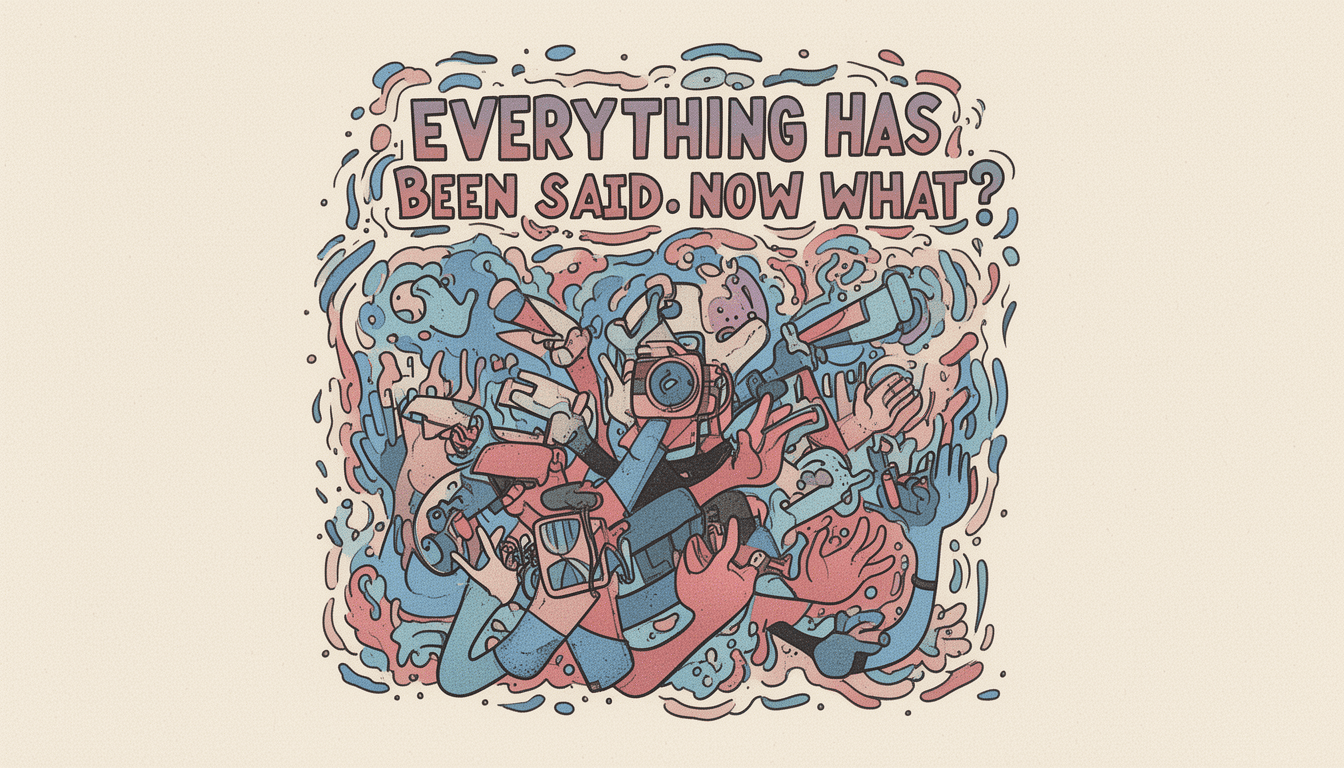
Everything has been said.
And somehow, it still hasn’t arrived where it needs to.
That’s where you come in.
What’s the idea you almost didn’t write because it felt like it already existed?
Write it in one sentence. Then ask: what do I see in this that others might have missed?
If this resonates, see how to apply it to your own work with the interactive Dispatch agent.
Be first to like this dispatch