Your outcomes aren’t missing—you’re misallocating attention, clarity, and decisions along the way.

Previous · Part 10
Better Judgement, Not More Input: The Filter Problem

Next · Part 12
Money Isn’t What You Think It Is
This builds on Part 10: Better Judgement, Not More Input: The Filter Problem
Continue with Part 12: Money Isn’t What You Think It Is
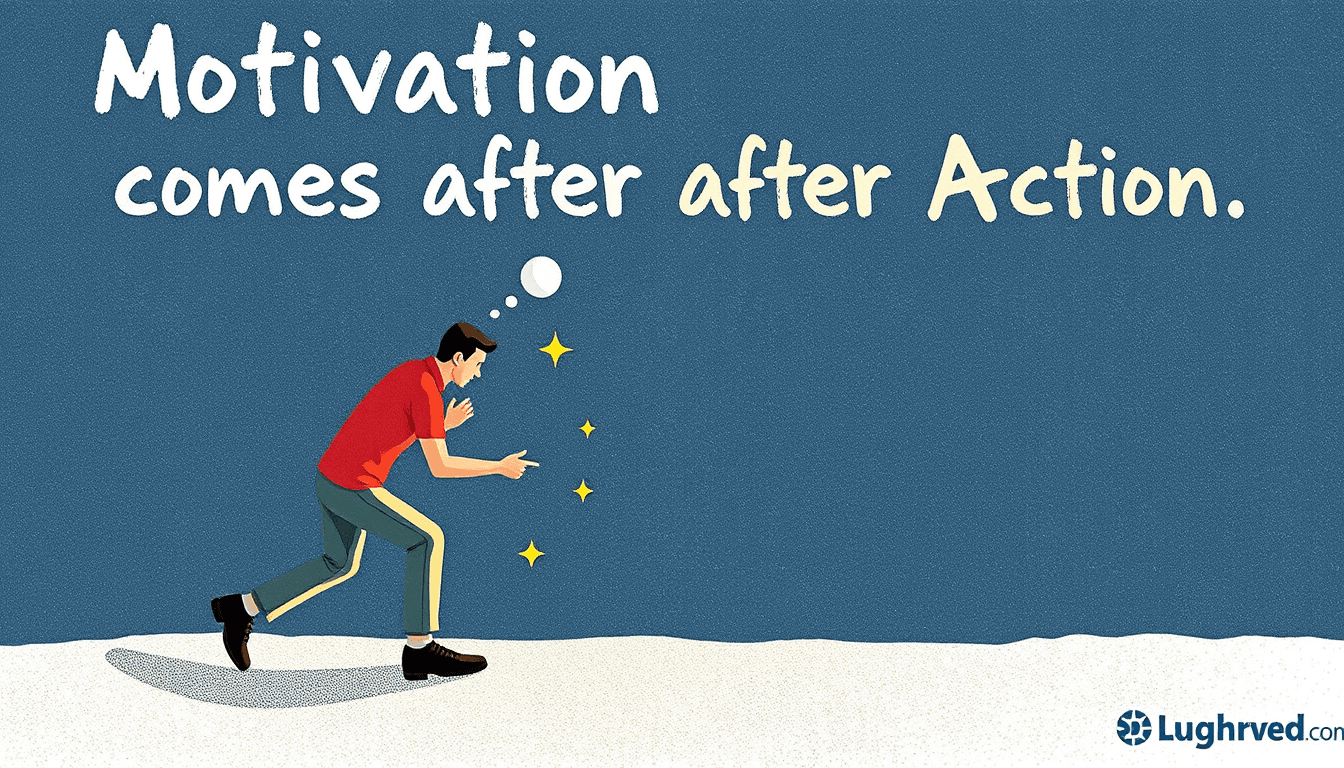
Motivation Is a Byproduct, Not a Starting Point
You don’t “find” motivation like it’s a hidden resource.
You produce it—by moving through small, deliberate acts that generate evidence your brain can trust.
When you wait to feel driven, you’re really waiting for certainty. And certainty doesn’t arrive first. It follows contact.
The trap: “I’ll start when I feel it.”
Feelings are useful—until they become gatekeepers.
Waiting to feel driven turns your life into a courtroom where your emotions must testify before you’re allowed to move. Spoiler: emotions don’t show up on schedule. And even when they do, they can vanish the moment the task becomes real.
So you end up stuck in a loop:
- You notice a goal.
- You feel resistance.
- You conclude you’re not ready.
- You wait.
- The resistance stays. The window closes.
What’s actually happening inside the loop
Your brain is doing risk management.
Starting implies uncertainty:
- What if you try and it’s worse than you hoped?
- What if you fail?
- What if you don’t have the right skills yet?
So your mind looks for a signal that reduces uncertainty. Motivation feels like that signal.
But motivation isn’t a prerequisite—it’s a response to momentum.
Action creates the feeling you’re waiting for
Here’s the counterintuitive shift:
You don’t need drive to begin. You need a starting point that produces drive.
Think of it like turning on a light.
You don’t stare at the switch waiting for “brightness.” You flip the switch. The brightness follows.
Action works the same way. Small actions:
- reduce ambiguity,
- prove to your brain you can begin,
- and make the task feel more doable in real time.
How to start without “feeling it”
This is where people get stuck—they try to find a perfect emotional setup.
Instead, design for motion-first.
Use the smallest possible commitment
Motivation often requires scale. But you can cheat the scale by starting smaller than you think you “should.”
The goal isn’t to complete the task.
The goal is to create a streak of trust: I can start even when I don’t feel like it.
Make the first win undeniable
Your first action should be easy enough that you can’t rationalize not doing it.
If the task is writing, the first win is not “a great paragraph.” The first win is “I typed something.”
If the task is working out, the first win is not “a workout I’m proud of.” The first win is “I put on my shoes and started.”
A useful mental model: evidence beats emotion
When you wait for motivation, you’re asking your emotions to create certainty.
When you act, you give your brain evidence:
- You showed up.
- You took a step.
- You moved the system forward.
Over time, emotion catches up to evidence.
This is why action often feels awkward at first—your nervous system is recalibrating. It’s not that you lack drive. It’s that your drive is being re-earned.
The “feel-driven” mindset also hides a deeper fear
Often, waiting for motivation isn’t about discipline. It’s about protection.
Starting means:
- visibility,
- possibility of being judged,
- confronting who you are when you stop pretending you’ll begin later.
So the psyche chooses delay because delay doesn’t risk exposure.
Action is brave not because it feels brave, but because it creates outcomes—then you can adapt. Delay creates nothing. It just preserves the fantasy of being “ready.”
Replace “When I feel driven…” with a working rule
Motivation doesn’t care about your intentions.
It cares about your pattern.
So create a rule that bypasses emotion and routes you directly into behavior.
When I want to start but don’t feel driven, I will do a 10-minute action version immediately.
I’m not aiming for “good.” I’m aiming for “begun.”
If I can continue after 10 minutes, I do. If not, I still win by completing the starter action.
Diagnose your current bottleneck (quickly)
Which version of waiting are you stuck in?
You delay because starting feels messy or pointless.
Pick the one that most resembles you. Then design the first 10 minutes to dissolve that specific obstacle.
The practice: a 7-day “evidence sprint”
You’re not trying to become a new person. You’re trying to teach your brain a new sequence: action → evidence → motivation.
Closing: stop auditioning for motivation
If you keep waiting to feel driven, you’ll keep experiencing what waiting always produces: more friction, more doubt, and less momentum.
Action doesn’t just move you forward.
It convinces you you’re the kind of person who can move forward.
And once that belief is earned, motivation stops being a mystery. It becomes a system output.
If this resonates, see how to apply it to your own work with the interactive Dispatch agent.
Be first to like this dispatch