Realism isn’t a look—it’s the consistent physics of causes across geometry, light, and camera capture.
Previous · Part 7
Exposure as Realism: Dynamic Range & Sensor Character for Images That Don’t Blink
Next · Part 9
Realistic Imperfection in AI Images: Motion Blur, Aberration, Haze & Bloom (Without Overdoing It)
This builds on Part 7: Exposure as Realism: Dynamic Range & Sensor Character for Images That Don’t Blink
Continue with Part 9: Realistic Imperfection in AI Images: Motion Blur, Aberration, Haze & Bloom (Without Overdoing It)
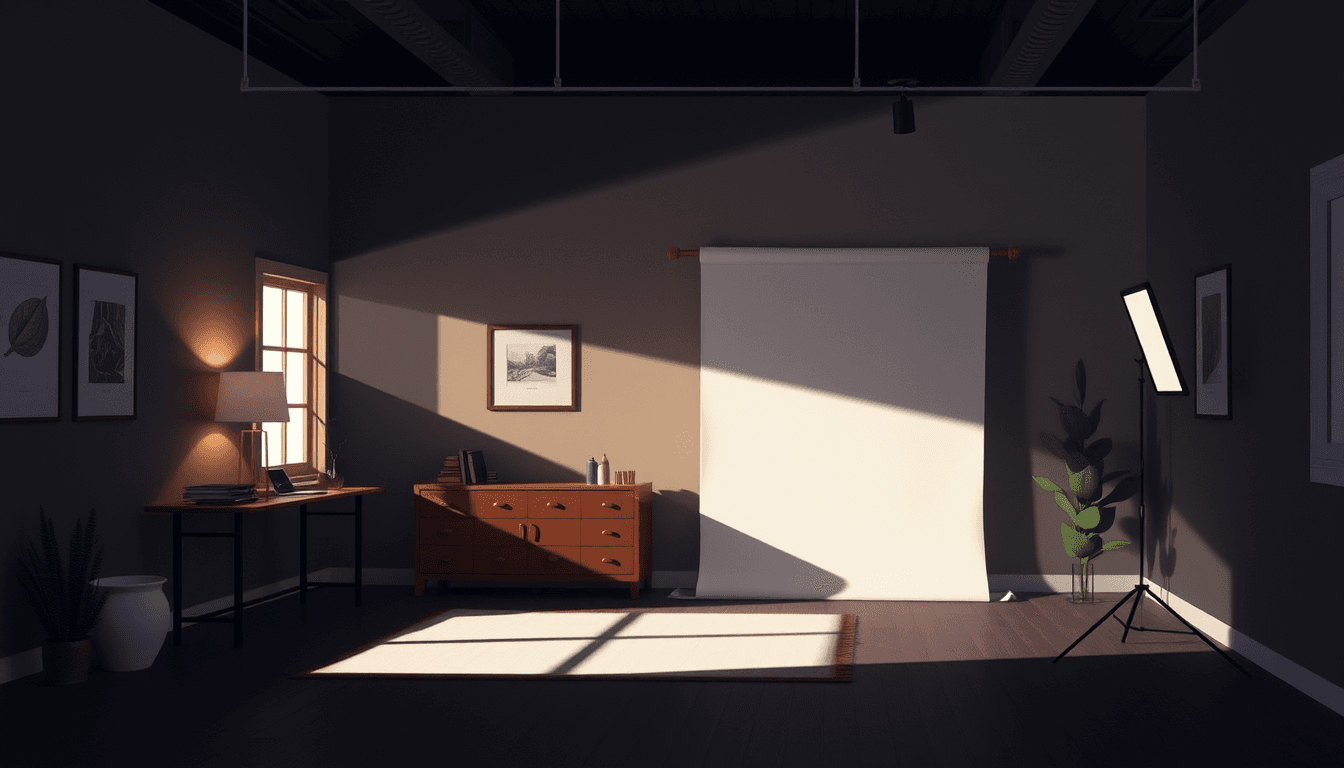
The difference between “pretty” and “photographic” is rarely the light source.
It’s the way light behaves after it leaves the source—how it falls off, where it hits, and what it does to materials.
In AI image prompting, that’s where believability is won. Not by adding “cinematic lighting” as a slogan. By specifying lighting geometry and surface response.
1) Prompting falloff: make distance, angle, and darkness agree
Most prompts treat lighting like a flat decal: “bright on the face, dark in the background.” Real light has depth. It dims with distance, and it changes intensity depending on incidence angle.
The two falloffs you must “make true”
- Intensity falloff (distance): closer surfaces are brighter; far ones recede.
- Occlusion falloff (space): light doesn’t just fade—it gets blocked, absorbed, and bounced unevenly.
You can prompt this without math by controlling relative brightness targets and where shadow transitions live.
Falloff cues that read as photographic
Try weaving these into your prompt:
- “inverse-square style falloff” (even if the model won’t calculate it literally, it tends to mimic the vibe)
- “distant background rolls off into shadow / deep ambient falloff”
- “shadow edge softens as it stretches” (a small but powerful realism cue)
- “lightest near the source, quickly dropping off away from it”
2) Prompting direction: control where the shadows “belong”
Directionality is what tells the brain: this object occupies a real world with a real light rig.
Unlock the full applied series
Get all 15 parts of The Physics of Better AI Images — 92 min read · 18,266 words across the full sequence.
Inside the series
Parts 1-4: Constraints make it real
Parts 5-9: Camera causes, not vibes
Parts 10-12: Surfaces, framing, and truth priority
Parts 13-14: Repair and recipe workflows
Part 15: Master Prompt Sheet
Realism isn’t a look—it’s the consistent physics of causes across geometry, light, and camera capture.
Membership gives access to subscriber dispatches and ongoing Pen & Muse tools. This paid series is sold separately.
If this resonates, see how to apply it to your own work with the interactive Dispatch agent.
Be first to like this dispatch