If your thinking is built on distortion, effort won’t fix it. This series gives you the models to see what’s actually going on.

Previous · Part 5
The Map Is Not the Territory: How Representations Distort Reality

Next · Part 7
The Hidden Mechanics of the Commons: How Incentives Deplete Shared Resources
This builds on Part 5: The Map Is Not the Territory: How Representations Distort Reality
Continue with Part 7: The Hidden Mechanics of the Commons: How Incentives Deplete Shared Resources
The invisible change that ruins “success”
A metric is a measurement of reality—at least, it’s supposed to be. But once you treat it as the goal, it stops being a window and becomes an instrument. People adjust their behavior to optimize the instrument, not the underlying reality.
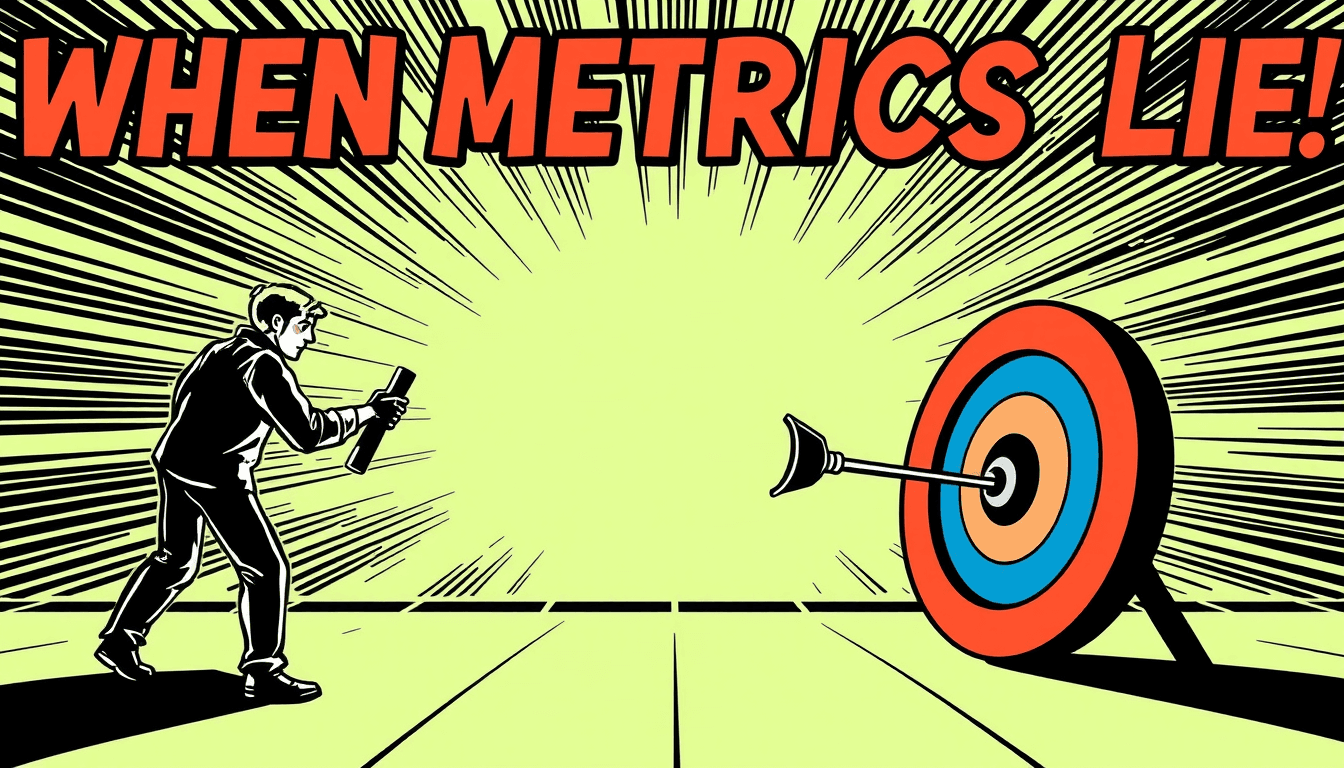
That’s Goodhart’s Law, in plain language: when a measure becomes a target, it ceases to be a good measure.
What actually breaks
The failure mode is rarely “people are bad.” It’s usually “the system is incomplete.”
When you introduce a single number as the target, you implicitly define success as whatever that number captures. Then you remove the incentives to care about everything else the number doesn’t capture.
So the metric becomes a game board, not a mirror.
The two common distortions
- Gaming the measurement
People learn loopholes: what to report, how to frame, what to delay, what to hide. - Narrowing the objective
The organization reallocates time toward whatever improves the number—even if it damages the true goal.
Why targets create perverse incentives
Metrics don’t just summarize performance. They change what decision-makers do, because they become the fastest feedback loop.
And when feedback becomes fast and legible, it crowds out slower, messier signals. Real progress often arrives indirectly—through trust, capability, learning, and compounding effort. But targets reward what’s immediate and measurable.
So the system optimizes toward short-term detectability.
A simple test: “Would I still want this if people optimized it?”
When you pick a metric, ask a sharper question than “is it correlated?”
Ask: If an intelligent team tried to maximize this number with zero shame, what would they do?
- Would they cut corners?
- Would they shift definitions?
- Would they change what gets measured (or who gets counted)?
- Would they prefer low-quality “easy wins” over high-quality “hard truths”?
If you can’t confidently predict the gaming vector, you’ve learned something important: the metric is not yet safe as a target.
The Goodhart trap in modern work (even without bad intentions)
You see it everywhere metrics go from “signal” to “score.”
- Customer success optimized for ticket closure rather than retention quality.
- Learning optimized for completion rather than understanding.
- Publishing optimized for output rather than craft and usefulness.
- Hiring optimized for time-to-fill rather than role fit and long-term performance.
The numbers get better.
The outcomes often don’t.
When it’s extra dangerous
Goodhart is most likely when:
- the metric is easy to influence,
- the measurement has ambiguity,
- the target is high-stakes,
- and alternative measures are ignored.
How to use metrics without becoming a metric-maximizer
The goal isn’t to ban measurement. It’s to design measurement so it remains a sensor, not a target.
Here are practical patterns that work in the real world.
1) Use metrics as guardrails, not prizes
Let the metric prevent disaster rather than induce obsession.
- “We must stay above X quality threshold.”
- “We must avoid Y failure mode.”
- “If this metric drops, we investigate.”
That framing keeps incentives aligned with outcomes while still leveraging measurement.
2) Pair every target with a counter-metric
If you only track what you want, you’ll get what you track.
Instead, track:
- the desired outcome,
- and at least one plausible harm indicator.
For example: optimize for “learning achieved,” and counterbalance with “time wasted,” “rework rate,” or “forgetting proxies.”
3) Rotate the target horizon
Short-term targets encourage short-term behavior. Long-term outcomes often require patience.
Rotate between:
- leading indicators (for early warning),
- and lagging indicators (for reality-check).
When both matter, gaming becomes harder. When gaming happens, the system self-corrects faster.
4) Keep definitions stable and measurement transparent
A moving target for people is usually bad. But a moving definition for a metric is worse.
- If the metric meaning can drift, teams will optimize the drift.
- If it’s opaque, teams will guess how to “score,” not how to improve.
Clarity reduces interpretation games.
Decision framework: do you need a metric-as-target at all?
Sometimes you don’t. You may only need a metric-as-feedback.
Should you turn this metric into a target?
- ✓You can’t reliably measure the true outcome directly
- ✓You have counter-metrics to catch harm
- ✓You can tolerate partial gaming and still learn
- ✗Use it as an early signal
- ✗Reward progress in the underlying capability
- ✗Treat it as something you manage, not something you “hit”
Steps to implement safely (starting this week)
The takeaway you can actually use
Goodhart’s Law isn’t a warning to stop measuring. It’s a reminder that measurement changes behavior. If you treat numbers as targets, you’re no longer observing performance—you’re co-authoring a new version of the game.
Use metrics to see, not to steer blindly. And when you must steer, build the steering wheel with brakes.
If this resonates, see how to apply it to your own work with the interactive Dispatch agent.
Be first to like this dispatch