Online success isn’t what you say—it’s how attention is earned, timed, and converted across moments.

Next · Part 2
The Scroll Is the Default State: Designing for Passive Engagement
Continue with Part 2: The Scroll Is the Default State: Designing for Passive Engagement
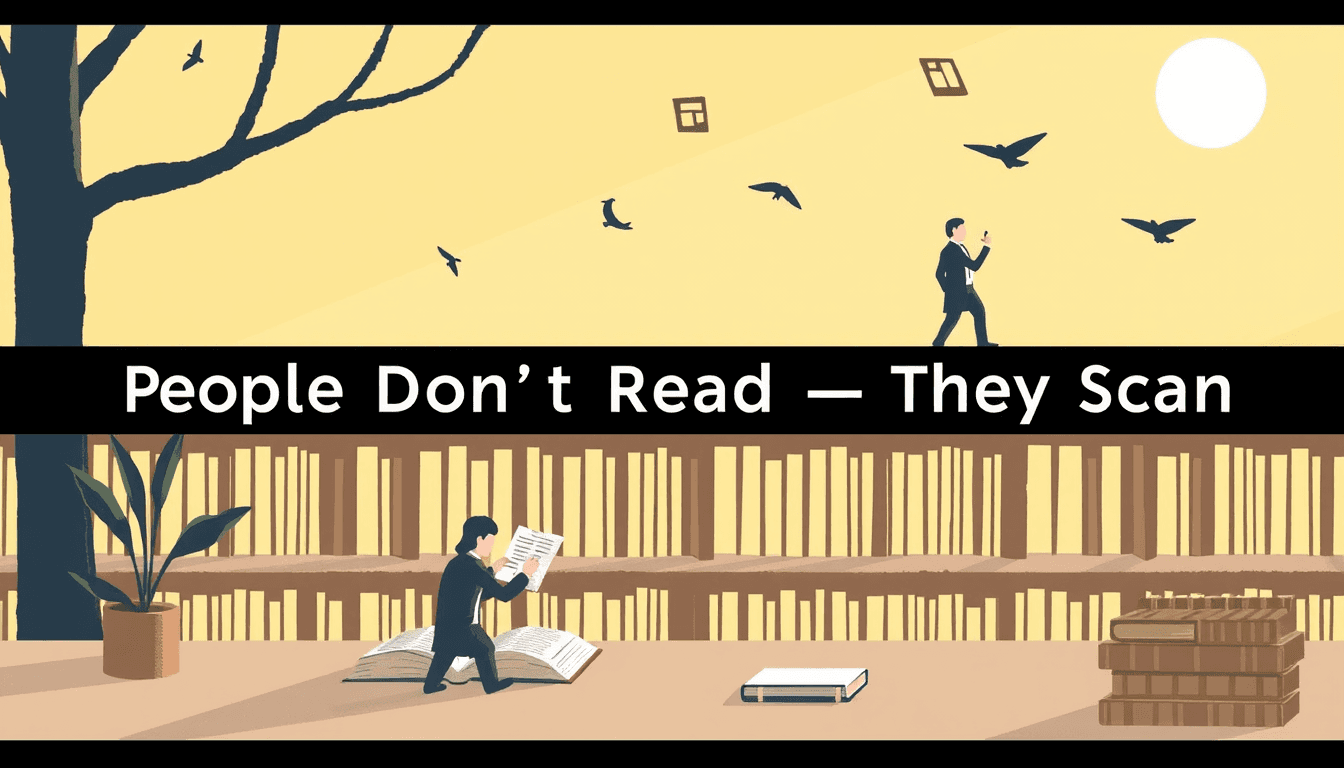
People don’t read. They scan.
On a screen, your reader isn’t “processing your work.” They’re searching for signals—fast.
They skim the surface for relevance. If your page doesn’t reward that search within seconds, your content doesn’t “fail”—it simply becomes background noise.
What “scanning” actually means
Scanning is an evidence-hunt. Readers move quickly through a page to answer three questions:
- Is this for me?
- Is it worth my time?
- What should I do next (if anything)?
If your structure doesn’t make those answers obvious, your reader has to work to find them. And on digital media, “work” equals “leave.”
The three layers of scanning
Think of a reader’s attention like a stack. They don’t start at the bottom.
1) The surface layer (seconds)
This is everything that can be understood without reading: layout, headings, typography, and visual rhythm.
Your job: make the page “legible at a glance.”
2) The meaning layer (moments)
If the surface layer passes, the reader looks for the gist. They skim for claims, structure, examples, and summaries.
Your job: make the message discoverable quickly.
3) The action layer (decisions)
Once a reader believes something is useful, they decide what to do with it: save, share, apply, click onward, or keep reading.
Your job: reduce friction between understanding and next steps.
A dispatch editor’s checklist for scan-ability
Use this as a diagnostic pass before publishing.
Why scanning changes your writing
When people scan, they don’t just absorb differently—they interpret differently.
- If your introduction is slow, they assume your value is slow.
- If your argument is buried, they treat it as optional.
- If your sections don’t signal their purpose, readers can’t trust the path.
Practical: reformat your ideas into scan-friendly blocks
Here’s how to turn one raw idea into something a skimmer can navigate instantly.
A simple pattern that respects scanning
If you want a stable structure for most digital formats, use this repeating cadence:
Test it (without overthinking)
Before you publish, run a “skimmer simulation.”
Read only:
- the headline
- the first sentence of the page
- each subheading
- the first line of each section
- the final paragraph
If you can’t accurately describe what the piece is saying from that alone, the page isn’t serving the reader you actually have.
Your takeaway—ship scan-native content
Which part of your content currently requires the most “effort to decode”—the intro, the headings, or the transitions?
Rewrite that part so a skimmer could predict the next idea within 3 seconds.
If this resonates, see how to apply it to your own work with the interactive Dispatch agent.
Be first to like this dispatch