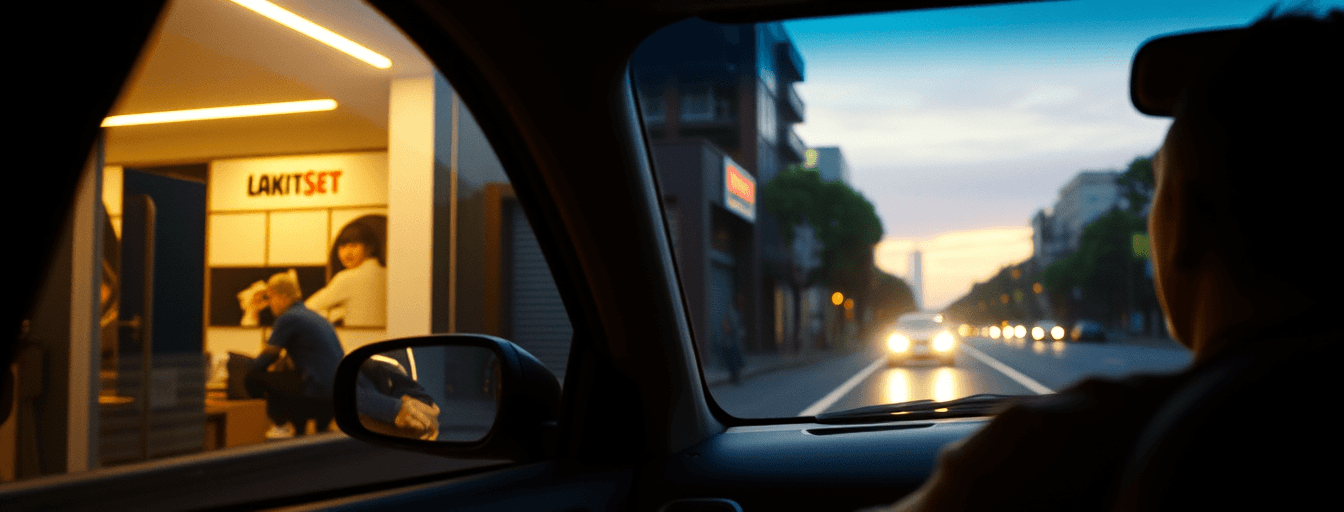
The afternoon light in North Harbour looked the same as it always had, but the way it landed on things didn’t. The new glass in shop windows caught it cleanly, like the town had scrubbed its own face. Ryan watched that catch of brightness from the driver’s seat as the car rolled slower than he expected, as if the route itself had been practiced.
Kelly sat beside him with her hands folded tight on her lap, knuckles pale under the skin. She’d said she wasn’t coming in the shopfronts with him today. She’d said it like it was mercy, like it kept her from being accused of something later. Still, every few minutes she leaned forward a fraction, peering at street corners and doorways in a way that felt less like curiosity and more like checking if the cameras were still there.
“You don’t have to talk to everyone,” she said, not looking at him. “Just… pick a few. People don’t like crowds when they’re already nervous.”
“I’m not a crowd,” Ryan said.
That earned him the smallest, bitter lift at the corner of her mouth. She finally looked at him then, and her eyes were tired in a way sleep couldn’t fix. “You’re not here by choice.”
He let the words sit. If he answered, the conversation would turn into the kind they’d been having since he came back—her warnings folded carefully around the same fear, his questions trying to slip through. He’d learned in prison that sometimes the best way to get a truth was to let silence do the pressure.
The route brought them past streets Ryan used to cross without thinking. He knew the dips in the pavement where water collected in winter. He knew which stairwell always smelled like fried onions and bleach. He knew where old men used to stand and pretend they weren’t looking at young women walking by. Now the dips had been filled and the smell had been replaced by something neutral and expensive.
When Ryan asked about the new paint, Kelly gave an answer that sounded rehearsed.
“It’s just maintenance,” she said. “A few families wanted to make things look better. That’s all.”
Maintenance. That word kept coming up in North Harbour the way salt kept coming up on fishing boats—always present, never questioned. Ryan didn’t believe in luck, and he didn’t believe in clean fronts without something behind them.
He asked to be taken to the harbour-adjacent neighbourhood first, the edges where people still walked their dogs without looking over their shoulders every two steps. Kelly’s approval for that part was quick, almost relieved.
“There are more older folks there,” she said. “They don’t—”
She stopped herself, swallowed, and tried again. “They don’t keep up with the new rules as much. They’re not as… careful.”
Careful meant watched. Careful meant rehearsed politeness. Careful meant a person’s mouth could be trained into smiles even when their eyes wanted to look away.
Ryan watched Kelly’s reflection in the car window as they pulled up beside a row of low houses with tired roofs. Some had shutters, real wood, not the fresh polymer the town had been installing near the waterfront. He thought he remembered one place being painted a bright sea-blue years ago. It was now a soft grey, as if the house had been told to lower its voice.

Kelly held out a small paper bag when he stepped out. “Just—take this with you.”
Inside were wrapped biscuits, the kind someone offered when they didn’t know how else to show warmth. He recognized the gesture. His mother had done it for years, back when she still believed that if she handed out little comforts she could buy safety.
“Who’s this for?” he asked.
“For Mara,” Kelly said. “She’s at number twelve. She’s… she’s the sort who remembers names. You’ll need that.”
Ryan nodded once and didn’t push. He didn’t want Mara to become a target before she’d even spoken to him.
When he knocked, the door opened after a delay, not because anyone had to look for the chain, but because someone had chosen how long to wait. Mara stood in the gap, small and wiry, hair pinned tight. Her face did something complicated the moment she saw him.
Recognition came first, sharp as a blade. Then the town’s version of politeness slid over it like a bandage.
“Ryan Kearney,” Mara said, as if naming him was a service she provided to those who demanded it.
“Mara,” he answered, using her name without thinking too hard. He could tell she appreciated the effort, even if she hated the reason.
He offered the bag. “Biscuits. I thought—”
“Come in,” she cut in quickly, then softened. “If you want.”
Her house smelled like old tea and damp cloth. The wallpaper near the window peeled in neat strips, the kind of failure the town had ignored when it decided repairs were optional. A crooked picture hung above the mantel. It looked like a holiday photo from years ago, the edges yellow with time.
Ryan took it in and let his eyes do the work his voice usually did. He had learned that people gave away more information when they were talking about their own clutter than when they were answering direct questions.
Mara poured tea without asking if he wanted it. Her hand didn’t tremble, but the pace of her movements had that careful rhythm—measured, controlled. He wondered how long she’d had to practice it.
Kelly remained in the hallway, just out of sight. She hovered close enough that Mara would know she was part of the same day’s arrangement, but far enough that she wouldn’t be blamed for what Ryan said.
Ryan didn’t start with the robbery. Not yet. He asked about the street.
“What happened to the boardwalk?” he said, glancing at a calendar nailed to the wall. The months were crowded with neat squares and notes. “It used to be a shortcut to the bait shop. It’s fenced now.”
Mara blinked. “Fenced,” she repeated, like she was checking a word in her mind. “Ah. That.”
She moved her teacup an inch closer, then farther, like she couldn’t decide what distance was safe.
“Just safety,” she said. “People got hurt out there.”
“People got hurt,” Ryan echoed. “Or somebody didn’t want anyone walking there.”
Mara’s eyes flicked toward the corner of the room. There was a small smoke detector with a tiny lens-like piece under it. New tech disguised as old necessity. Ryan recognized that disguise now.
“You always did notice things,” Mara said, and the praise in her tone sounded like warning. “You’re not wrong to ask. But you’re not the only one asking these days.”
“These days?” Ryan asked. “After I went away?”
Mara’s mouth tightened. “Your absence gave folks permission,” she said, and the words landed with weight. “When you were gone, it was like nobody had to pretend anymore. They could do what they’d wanted to do.”
That was the first time anyone said anything that clear. Not about guilt. About timing.
Ryan let a breath out slowly. “Who started doing it?”
Mara stared at the tea surface, watching it tremble. “The ones who used to stand at the edge,” she said. “They stepped forward. People who were always ‘tired’ suddenly had schedules full. Folks who used to borrow tools just… stopped needing them.”
Ryan’s mind moved along those sentences like a hand tracing a familiar wall. He thought about how North Harbour had rebuilt the waterfront while letting the side streets sag. He thought about which families had suddenly driven new cars into town, shining and loud.
“And the work?” Ryan asked. “Did it change?”
Mara’s expression shifted. For a moment, the rehearsed politeness slipped and the real fear showed through.
“Some work stopped,” she said. “Not because it was dangerous. Because it was too visible. After what happened, people didn’t want to be the kind of people who got remembered.”
Ryan didn’t say “the robbery.” He didn’t need to. Mara’s eyes didn’t ask for the word; they carried it already.
Ryan leaned forward a fraction. “Did anyone vanish?”
Mara’s shoulders lifted with a tiny shrug that wasn’t dismissal; it was resignation. “Vanished,” she echoed again, and this time the word sounded bitter. “You know what that means here. It doesn’t always mean moving to another town. Sometimes it means changing your face. Sometimes it means you don’t answer when someone calls your name, even when you can hear it.”
Kelly’s breath caught in the hallway. Ryan felt it more than heard it.
“Refusing to be seen talking,” Ryan said quietly, not as a question.
Mara looked at him fully then, and the recognition in her eyes turned into something darker. “You’re smarter than you think,” she said. “That’s why they don’t like you asking.”
Ryan took that in and kept his tone steady. “Who taught them to not like it?”
Mara flinched at the question itself, not the meaning. Like there were rules about how deep you could go in conversation with a returning prisoner.
She set her teacup down with care. “Maybe it was the people in charge of the new jobs,” she said. “Maybe it was the ones who didn’t want you back in the room, because you might remember what the town tried to forget.”
Ryan pictured Mick Donnelly and Terry Mullen standing in the neat surface of their positions, smiling shallowly at him like he was a nuisance. He pictured Paul Barrett’s polished hands, his calm suggestions disguised as help.
He couldn’t force answers from them. Not by asking. They thrived on the idea that he’d be the one who violated manners first, the one who “made trouble.”
So he let Mara’s story sit and used it like a map.
“Do you remember anyone who used to be around the crew?” he asked. “Not the main men. People near them. People who worked in the background.”
Mara’s gaze drifted toward the peeling wallpaper, toward the crooked picture. Old memories were hard to tidy.
“There was a man who delivered things,” she said slowly. “He had a laugh you could hear from the street. That laugh stopped around the time you went away. At first we thought he was ill. Then we realized he wasn’t sick. He just didn’t show up. Not at the shops. Not at the docks. Not even when someone bumped into him. He’d stand there and look through you like you were furniture.”
Ryan wrote nothing down, but his mind kept a running list. In North Harbour, deliberate forgetting was a kind of construction.
“Did you see him relocate?” he asked.
“No,” Mara said. “That’s what I mean. He didn’t move. He erased himself in place.”
Ryan let his shoulders loosen a touch, though nothing in him felt relaxed. “Thank you,” he said simply, and for once the gratitude wasn’t a performance. He meant it.
Mara watched him for a moment longer, as if deciding whether kindness was safe. Then she said, almost under her breath, “You’ve got a fire in you. That’s what gets people hurt.”
Ryan met her gaze. “I’m not trying to burn the town down,” he said. “I’m trying to understand who changed the locks while I was gone.”
Mara’s lips pressed together. “Then understand this,” she replied. “You were never only locked away from them. You were locked away from their choices. When you came back, it wasn’t just your life that had to restart. It was theirs.”
When he stepped back outside, the air felt colder. Kelly had followed him to the steps, close enough to catch his words if they turned sharp.
“You got enough?” she asked.
“I got a pattern,” Ryan said. “Not names yet.”
Kelly swallowed. She rubbed her thumb over the seam of her jacket like she was trying to erase tension from her skin.
“Mara talks too much when she’s upset,” Kelly said.
“Is she upset about my return?” Ryan asked.
Kelly hesitated. That hesitation held the answer.
“She’s upset about what happened,” Kelly said finally. “About what people did with the quiet. She’s not thinking about you.”
Ryan looked past her at the street, at the way curtains shifted behind glass. He remembered the first day he’d come home, the camera above the door, the sense that his movements were being logged not for safety but for compliance.
His absence had been used like a blank page. Then other people had filled it with their own handwriting.
He needed more than one anecdote. He needed connections. But he also needed to move before the town decided which version of him it could tolerate.
They visited two more houses. At each one, Ryan asked small questions about ordinary routines: when deliveries started arriving on different days, when the local shop clerk stopped making eye contact, when someone’s car was replaced with another model that looked more expensive but less used. He didn’t demand confessions; he listened to people describe their small changes as if the changes were weather, something that happened to you.
That was how North Harbour worked. It treated consequences like tides. If something shifted in your life, you were supposed to accept it as fate, not design.
By late afternoon, Ryan’s mind was crowded with moments that didn’t agree with one another. A woman who swore she’d never seen certain men at the pier after his arrest. A man who said he’d seen them every week but never speaking, never stopping, never letting the conversation land. A pair of neighbors who insisted they’d moved only because their lease ended, even though the moving truck parked behind their house for one hour and then disappeared before nightfall.
Ryan noticed a detail in his own body as he collected those fragments. Each time someone described avoiding him after the robbery had been known publicly, his chest tightened. It wasn’t anger exactly. It was something closer to grief, because grief came when a person’s absence revealed itself as a choice made long before they disappeared.
Kelly kept close but silent most of the time. When Ryan asked her a question on the way to the car, her answers were short, and her eyes flicked toward the rearview mirror.
“Who’s watching?” he asked.
Kelly’s mouth twitched. “Everyone,” she said, then immediately changed course. “No. Not everyone. The ones who have to. That’s what the town does now. It doesn’t just watch. It teaches you to watch yourself.”
Her words made him think about Sheila, the way his mother had smiled too brightly in recent days. Her warmth had always sounded like she was trying to make him safe. Now Ryan wondered if the warmth was also a leash, a way to keep him from saying the things that would break someone else’s staged version of calm.
When they returned to the Kearney house, Sheila was waiting in the doorway like she’d been positioned there on purpose. Her apron hung neatly on her waist. Her hair was pinned in the same shape as always. Even her expression had that practiced steadiness, as if she could hold the room together by keeping her face from moving too much.
“Did you see anyone?” she asked. Her voice carried the lightness of a greeting meant to hide tension.
“A few people,” Ryan said.
Sheila stepped back to let him in, but her eyes went straight to his hands. She watched for the bag of biscuits, the impression of items offered and taken.
“You shouldn’t stay out long,” she said. “Not with the way things are.”
Kelly’s posture stiffened. Ryan caught it. Sheila’s words were not about weather or safety. They were about boundaries that felt like rules in a game.
Ryan turned his attention away from Sheila’s face and toward the hallway. There were no new objects, but the air felt different. The house seemed to have been rearranged emotionally, not physically.
Then Sheila spoke again, and her voice dropped just enough to make the sentence private even though it wasn’t.
“Someone called today,” she said. “They wanted to know if you’re behaving.”
Ryan didn’t ask who. He didn’t need the name. Names in North Harbour came with consequences.
“And are they satisfied?” he asked.
Sheila’s lips tightened. “Don’t,” she whispered. “Not like that.”
Kelly let out a quiet breath, almost a laugh with no humour. “You’re not going to win,” she said, and her voice was tired now, not just cautious.
Ryan watched his mother’s hands. She smoothed the fabric of her apron twice, then stopped as if she’d remembered she was doing it.
“I’m not trying to win,” Ryan said. “I’m trying to find what was taken. And what was changed while I was gone.”
Sheila’s eyes glistened, but she didn’t let tears fall. Tears were for places without cameras.
“Your father would be ashamed,” she said, and the sentence arrived like a slap disguised as loyalty.
That word—ashamed—was the first honest emotion Sheila had offered in years. It didn’t come from concern for Ryan’s safety. It came from shame over what their family had become in the gap he’d left behind.
Ryan felt it settle in him. He didn’t know how to argue with shame that had taken root so deeply.
Instead, he asked a gentler question.
“Who told you to keep me out of conversations?” he said. “Who taught you to smile and call it kindness?”
Sheila’s face tightened further, and her gaze moved toward the living room where a cable ran along the baseboard, newly installed. She hadn’t noticed it today. She’d noticed it long ago and pretended she hadn’t.
Kelly stepped between them before Sheila could answer.
“Please,” Kelly said to Ryan. “You can’t push her. You’ll only make it worse.”
“Worse how?” Ryan asked, and his voice held steady because he’d learned how to keep control when anger wanted to take the wheel. “Worse than she already feels?”
Kelly’s throat bobbed. She looked at her mother, then back to Ryan. There was something new in her eyes, something like a decision.
“You want to know what your prison time cost people?” Kelly asked.
Ryan stared at her. “I do.”
She shook her head once, slow. “Then listen. Not to their excuses. To mine.”
Sheila flinched at that, but she didn’t interrupt. Maybe she couldn’t. Maybe the town’s rehearsed script had reached the limit of what it could contain.
Kelly’s hands curled together. She looked down at the skin between her fingers as if she needed something tangible to hold.
“When you got taken,” she began, “things slowed down. We told ourselves it would be a while, that you’d get through it, that we could survive. But then the weeks turned into seasons and people started behaving like the story was already finished.”
Ryan listened. He didn’t interrupt. He let her words come at their pace, because pace was part of the truth—when someone slowed down, it meant they were choosing what not to say.
“Some people stopped coming by,” Kelly continued. “Not because they didn’t care. Because it felt safer to be distant. They acted like you were a stain, not a person. They didn’t want to be seen near us in case it made them look connected.”
She squeezed her fingers once. “And the ones who did come… they didn’t come to talk. They came to confirm we were still in line.”
Ryan felt something tighten behind his ribs. “Confirm what?” he asked.
Kelly’s eyes lifted. “That we’d learned,” she said. “That we’d stop asking. That we’d stop looking.”
Sheila made a small sound, half protest, half surrender. Her face crumpled for a second, then smoothed again. The smoothing was automatic, like a reflex trained by fear.
Kelly continued, voice steadying as she went. “You think they waited eight years for a trial verdict. They didn’t. They waited eight years for you to stop being a problem. They used your sentence like a tool. Not to punish you. To give themselves room.”
Ryan took a step closer, careful not to crowd her. “Room for what?”
Kelly’s mouth twitched, not quite a smile. “Room for spending like money didn’t have a shadow,” she said. “Room for jobs that weren’t loud. Room for friendships that didn’t require explanations.”
“And us?” Ryan asked.
Kelly glanced at Sheila, and the glance carried years of awkwardness and unsaid resentment. “We became an inconvenience,” she said. “Not a priority. We existed in the background so they could say they’d been kind to the family of the man who—”
She stopped herself again. Her breath came faster, and Ryan could see her deciding whether saying the next word would tear something open.
She landed on a safer sentence. “So they could say they’d done the right thing. Without ever being held to the truth.”
Ryan looked at Sheila then. His mother’s eyes were wet now, but she still didn’t let tears run.
“Why did you play along?” he asked her, and the question was softer than his earlier ones. “Because you were scared? Or because part of you wanted the story to stop?”
Sheila stared at the floor. “Because it did stop,” she said in a voice that barely carried. “It stopped being dangerous for a moment. That’s what you don’t understand, Ryan. When the town started acting like you were finished, I could sleep. I could breathe. I could pretend the days weren’t full of dread.”
She lifted her gaze and there was fury in it now, aimed at herself first and then at everyone else. “And then you came back. And I realized what I’d been doing.”
Ryan waited.
Sheila swallowed hard. “I’d been learning the town’s new script,” she admitted. “Learning how to perform normal so no one would notice how wrong it was.”
Kelly’s shoulders sagged, as if the confession had moved something heavy off her back.
“That’s why they’re nervous about you asking,” Kelly said. “Because you’re not just asking about money. You’re asking about the gap they filled with their own version of events.”
Ryan’s mind ran forward to the next complication, the one he could already feel approaching. If the town had taught people to perform prosperity, then their stability depended on him staying unsettled—staying busy with questions that led nowhere, staying distracted by the idea that a wrong robbery could be solved like a missing item.
Instead of letting the town steer him into dead ends, he decided to corner one of their control points—bluntly, before they could wrap it in politeness.
He asked to see paperwork next, the kind Terry Mullen used as a leash. Sheila’s face tightened immediately. Kelly’s eyes narrowed, but she didn’t stop him. Her silence was permission dressed up as fear.
They didn’t leave the house right away. Ryan needed to cool his impatience into something usable. While Sheila gathered keys with hands that shook only slightly, Ryan stepped to the window and watched the street.
Two houses down, a man sat on his porch with a fishing rod across his knees. He stared out at the water like it was a habit he’d learned for company. As soon as Ryan pulled into view, the man shifted the rod angle, blocking his face from the line of sight to the road. It wasn’t a big gesture. It was just enough to say, I saw you and I don’t want you to see me.
Ryan turned away, and the shift in his stomach told him the day was doing what he’d hoped: showing him that the same streets were holding different people now. The absence had redistributed ownership, not just money. It had changed who felt entitled to look you in the eye.
When they reached the marina-adjacent office, the clerk behind the desk smiled the way Mara had offered tea—warm until you leaned on it too hard. A notice board behind him displayed community updates in clean fonts, as if the town needed to remind itself that order was ongoing.
Ryan didn’t ask for long. He asked for Terry Mullen directly.
The clerk’s smile didn’t break, but his eyes flicked toward a hallway door. He tapped his keyboard, then said, “Mr. Mullen is busy today.”
Ryan waited for the rest of the sentence, the coded part that would suggest an appointment time, a later opportunity, a polite obstacle.
Instead, he got a different offer. “He asked me to pass along a message,” the clerk said. “He said you’re free to work, but you’re not free to cause issues.”
Ryan’s jaw tightened.
Kelly’s hand landed lightly on his arm. She didn’t plead. She warned. Don’t make it worse. She couldn’t say it aloud because the walls were too thin.
Ryan leaned over the desk, close enough that his voice would carry only to the clerk.
“Tell him I came back exactly for issues,” Ryan said. “I didn’t come back for permission.”
The clerk blinked at him, then the smile returned with greater force. “I’ll be sure to—”
Before the clerk could finish, the hallway door opened and Terry Mullen stepped out, sleeves rolled precisely, hair combed in that neat way that made him look like he’d been built for office work rather than the salty air outside.
He didn’t look surprised. He looked relieved, like the confrontation had been scheduled and he was on time.
“Ryan,” Terry said. “Welcome home.”
Welcome home, as if home was a destination and not a punishment you served yourself.
Ryan held his gaze. “You’ve been busy,” he replied.
Terry gestured toward a chair opposite the desk. “Let’s not turn this into a scene,” he said. “Sit. Have a proper talk.”
Ryan sat, because standing would have looked like temper and temper was what North Harbour punished.
Terry leaned forward, voice calm. “You need to understand something,” he said. “This town didn’t break because you went away. The town adjusted. People put their heads down and did what they had to do.”
Ryan listened to the structure of the sentence. It was a fence. It was a boundary built from phrases designed to sound reasonable.
“So you’re saying my absence made things better,” Ryan said.
Terry’s smile flickered. “No,” he said quickly, and the speed of the correction told Ryan the truth had a sharp edge. “I’m saying the town protected itself.”
“Protected from what?” Ryan asked.
Terry’s eyes narrowed slightly. “Protected from you,” he said, blunt now. “Protected from the kind of attention you attract when you start asking questions that no longer belong to the public.”
Ryan felt the air leave his lungs. He didn’t show it.
“Questions don’t belong to the public?” he repeated. “Is that the rule you live by, Terry?”
Terry exhaled as if he’d grown tired of arguing with someone who didn’t respect social order. “The robbery happened. It’s over. People moved on. You can’t treat every change in this town like it’s connected to you.”
Ryan leaned back in the chair, careful not to look aggressive. “I don’t have to treat it like it’s connected to me,” he said. “I just have to notice what changed while I was gone.”
Terry’s gaze dropped for a moment to Ryan’s hands, then returned. “You’ve been out talking to people,” he said.
Ryan let a slow smile form. It wasn’t friendly. “So you noticed.”
Terry’s expression tightened. “People talk,” he said. “And then they regret it.”
He tried to sound like a threat disguised as concern, but the timing made it clear: he was trying to warn Ryan before Ryan made it worse for the town.
Ryan sat forward again. “Let’s talk about regrets,” he said. “Where did my share go?”
Terry didn’t blink. He reached behind him and pulled a folder from a shelf. The folder was labeled with neat handwriting, the kind of neat that came from control rather than accuracy.
He placed it on the desk between them without opening it. “Your share was handled,” he said. “As required.”
Ryan didn’t touch the folder. “As required by whom?”
Terry’s lips pressed together. “By the process.”
Ryan felt the trap in the language. Terry wanted this to be about rules, about forms, about paperwork that could be used to drown Ryan in waiting rooms.
“Process doesn’t build new cars,” Ryan said. “Process doesn’t paint over the kind of fear that makes people stop meeting your eyes.”
Terry’s patience finally thinned. “You want blunt?” he asked, and his voice was still quiet but harder now. “Here’s blunt. You don’t get to come back and pull on threads that will unravel other people’s lives. You’re one man. North Harbour isn’t a puzzle for you to solve.”
Ryan stared at him. “Then why does it feel like my life is the lever everyone keeps stepping on?” he asked.
Kelly’s breath was visible now through her controlled stillness. Sheila, sitting in the waiting room, couldn’t be seen but her presence pressed on Ryan’s back like an invisible hand.
Terry’s eyes shifted toward the door, and Ryan followed the glance. A small camera lens sat high in the corner, its black dot staring without blinking.
Terry’s voice turned slightly warmer, the way a person speaks when they want to keep their own record clean. “You’re being monitored,” he said, like he was doing Ryan a favour. “Not because we want to hurt you. Because you need boundaries. Because you might say something you can’t take back.”
Ryan’s throat tightened. He had expected the town to watch. He hadn’t expected Terry to call it out so openly.
Ryan stood up slowly. “That’s the setback,” he said, and his tone stayed steady on purpose. “Your boundaries are the problem.”
Terry rose too, matching his movement. “You’re not going to intimidate me,” he said.
Ryan met his gaze. “I’m not trying to intimidate you,” he replied. “I’m trying to make you answer while you still think you control the room.”
For a moment Terry looked like he might explode—like he’d reached his own limit. Then he smoothed himself back into place. North Harbour had trained men like Terry to recover fast.
“Come back when you’re calmer,” Terry said. “There’s a process. There’s always a process.”
Ryan’s hands curled at his sides. He could feel the frustration pushing up from his ribs, but he refused to let it turn him into the kind of person the town wanted: loud, careless, easy to blame.
Instead, he picked up the folder without opening it. He held it for a second, then slid it off to the side, out of the immediate center of the desk like it was just another piece of furniture.
“You can keep the folder,” he said. “What I need is what you won’t put in writing.”
Terry’s face went still. That stillness was new. It meant Ryan had reached the line where the town’s performance stopped being comfortable.
Kelly moved closer to Ryan when they left the office. She didn’t ask if he was okay. She asked something else, something more practical and more dangerous.
“What did he do?” she whispered.
Ryan looked at her. “He reminded me,” he said. “The town doesn’t just want me quiet. It wants me predictable.”
Kelly’s eyes flicked to the camera again, then away quickly. “Then don’t be predictable,” she said.
Ryan turned his face toward the harbour-adjacent road, toward the edges where neat surfaces gave up.
“We’re going to find the old ground,” he decided aloud.
Kelly’s shoulders tightened. “You said you were looking for a place,” she replied, cautious. “Not for trouble.”
Ryan didn’t argue. He had learned that tension turned into anger when you pushed too hard. Today he needed momentum.
He nodded once toward the direction of the abandoned industrial strip, the one he’d seen from afar when he arrived—fence lines that didn’t match the tidy routes, structures that still looked like they belonged to a different North Harbour.
“Trouble lives there,” he said. “That means truth might too.”
Kelly stared at him as if she wanted to tell him that hope was dangerous. Then she did something that surprised him: she didn’t stop him. She turned the car around and drove toward the place where cameras seemed to forget their own job.
As they traveled, Ryan watched the buildings thin out. The neat paint faded into older materials, salt-stained and rough. The air smelled different—less like disinfected surfaces and more like water and rust and time.
He remembered what he’d heard in the town’s polite conversations: that there was nothing worth seeing beyond the fenced areas. That the past had been cleaned up. That the town had moved on.
Yet the closer they came, the more the story fell apart. He saw weeds growing through cracks where new pavement had been avoided. He saw a sign with letters so faded they looked like they’d been trying to disappear. He saw a gate half-hung on its hinges, not maintained, not replaced, not sanitized for anyone’s comfort.
Kelly parked where the road bent, far enough that she could pretend they were just visiting the shoreline.
They walked the remaining distance on foot. Ryan felt the shift in his mind the moment the fence line appeared. This wasn’t just an abandoned site. It was a refusal. Someone had chosen not to fix it, not to repaint it, not to turn it into a safe story.
The wind moved through the broken slats of a shed roof. Salt clung to everything. The place looked stripped down to what couldn’t be edited out: beams, boards, shadows. No curated display. No official signage. No polite reminder that the town was watching you.
In the distance, water slapped against pilings that had held long before the new prosperity arrived. Ryan stepped closer and saw the stains on the wood, the marks that time had made in slow motion.
“This place wasn’t on your routes before,” he said, more to himself than to Kelly.
“It was,” Kelly replied, voice quiet. “But you didn’t look at it the way you look now. You were always… you were always trying to get to the next safe thing.”
Ryan ran his fingers along a splintered edge without tearing the skin. He wasn’t sure why he needed to touch it. Maybe it was a way to remind his body that some truths didn’t require permission.
He stood by a collapsed wall and stared at the damp plaster. Mildew had grown there like slow handwriting, spelling out the fact that neglect existed even when other parts of North Harbour had decided not to admit it.
North Harbour’s sterile legitimacy around him felt like a cover laid over the same old ground. It wasn’t that the town had become new. It was that the town had learned to hide what didn’t match the version it wanted to sell.
He turned slightly, scanning the site. There were no obvious documents, no obvious stash, no neat clue waiting like a reward for persistence. But that lack of neat answers didn’t disappoint him. It felt right, almost honest. If the town had rebuilt itself through performance, then the only place that contradicted that performance would be the one it couldn’t be bothered to sanitize.
Kelly stepped closer beside him. She kept her eyes on the broken beams, but her voice came out softer than it had all day.
“Sheila can’t stop doing the performance,” she said. “It’s her way to survive. I used to think it was just because she loved you. I think now it’s also because she’s afraid of being confirmed.”
Ryan glanced at her. “Confirmed?”
Kelly nodded, once, quick. “Confirmed that the old crew didn’t keep its distance out of respect. Confirmed that it kept its distance because it didn’t want your family pulled into what they were doing next.”
Ryan let the words settle. Mara’s tea, the porch man blocking his face, Terry’s calm threats—all of it connected. Not as a single solution. As a network of choices.
He had returned to find money. He had ended up learning that his absence had been used to rearrange lives. People had stepped into new standing because the person who might challenge their story was out of reach. And the people closest to the story—his mother, his sister—had learned to speak in careful tones so they could keep breathing within the town’s boundaries.
Ryan looked back toward the main road, imagining it tidy and watched. Then he looked at the damp, unfinished site and felt something steady in him: contradiction. The town could not make this place into anything polite. It could not make mildew into legitimacy.
He knew now the plan he’d been forming since his return wasn’t sufficient. He had wanted direct answers. He had wanted to force men like Terry to explain themselves. But North Harbour didn’t function through explanations. It functioned through pressure and delay, through social scripts and controlled conversations.
So his next move would not be another demand. It would be gathering enough emotional and social residue to make the town’s story impossible to hold.
In the silence of the decaying building, Ryan felt the setback sharpen into direction. Terry had shown him the line: if he tried to pull hard, the town would tighten the net and frame him as the problem. He needed to move differently, to keep tension grounded in people and memory rather than chasing procedure.
He turned to Kelly. “Tell me everything you remember about the day after the robbery,” he said. “Not details. Feelings. Who avoided whom. Who suddenly got busy. Who stopped answering.”
Kelly’s eyes flicked toward the direction of home. For a moment, fear was visible in her whole posture, like her body expected someone to step out from behind a beam and stop her.
Then she nodded.
“You’re going to ask for more than the town can give,” she said.
Ryan breathed in the damp air and tasted rust on the back of his tongue. “I’m going to ask for what the town can’t erase,” he replied. “The part where my absence helped them become someone else.”
He didn’t know yet how to force the town into speaking truth. But standing beside what hadn’t been cleaned up, he understood what “truth” would look like here: not paperwork, not confessions. Patterns. Contradictions that showed up in how people spent, where they refused to be seen, which faces turned away.
North Harbour would always try to keep its neat surface intact. That was the point of the cameras and the rehearsed smiles and the polite refusals. But old ground didn’t care about their script.
And once Ryan could feel the distance between the town’s performance and the residue beneath it, the questions stopped being just questions. They became a map toward who had benefited, who had chosen avoidance, and who would eventually run out of clean lines to hide behind.
If this resonates, see how to apply it to your own work with the interactive Dispatch agent.
Be first to like this dispatch