True synthesis is not an innate talent, but a rigorous, daily infrastructure of observation and connection.

Previous · Part 2
The Way In: Goethe's Science of Participation
Next · Part 4
The Machine That Never Was — Ada Lovelace and the Art of Imagining What Doesn't Exist
This builds on Part 2: The Way In: Goethe's Science of Participation
Continue with Part 4: The Machine That Never Was — Ada Lovelace and the Art of Imagining What Doesn't Exist
There's a view from above Alexandria — the kind you'd get from a kite-mounted camera in the 1890s, or a satellite pass today — that makes the city look like a diagram. The streets of the ancient grid still whisper through the modern layout. The harbour arm reaches into the Mediterranean like a compass line. The Serapeum hill rises toward the south. Every feature seems placed, as though someone drew the city first and then built it.
That feeling isn't nostalgia. It's the residual footprint of a culture that genuinely believed knowledge was one thing — and built their cities, their temples, and their minds accordingly.
This is the story of that integration, and of the woman who became its last great expression.
The City as Knowledge Machine
Alexandria in the fourth century CE was already ancient, already declining, and still the most extraordinary intellectual ecosystem on Earth.
The Mouseion — the institution that gave us the word "museum" — wasn't a collection of dead things behind glass. It was a living research campus. Scholars lived there. They ate together. The geometer argued with the poet over dinner; the physician studied the same texts as the theologian. The library, whatever remained of it by Hypatia's time, wasn't organised by discipline the way we'd shelve a modern bookstore. It was organised by problem.
This wasn't confusion. It was a working epistemology — a way of knowing that treated the universe as a single coherent text written in multiple languages. Geometry was one dialect. Number theory another. Astronomical observation a third. But they were all translations of the same underlying structure.
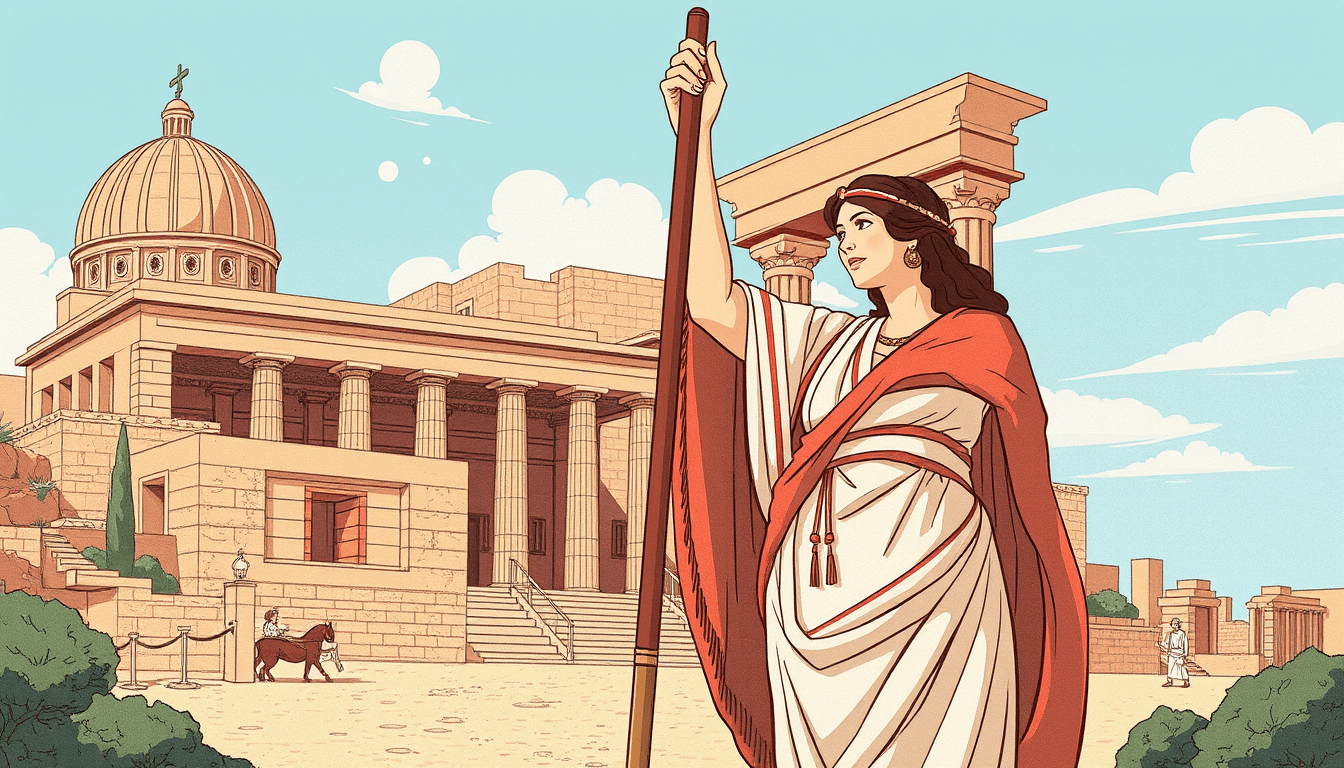
Hypatia: The Last Translator
We know Hypatia (c. 350–415 CE) through fragments. This is important to state plainly, because the temptation is to fill those fragments with either hagiography or melodrama.
Here is what the sources actually support:
The lost commentaries are the real tragedy. Not because they were certainly revolutionary — we cannot know — but because they represent a method that has no modern equivalent. When Hypatia wrote on Diophantus, she wasn't doing pure mathematics. She was performing an act of philosophical interpretation. The arithmetic meant something beyond itself.
The Convergence: Three as One
To understand what Hypatia was actually doing, you have to understand the Neoplatonist framework she inhabited — not as dogma, but as a working theory of everything.
Diagram: The One — Unity, Source leads to Nous — Divine Mind; Nous — Divine Mind leads to Psyche — World Soul; Psyche — World Soul leads to Material World; Mathematics leads to Nous — Divine Mind (reveals); Astronomy leads to Psyche — World Soul (maps); Philosophy/Ethics leads to Material World (navigates); Mathematics leads to Astronomy (same structure); Astronomy leads to Philosophy/Ethics (same structure); Philosophy/Ethics leads to Mathematics (same structure).
Diagram: The One — Unity, Source leads to Nous — Divine Mind; Nous — Divine Mind leads to Psyche — World Soul; Psyche — World Soul leads to Material World; Mathematics leads to Nous — Divine Mind (reveals); Astronomy leads to Psyche — World Soul (maps); Philosophy/Ethics leads to Material World (navigates); Mathematics leads to Astronomy (same structure); Astronomy leads to Philosophy/Ethics (same structure); Philosophy/Ethics leads to Mathematics (same structure).
The diagram is modern. The thinking was ancient. In this framework:
- Mathematics wasn't an abstract game — it was the grammar of divine thought. When you proved a geometric theorem, you were reading the mind of God.
- Astronomy wasn't data collection — it was the study of the World Soul made visible. The planets' movements were the heartbeat of a living cosmos.
- Philosophy wasn't opinion — it was the practical discipline of aligning human reason with the structure the other two revealed.
Reconstructing the Method
How do we know any of this? The honest answer: through a kind of intellectual archaeology.
The textual evidence is damaged. Hypatia's works survive only as references in other people's letters — Synesius of Cyrene, most notably, who writes to her with easy familiarity about astrolabe construction and philosophical disputes. The archaeological evidence is suggestive but silent. Alexandria's ancient layers are buried beneath a modern city; what survives is fragmentary.
What we can triangulate:
Synesius's letters give us a portrait of a teacher who moved fluidly between instrument design and metaphysical argument — no code-switching, no apology. He asks her to build him an astrolabe in the same breath as he discusses the nature of evil.
This triangulation — text, artefact, landscape — is the method. It doesn't give us certainty. It gives us plausibility. And plausibility, honestly held, is worth more than myth.
The Fracture
What happened to this unified knowledge?
The standard story blames Christianity. The real story is more structural and more interesting.
As the Roman Empire fragmented, so did its institutional support for integrated knowledge. The Mouseion's funding dried up. Scholars scattered. The great synthesis — philosophy-mathematics-astronomy as one project — required a context: a city, an institution, a patron class that believed in it.
When Hypatia was killed, it wasn't just a person who died. It was the last visible instance of a civilisational agreement that knowledge should be whole.
We've been living with the consequences ever since. Our universities are Hypatia's city carved into departments. Our expertise is her method fractured into specialisations. The depth we gained is real. The unity we lost is also real.
The Practice: Weekly Convergence
Which brings us to the practice this series demands — not as nostalgia, but as a discipline.
The ancient integration wasn't effortless. It required active synthesis — the deliberate work of holding two disciplines in mind simultaneously and looking for their shared structure. Hypatia didn't simply know mathematics and philosophy. She practised their convergence.
Here is the modern version:
The pairing matters less than the practice. Astrophysics and baking. Game theory and gardening. Typography and ecology. The point is not to become expert in everything — Hypatia didn't either. The point is to train the connecting tissue that modern education has atrophied.
Field A this week:
Field B this week:
The shared structure I noticed:
The sentence that could only exist at the intersection:
What surprised me:
What Survives
There's a detail from the sources that stays with me. When Synesius asks Hypatia to build an astrolabe, he doesn't specify a design. He trusts her to know what he needs — because the instrument, the philosophy, and the person are inseparable in their correspondence. The request is for a tool. The relationship is for a mind.
That's the real inheritance. Not the lost commentaries, not the astrolabe itself, but the way of thinking that made those things coherent expressions of a single practice.
We can't restore Alexandria. We can restore the conviction that drove it: that the universe is one text, that every discipline is a way of reading it, and that the deepest understanding comes from reading it in as many languages as you can learn.
Alexandria burned. The practice survives wherever someone has the discipline to hold two worlds in mind and wait for them to rhyme.
If this resonates, see how to apply it to your own work with the interactive Dispatch agent.
Be first to like this dispatch