Online success isn’t what you say—it’s how attention is earned, timed, and converted across moments.

Previous · Part 4
Sharing as Identity Signalling: The Person People Are Trying to Become
Next · Part 6
When Preferences Lie: The Gap Between What People Say and Do
This builds on Part 4: Sharing as Identity Signalling: The Person People Are Trying to Become
Continue with Part 6: When Preferences Lie: The Gap Between What People Say and Do
Attention Is Earned in Layers
Attention isn’t a switch you flip. It’s a sequence you re-earn—moment by moment—until the reader finally decides you’re worth their effort.
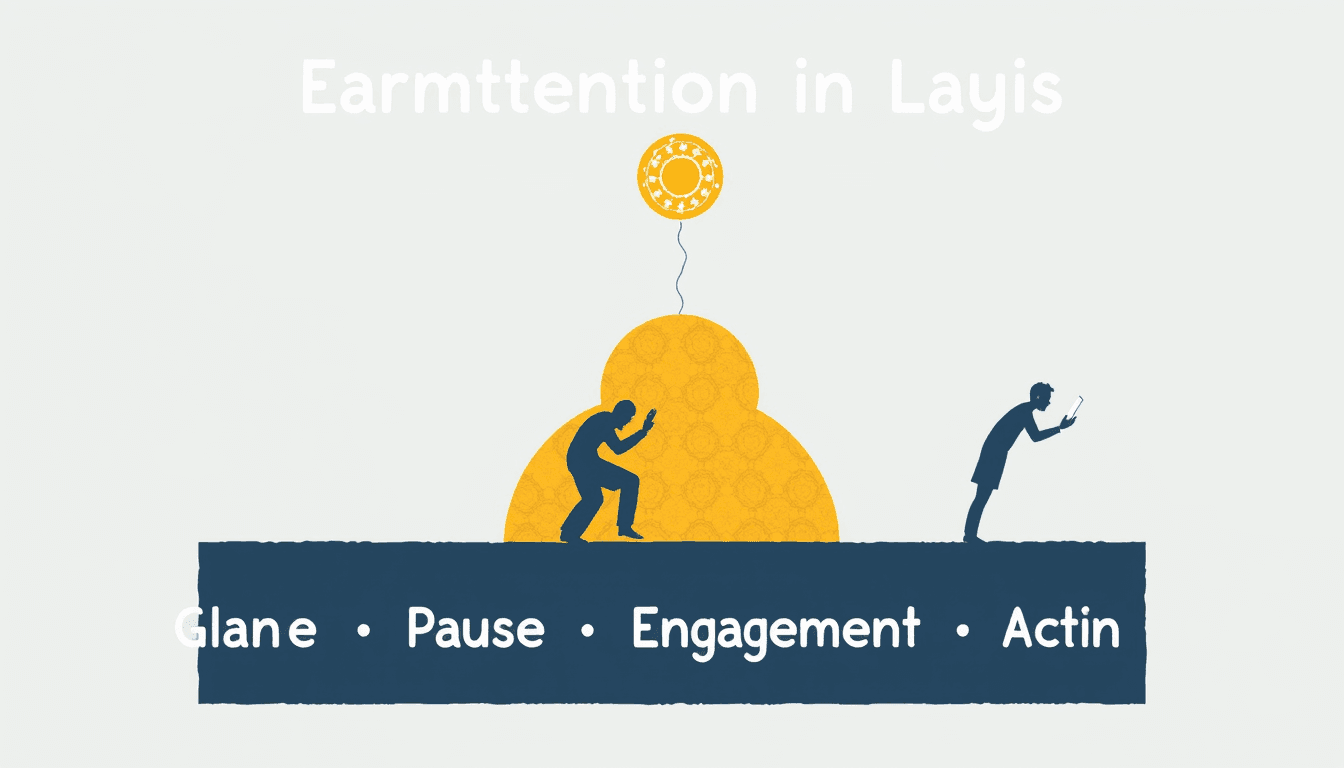
The Four-Stage Ladder: Glance → Pause → Engagement → Action
Think of every page, post, product screen, and pitch as a ladder with four rungs. Most people fall off at the first one you make expensive.
Diagram: Glance\nCan I understand this in 1–2 seconds? leads to Pause\nIs it worth the next breath?; Pause\nIs it worth the next breath? leads to Engagement\nWill I do something small to get value?; Engagement\nWill I do something small to get value? leads to Action\nWill I commit: click, subscribe, buy, reply?.
Diagram: Glance\nCan I understand this in 1–2 seconds? leads to Pause\nIs it worth the next breath?; Pause\nIs it worth the next breath? leads to Engagement\nWill I do something small to get value?; Engagement\nWill I do something small to get value? leads to Action\nWill I commit: click, subscribe, buy, reply?.
Each rung has its own job. The mistake is treating them as the same.
Stage 1 — Glance (1–2 seconds): Make It Legible
Glance is about pattern recognition. The reader asks: What is this? Where am I? Why would I care right now?
What earns the glance:
- A promise you can read immediately (not cleverness)
- A visual hierarchy that points to the core
- Language that matches the reader’s internal vocabulary
What breaks glance:
- Generic intros that say nothing
- Dense blocks with no “map”
- Titles that describe the topic instead of the benefit
Stage 2 — Pause (2–10 seconds): Give Them a Reason to Stay
Pause is the first commitment to continue processing. Here, clarity becomes momentum.
The reader is no longer just scanning. They’re deciding whether the next moment will pay off.
Pause is earned by:
- A second line that sharpens the promise (what exactly changes)
- Proof signals (authority, specificity, outcomes, examples)
- A “no wasted time” structure (you’ll deliver quickly)
Pause fails when:
- The first paragraph is an apology, a history lesson, or a vague setup
- The value is postponed until “later”
- The reader can’t locate themselves (“What do I do here?”)
Stage 3 — Engagement (10 seconds to 2 minutes): Create a Micro-Interaction
Engagement isn’t “be entertaining.” It’s participation.
A reader engages when they do something small that makes them feel progress:
- They find a relevant section
- They see an example that matches their situation
- They evaluate, compare, or apply a concept
- They respond to a question (even silently)
Design engagement with “low-friction value”:
- One clean concept per section
- Examples that make the abstraction usable
- Subheads that let them choose their own path
- Interactive prompts (even lightweight ones) that pull them forward
Stage 4 — Action (the commitment moment): Make the Next Step Obvious and Safe
Action is where the reader finally converts attention into behavior.
But action isn’t only persuasion. It’s logistics:
- Can they do it immediately?
- Do they understand what they’re getting?
- Is the cost clear (time, money, effort, risk)?
- Is there a reason to trust that action won’t waste them?
Design action with:
- A single primary CTA (not five competing moods)
- Clear expectations (“You’ll get X. No spam.”)
- Reduced steps (“Start now” beats “Request access”)
- Social or credibility cues where appropriate
What “Layered Attention” Looks Like in Practice
Use this mental model when you review any page:
- Glance: Is the promise legible at a glance?
- Pause: Can the reader tell why it matters right now?
- Engagement: Is there a small interactive payoff?
- Action: Is the next step obvious, low-risk, and aligned with the value delivered?
Common Failure Modes (And the Fix)
Failure Mode A: You built a “good article” but no action
You earned attention up to understanding, but not up to commitment.
Fix: Add a frictionless CTA that matches the value already delivered (not a random upsell).
Failure Mode B: You chase engagement metrics while readers are still confused
Time-on-page can hide a problem: people linger while trying to decode.
Fix: Improve pause—clarify promise, tighten hierarchy, bring proof earlier.
Failure Mode C: Your glance is strong, but pause collapses
You got the click, but you didn’t keep the investment.
Fix: Ensure the first 5–10 seconds confirm the promise and deliver a tangible reason to continue.
A Quick Self-Audit (Do This Before You Rewrite Anything)
Make the Ladder Explicit in Your Design
Here’s the unglamorous truth: layered attention is a writing + design discipline, not a creative mood.
Glance is language and hierarchy.
Pause is payoff and proof timing.
Engagement is participation and usefulness.
Action is clarity, trust, and low-cost commitment.
Practical Takeaway Checklist
Where do your readers most likely exit your work: at the first skim, the early promise check, the “where do I fit in?” moment, or the final commitment step? Write the exact sentence they likely don’t want to read anymore.
If this resonates, see how to apply it to your own work with the interactive Dispatch agent.
Be first to like this dispatch