Reality is a conditional output of models, measurements, and scale—not a fixed backdrop waiting to be noticed.
Previous · Part 5
Quantum Entanglement and the Myth of Clean Causality
Next · Part 7
The Brain Edits Reality: Perception as Curated Experience
This builds on Part 5: Quantum Entanglement and the Myth of Clean Causality
Continue with Part 7: The Brain Edits Reality: Perception as Curated Experience
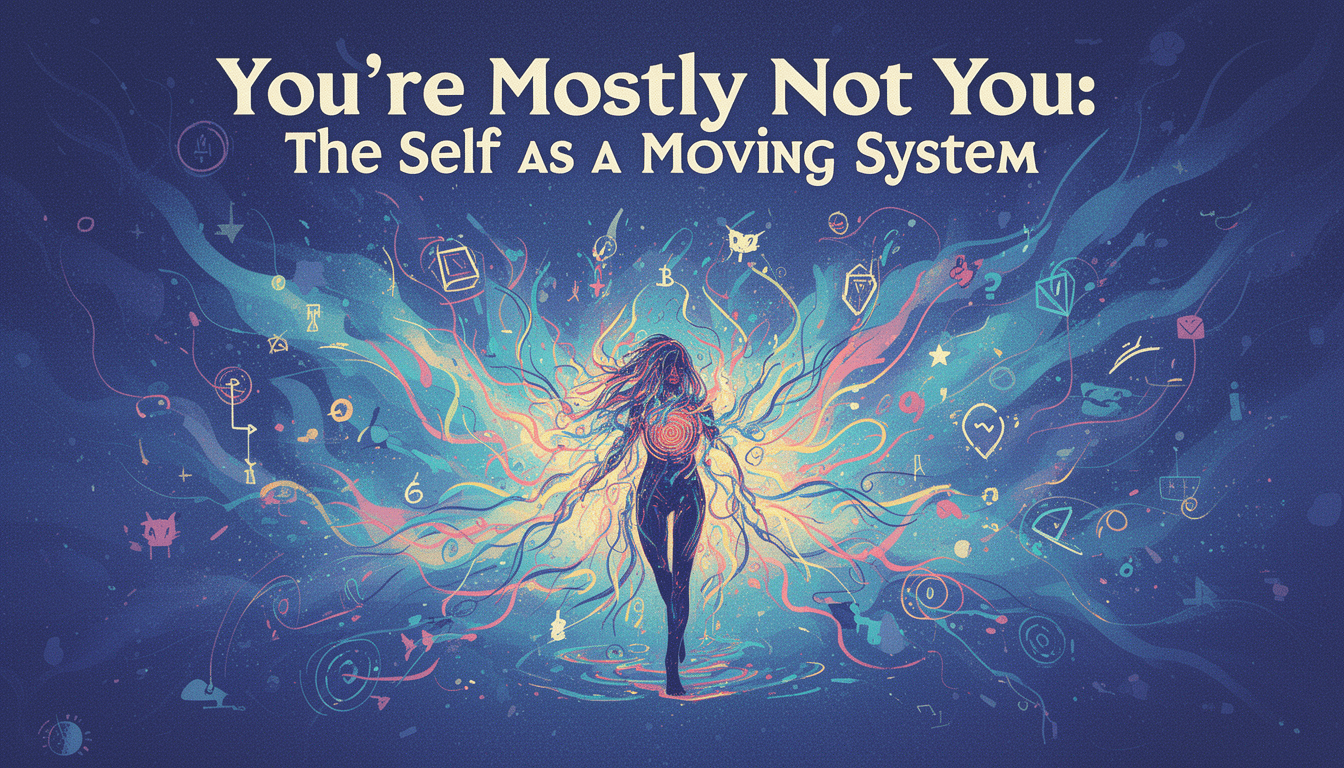
The strange center of “I”
Most people experience the self like a light switch: on, then on again. Yet biologically, “you” behaves more like a living process with a maintenance schedule.
Your body is not a single continuous object. It’s an ongoing negotiation between components, signals, and replacements—held together just long enough for you to call it a person.
The microbiome: you, but not you
A huge portion of what you call “your body” is microbial life—bacteria and other organisms that live on and within you. They are not passengers you could cleanly remove without changing you.
They help regulate digestion, immune behavior, inflammation, even aspects of metabolic signaling. Without them, the same physical organism wouldn’t operate the same way.
So the question “Are you mostly you?” gets an answer that feels morally confusing and biologically true:
You are an ecosystem with boundaries that can shift.
Not a solitary individual sealed inside skin.
Constant cellular replacement: the body you “are” is changing
Even if you ignore microbes, your own cells aren’t permanent fixtures. Many of your tissues renew continuously—cells die, are replaced, reorganized. Your chemistry and structure update over time.
So the body that sits in your mirror is not the same body you had years ago—at least not in any literal “same stuff, same arrangement” sense.
This doesn’t mean you’re not real. It means “same” is not the same kind of word you think it is.
Identity as a process, not a possession
If the ingredients of “you” are replaced and exchanged, what makes you you?
Unlock the full paid series
Get all 10 parts of Reality Isn’t Stable — 45 min read · 8,873 words across the full sequence.
Inside the series
Parts 1-2: Context changes what’s real
Parts 3-4: Perception as inference, not a record
Parts 5-6: Joined systems break classical stories
Parts 7-9: Models, regimes, and the limits of “nothing”
Part 10: Probability and sanity checks
Reality is a conditional output of models, measurements, and scale—not a fixed backdrop waiting to be noticed.
Membership gives access to subscriber dispatches and ongoing Pen & Muse tools. This paid series is sold separately.
If this resonates, see how to apply it to your own work with the interactive Dispatch agent.
Be first to like this dispatch