Podcast · Episode 2
The Past Had Stranger Ideas Than You Think
Alex and Sam explore an ancient coin-operated dispenser, a mechanical model of the heavens, rotating wheels of argument, fictional talking books, and a fax concept older than the telephone. Along the way, they ask what it really means for an idea to arrive before its time.
Alex & Sam · About 16 min
Listen here and keep browsing. Your place is saved. Autoplay continues through this programme; switch it off in the player.
Read the conversation
Alex
An ancient coin-operated water dispenser
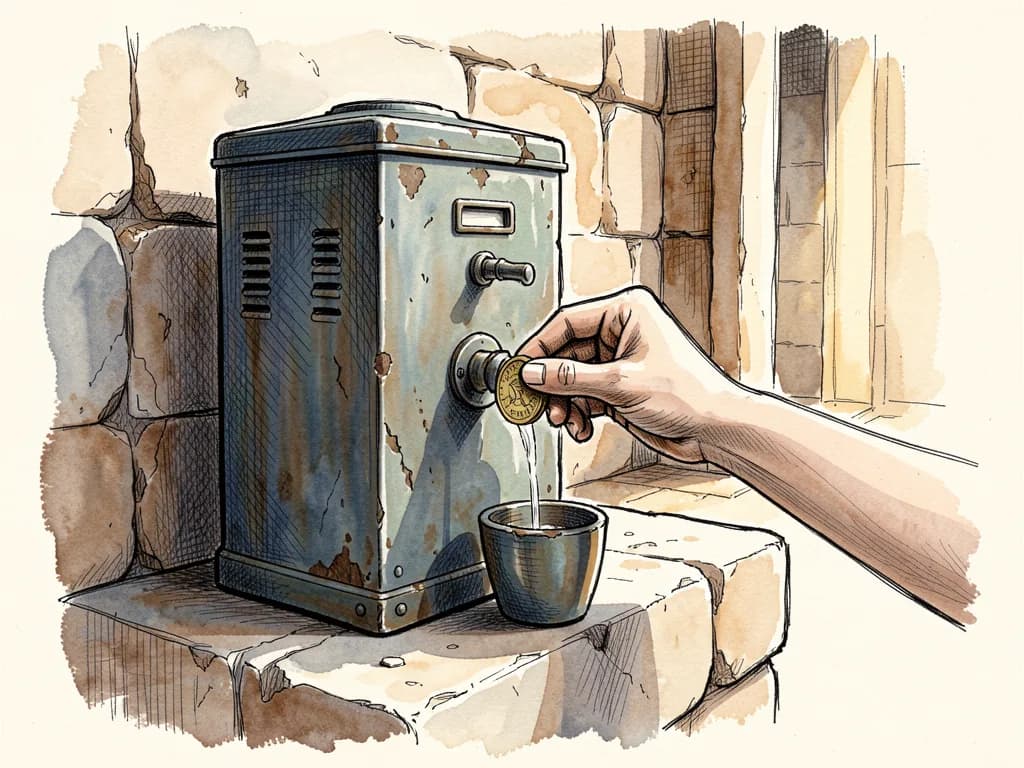
Imagine walking into a temple almost two thousand years ago. You need some water for a ritual. There’s a vessel nearby, but instead of asking an attendant, you put a coin into a slot. A measured amount of water comes out. It sounds like someone has accidentally left a vending machine in antiquity.
Sam
And already I want to know whether we’re talking about an actual ancient design or a modern person looking at an old jug and getting carried away. Because that boundary is where some wonderfully strange history becomes wonderfully unreliable history.
Alex
An actual design, described by Hero of Alexandria, a mathematician and engineer generally placed in the first century CE. His work on devices powered by air and water includes a coin-operated dispenser associated with sacred water. We shouldn’t assume every temple had one. But the mechanism itself is beautifully straightforward.
Sam
Go on. I’ve put my coin in. What happens inside? Because the lovely thing about a machine that old is that we ought to be able to understand it without needing a software update.
Alex
The coin lands on a little pan attached to a lever. Its weight tilts the lever and opens a valve. Water flows. Then the coin slips off, the lever returns, and the valve closes. Your payment briefly becomes part of the mechanism. The machine doesn’t identify money; it responds to weight.
Sam
That’s the surprising bit. From outside, it seems to recognise a transaction. Inside, it’s a balancing act. And its purpose isn’t to sell crisps at a railway station. It’s managing access to something sacred. A familiar interaction, sitting inside a very unfamiliar world.
Alex
Exactly. Hero also described devices that could make temple doors open through the action of heat, air pressure, and water. You can imagine how powerful that might feel to someone watching. Although a description of a device doesn’t establish how commonly it was built, or precisely how spectators understood it.
Sam
We’re tempted to split the scene into clever engineer behind the wall and gullible worshipper in front. But that may be too neat. Mechanical ingenuity and religious wonder don’t have to cancel each other out. Knowing how a bell works doesn’t tell you what its sound means to a congregation.
Alex
And that gives us a useful way into these strange ideas. Not, 'Ancient people secretly had everything we have.' More interestingly: people in very different worlds sometimes arrived at arrangements that feel uncannily familiar. Sometimes they even built something whose sophistication survived only by extraordinary luck.
Sam
So let’s leave the working water dispenser and pick up something broken. Because a machine that still works tells you what it does. A ruined machine can leave you wondering what kind of world was capable of making it.
Alex
The sky preserved in broken gears
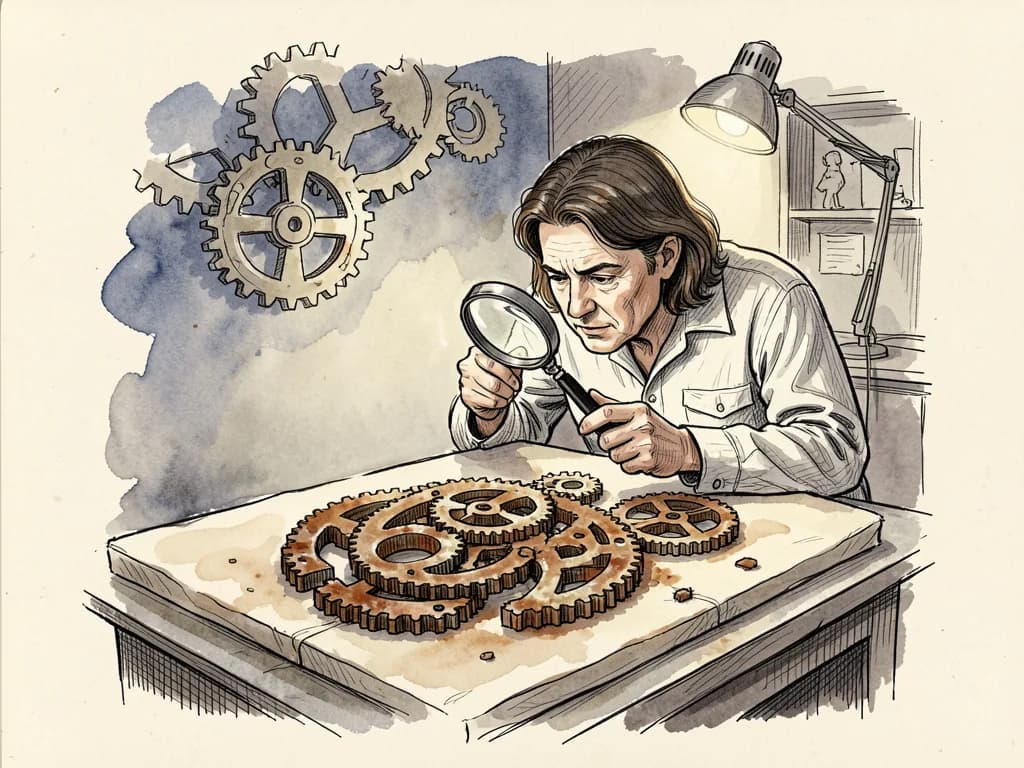
In the early twentieth century, material recovered from a shipwreck near the Greek island of Antikythera included corroded fragments with gears inside. They became known as the Antikythera mechanism. The wreck is usually dated to the first century BCE; the mechanism’s precise age and origins remain debated.
Sam
For someone who hasn’t seen it, don’t picture a gleaming brass instrument on a captain’s desk. What survives looks battered and crusted together. The astonishing part is discovering that those damaged pieces once belonged to a carefully organised mechanical model of the heavens.
Alex
Its gearing and scales represented astronomical cycles. Turning its input could move displays through time, tracking the Sun and Moon and indicating cycles associated with eclipses. Researchers have recovered much of its operation from the surviving parts and inscriptions, although not every detail of the original arrangement is settled.
Sam
So imagine asking, 'Where will the Moon be at a different date?' Instead of doing every calculation afresh, you turn a handle. Relationships learned from observing the sky have been built into the relationships between wheels. That’s an extraordinary translation: time and sky becoming teeth and metal.
Alex
It’s often called an ancient analogue computer, which is useful if we explain the phrase. It didn’t run apps or contain a general-purpose electronic brain. Its physical movements embodied particular mathematical relationships. You could obtain information by operating the model rather than repeating the underlying arithmetic yourself.
Sam
But now the obvious question becomes almost irritating. If people could make that, why wasn’t the ancient Mediterranean full of increasingly sophisticated machines? Why doesn’t this turn into a neat story where everything gets steadily smaller, cheaper, and better?
Alex
Because one surviving object can’t tell us the size or continuity of the craft behind it. Metal gets recycled. Workshops close. Skills may depend on a small number of makers and patrons. This instrument strongly suggests substantial expertise, but it doesn’t give us a complete lost industry we can confidently reconstruct.
Sam
There’s a difference between 'We’ve lost evidence' and 'We know exactly what the missing evidence would say.' Still, it changes the texture of the past. The absence of surviving machines no longer feels like simple proof that nobody knew how to make them.
Alex
And it challenges the idea that knowledge is a staircase nobody ever steps down. Knowledge also lives in hands, tools, habits, and institutions. A written description might survive while the ability to make the thing becomes much harder to recover.
Sam
We’ve had a mechanism controlling water and another modelling the sky. The next leap would be to mechanise something less cooperative. Not the movement of the Moon, which at least follows patterns, but the movement of an argument.
Alex
Ramon Llull’s wheels of reasoning
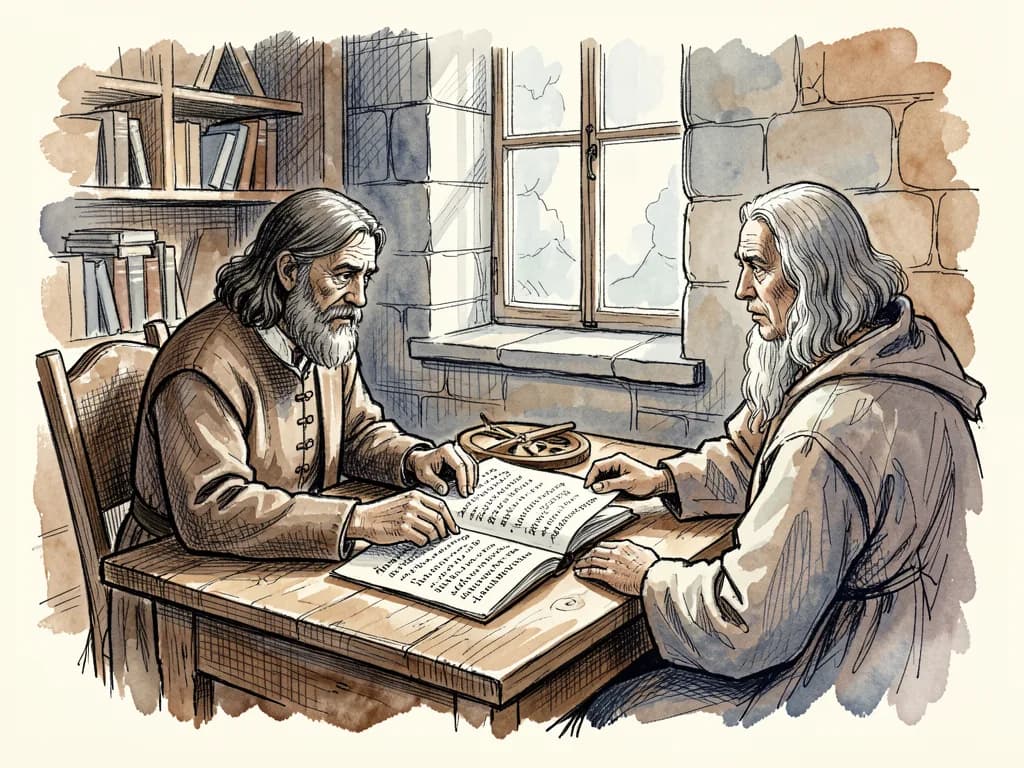
Enter Ramon Llull, a thinker from medieval Majorca who lived in the thirteenth and early fourteenth centuries. He developed what he called an Art: a system intended to organise reasoning around basic principles. Some versions used figures and rotating wheels marked with letters.
Sam
Letters standing for concepts, rather than letters spelling secret messages? I’m picturing someone turning a paper wheel until wisdom drops out, which is probably both irresistible and unfair.
Alex
The letters represented principles such as goodness, greatness, and wisdom. Moving through combinations could help a user generate and examine relationships between them. Llull wanted more than a memory aid. He hoped his method could support demonstrations of religious truth, particularly Christian truth, in arguments across faiths.
Sam
Which makes it much less like a neutral machine for asking anything. The foundations already carried commitments. If another person didn’t accept what the basic terms meant, rotating them into a new combination wouldn’t magically produce agreement.
Alex
Right. It would be misleading to call it a medieval laptop, or suggest it successfully automated proof. But there is a remarkable ambition here: represent ideas using symbols, organise permissible combinations, and make parts of thinking systematic enough for another person to follow.
Sam
Let’s try an imagined, everyday cousin of that ambition. A town is deciding what to do with an empty building. Put housing, cost, access, and preservation on cards. Force yourself to consider them in pairs. You might notice a conflict you’d missed, even though the cards can’t decide what matters most.
Alex
That’s a helpful distinction. A device can enlarge the set of questions you consider without guaranteeing the answers. Llull’s actual system had its own much more elaborate structure, but your example captures why arranging symbols outside your head can change what happens inside it.
Sam
It also explains the danger. Once an argument comes out of an impressive procedure, it can feel more authoritative than its starting assumptions deserve. We should ask not only whether the wheels turn correctly, but who chose what went on the wheels.
Alex
That question still matters whenever a formal system helps people make decisions. But the historical connection isn’t that Llull secretly invented today’s technology. His work belongs to a long exploration of symbolic reasoning, and it influenced later thinkers interested in combinations and universal methods.
Sam
There’s something touching about the hope underneath it: perhaps disagreement could become tractable if we arranged our thoughts properly. And something unsettling about imagining that the right arrangement would make everybody arrive at your own conclusion.
Alex
Cyrano’s fictional talking book
Now for a different way to get ahead of your time: don’t build the machine. Write a story in which using it feels completely ordinary. The seventeenth-century French writer Cyrano de Bergerac did something rather wonderful with books.
Sam
The name may bring to mind the large-nosed romantic hero from the later play. But this is the historical writer who helped inspire that character, and his own imagination went considerably further than the balcony.
Alex
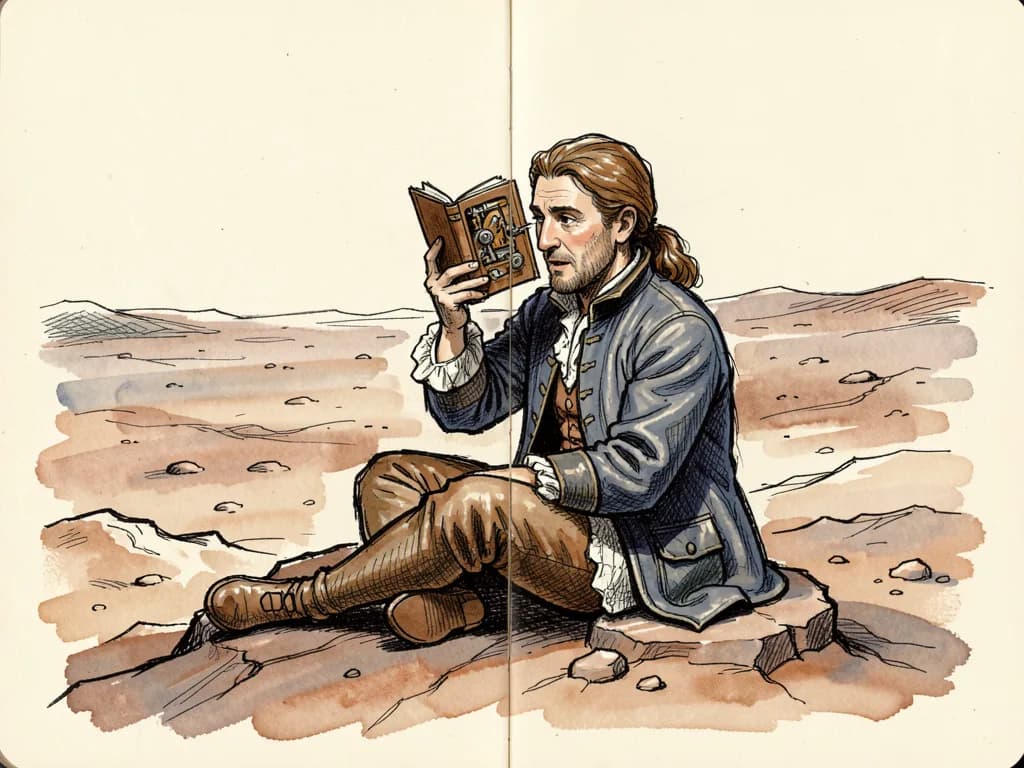
His fictional voyage to the Moon, published after his death in 1657, includes books that speak. They are mechanical objects rather than volumes you read conventionally. The reader uses the ears instead of the eyes. It’s a striking imagined experience centuries before recorded audiobooks.
Sam
Especially because we are currently having a conversation for someone who may be walking, cooking, or looking out of a train window. The eeriness isn’t merely 'He imagined a gadget.' He imagined separating access to a book from the act of looking at a page.
Alex
But he didn’t supply a workable sound-recording technology. These are fictional talking mechanisms. Calling him the inventor of the audiobook would erase the enormous difference between imagining an experience and developing the means to deliver it.
Sam
Still, imagining the experience is its own achievement. Engineers often have to ask, 'How could we do this?' A storyteller can ask, 'What would life feel like if we could?' That second question can reveal a possibility before the first question has an answer.
Alex
And Cyrano’s lunar writing isn’t simply a catalogue of future products. Strange societies and impossible journeys give him room to unsettle earthly assumptions. The invented world becomes somewhere to test whether familiar customs really are inevitable.
Sam
Which saves us from treating old fiction like a prediction competition. A talking book is fascinating even without awarding its author points for guessing our headphones. It asks what a book fundamentally is: bound pages, or thought made available beyond the person who first had it?
Alex
An electrical image before the telephone
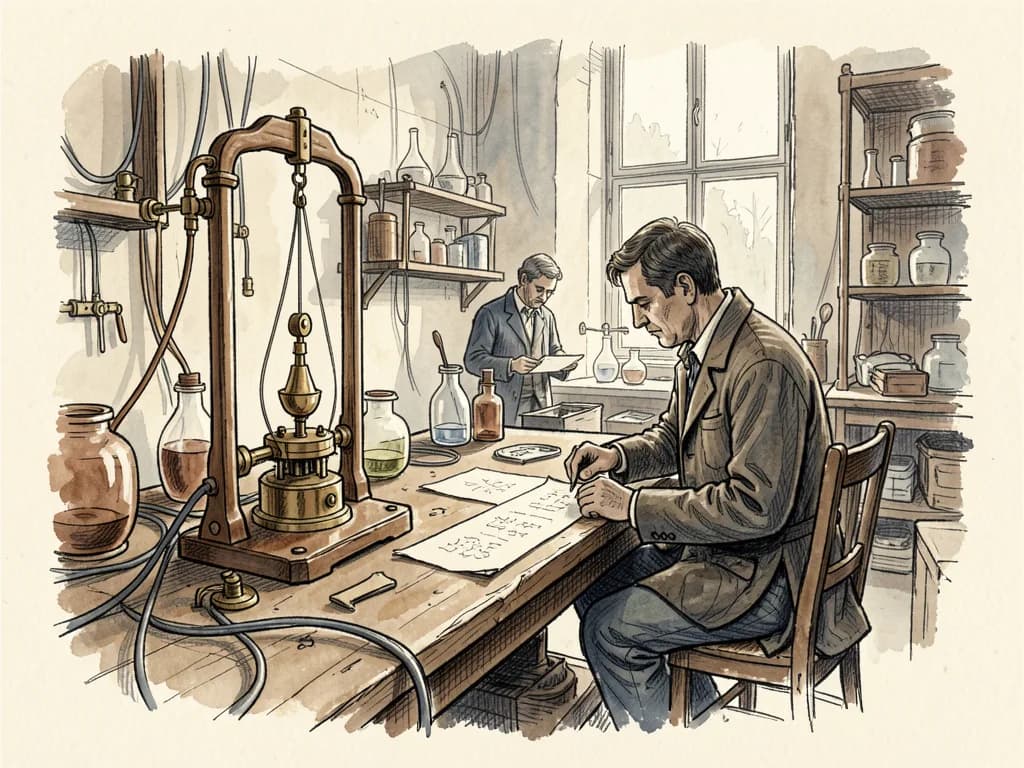
That question connects beautifully with our next device. Once you stop insisting that a message must travel with its original physical surface, you can try something that still sounds oddly out of order: a fax concept before the telephone.
Sam
The fax feels so specifically like office life at the end of the twentieth century. A machine beside a filing cabinet, slowly producing a slightly disappointing copy. Putting its beginnings before familiar voice telephony scrambles the whole mental timeline.
Alex
In 1843, the Scottish inventor Alexander Bain patented an arrangement for electrical copying at a distance. His approach involved coordinated movement at the sending and receiving ends and chemically treated material on which electrical action could make marks. It belongs to the early history of facsimile transmission.
Sam
Let’s make the principle tangible without pretending it was a modern scanner. Imagine a stylus moving across a prepared pattern. As it encounters different parts, an electrical signal changes. Far away, another moving point makes corresponding marks. Build up enough of those marks and a shape emerges.
Alex
The difficult word there is 'corresponding'. The two ends have to keep their movements coordinated. Otherwise the right marks appear in the wrong places. Bain’s early arrangement used pendulums; later inventors developed other approaches. His patent wasn’t the arrival of a dependable office appliance.
Sam
And suddenly the chronology makes more sense. Sending an image feels more advanced than sending speech to us. But an image can be examined piece by piece over time. Reproducing the continuously changing character of a voice poses a different technical problem.
Alex
Exactly. Our sense of which invention ought to come first is shaped by how the finished products reached us. We meet them after years of development and assume their order was natural. Early inventors encountered a landscape of separate obstacles, not a numbered queue.
Sam
So being ahead of your time might mean having one crucial idea while all the neighbouring ideas remain inconveniently absent. You can work out how to encode a pattern and still need better materials, steadier mechanisms, reliable connections, and somebody willing to pay.
Alex
Invention needs a world around it
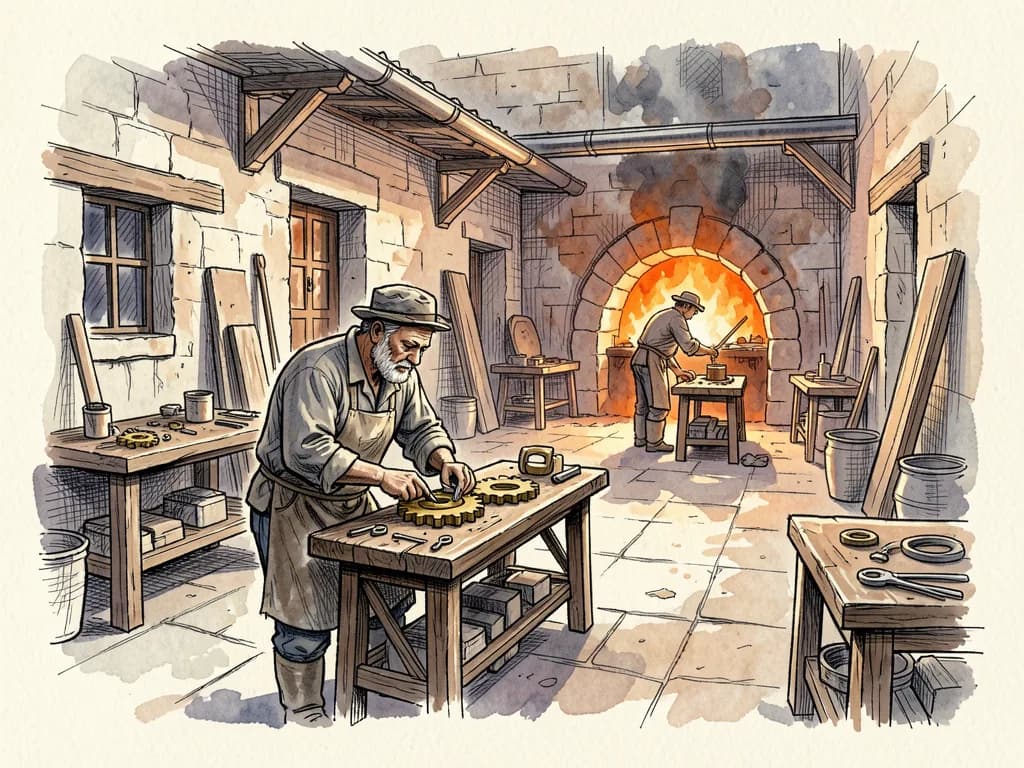
Which brings us back to the ancient gears. An invention doesn’t live alone. It needs makers, maintenance, customers or patrons, and ways for skill to pass between people. Having the central insight is extraordinary. Making it ordinary is another achievement entirely.
Sam
That changes the phrase 'ahead of their time' for me. It can sound as though one brilliant person escaped the ignorance around them. But Hero had mechanical traditions to draw on. Llull had intellectual traditions. Bain had electrical experimentation. Even a startling departure has a place it departs from.
Alex
And their purposes weren’t necessarily ours. Sacred water, astronomical cycles, religious argument, imagined lunar life, electrical copying: these aren’t five attempts to invent the twenty-first century. They are five encounters with problems or possibilities that mattered in very different settings.
Sam
Yet the recognition is real. A coin starts a process. A handle answers a question about time. Symbols help organise thought. A book speaks. A mark travels without its paper. Those little moments make the distance between us and the past feel suddenly much smaller.
Alex
We began with the suspicion that these things sounded made up. The satisfying answer isn’t that history contains secret modernity. It’s that human ingenuity has taken more forms, and travelled less direct routes, than a tidy timeline allows.
Sam
And some of the mystery can stay honest. We don’t know every workshop behind the broken gears. We can’t make a fictional book speak by admiring the idea. What we can do is look closely enough to distinguish a working mechanism, an ambitious method, and an imagined possibility.
Alex
All three deserve our attention. The next time an old object looks crude or an old idea sounds absurd, it may be worth pausing before moving on. Somewhere inside there might be a surprisingly good question—and occasionally, a little lever waiting for a coin.
Still open
- How commonly were Hero’s temple devices built, and how did spectators understand them?
- What are the precise age and origins of the Antikythera mechanism?
- What was the complete original arrangement of the Antikythera mechanism?
- How extensive and continuous was the craft tradition behind the Antikythera mechanism?
- What fundamentally makes something a book: bound pages, or thought made available beyond its original thinker?