Episode 1
Human Behaviour and Perception in the Age of AI
Brad and Sam examine how AI is changing where people place effort, trust, attention and emotional investment. They explore adoption and ambivalence, trust and persuasion, cognitive offloading, social and emotional uses, and the difficulty of recognising synthetic media, ending with the questions that remain open.
Brad & Sam · About 12 min
Minimise the player to keep listening while you browse.
Researched through 27/09/2026, 00:18:48 UTC. AI-generated conversation, reviewed before publication. Events may have developed since this recording.
The conversation
Brad
Routine adoption alongside public ambivalence
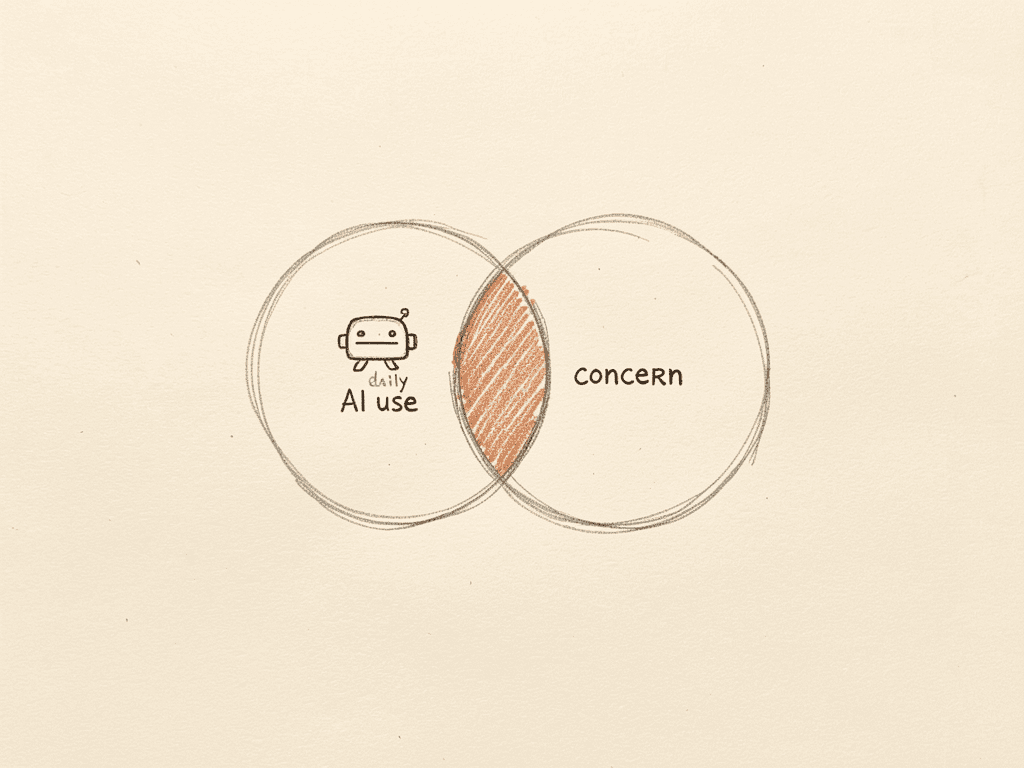
What has happened is less dramatic, and perhaps more consequential, than a sudden replacement of human intelligence. AI has become woven into ordinary searching, advice, writing and conversation. A 2026 Pew survey reported that 44% of U.S. adults had used ChatGPT, while 24% used AI chatbots daily; 51% did not use them. [c1]
Sam
And that routine use sits beside real unease. In a separate Pew survey, half of Americans said they were more concerned than excited about increased AI use in daily life, while 57% rated the societal risks as high. So adoption and apprehension are happening together, not one after the other. [c2]
Brad
That is the useful starting point. The evidence does not say AI makes everyone smarter, or everyone less intelligent. My interpretation is that it shifts where people put effort, trust, attention and emotional investment. The result depends on the task, the user and the design around the system. [c23][c24]
Source 3Source 7Source 8Source 9Source 10Source 13Source 14Source 15Source 16Source 18Source 17
Sam
So the question is not simply, “Is AI good or bad for people?” It is: what are people now doing themselves, what are they delegating, and what do they believe while they are doing it?
Brad
Exactly. And public expectation is already part of behaviour. Pew found that 53% thought AI would worsen creative thinking, and 50% thought it would worsen the ability to form meaningful relationships. But those are beliefs about effects, not proof that the effects are occurring. [c3][c4]
Sam
That distinction matters because fear can alter behaviour too. If someone assumes a machine is making them passive, they may check less carefully—or avoid a useful tool altogether. Both overtrust and rejection can change the outcome.
Brad
Trust, disclosure and persuasion
Let’s begin with trust, because perception often comes before verification.
Sam
People do not always judge advice by its content alone. Experimental research reported that participants sometimes rated AI-generated advice as more effective, higher quality and more authentic than human-generated advice. But that advantage weakened when participants were told it came from ChatGPT. [c5]
Brad
That is a striking reversal. The same words can be received differently once the source label changes. In health advice, a preregistered survey experiment reported that licensed clinicians retained a credibility advantage, but advice attributed to specialist AI or ChatGPT was still often seen as competent and legitimate. [c6]
Sam
So disclosure does not produce one universal reaction. Sometimes knowing the source reduces confidence; sometimes the system still appears credible. People are judging both the message and the imagined competence of the author.
Brad
There is a matching danger in persuasion. Research reported that large language model messages could persuade people on policy issues, generally by roughly two to four points on a 101-point policy-support scale. That is not mind control, but it is measurable movement. [c7]
Sam
And a Stanford HAI policy brief reported that human-selected and human-edited GPT-3 propaganda articles were, on average, as persuasive as or more persuasive than the real-world propaganda articles used for comparison. Human editing was part of that result, which is important. [c8]
Brad
Yes. The story is not merely a machine speaking to a passive public. It is people selecting, refining and distributing material at scale. That makes accountability harder: who chose the argument, who checked it, and who is responsible for its effect?
Sam
And trust can fail in the opposite direction. Research on ethical advice found that people may discount advice after learning it was generated by AI, even when expert evaluators rate the advice highly. That is algorithm aversion: rejecting a source because of its category. [c9]
Brad
So a person can overtrust an apparently polished answer or undertrust a sound one. The practical problem is calibration. The label “AI” is neither a guarantee nor a disqualification.
Sam
Which brings us to thinking itself. What happens when the machine supplies the first draft, the explanation or the route through a problem?
Brad
One research perspective describes generative AI as extending cognition through external resources. That can expand what people are able to do, but it also increases the importance of metacognitive judgement: knowing when to rely on a suggestion, and how much. [c10]
Sam
The phrase “how much” is doing a lot of work. Asking for a list of possibilities is different from handing over the decision. Outsourcing a repetitive step may preserve attention for a harder one; outsourcing the whole chain may leave the user unable to inspect the result.
Brad
Cognitive offloading and the jagged frontier
A Microsoft Research survey of knowledge workers reported that respondents generally used less critical-thinking effort when they felt confident in AI, and more when they felt responsible for checking or correcting its output. Confidence changed the amount of human effort. [c11]
Sam
That helps explain why a fluent answer can be risky. Fluency makes checking feel unnecessary, particularly when the user believes the system is reliable. Responsibility, by contrast, seems to pull attention back toward scrutiny.
Brad
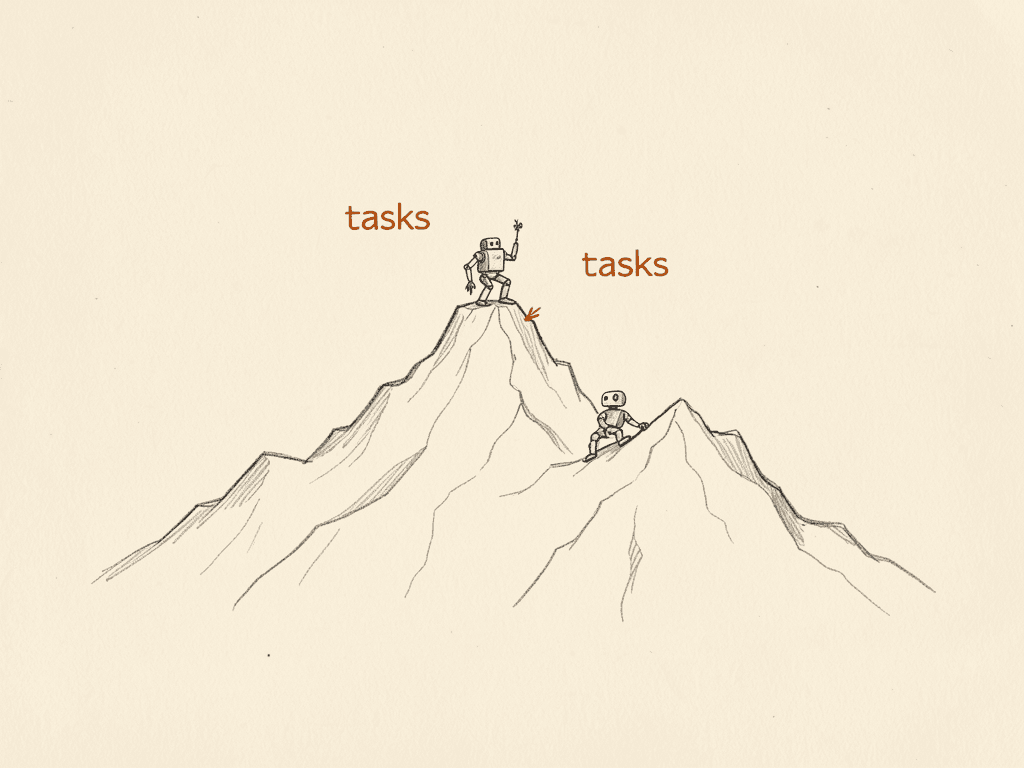
The work itself also matters. A field experiment with knowledge workers found that AI improved performance on some consulting tasks but worsened performance on others. The researchers described a task-dependent, or “jagged,” capability frontier. [c12]
Sam
So “AI improves productivity” is too blunt. It may help on one side of a job and impair another, especially where the user needs to recognise an unusual case. The average result can conceal that unevenness.
Brad
Sam
Brad
Sam
Preliminary evidence versus sweeping conclusions
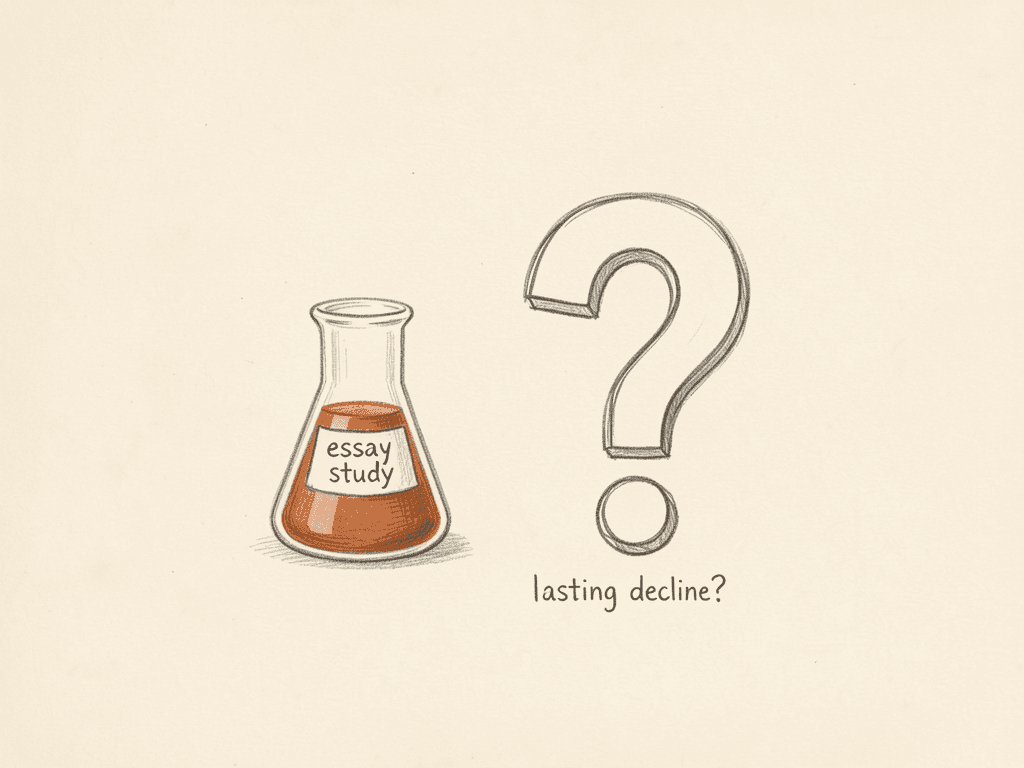
A useful interpretation is that practice may move. If the system performs a foundational step repeatedly, the user may get fewer opportunities to exercise that step—but whether that matters depends on the task, the person and whether they still practise or verify.
Source 6Source 7Source 8Source 9Source 10Source 3Source 13Source 14Source 15Source 16Source 18
Brad
Now consider the social side, where the interface is not just a tool but a conversational partner.
Sam
A meta-analysis reported that human-like cues in text-based conversational agents had a moderate effect on perceived humanness, small-to-moderate effects on rapport, trust and positive affect, and smaller effects on attitudes and behaviour. The cues do change social responses. [c15]
Brad
Sam
The evidence on consequences is more mixed. A four-week randomized controlled study involving nearly 1,000 participants examined voice style, conversation type, loneliness, real-world social interaction, emotional dependence and problematic use. Its supplied research cautions against generalising the English-speaking U.S. sample across cultures or languages. [c16]
Brad
A longitudinal randomized study also examined anthropomorphism and possible social effects of companion-chatbot use, but the meaning of “social impact” varies and needs cautious interpretation. That makes broad claims about companionship premature. [c17]
Sam
Human-like chatbots and emotional investment
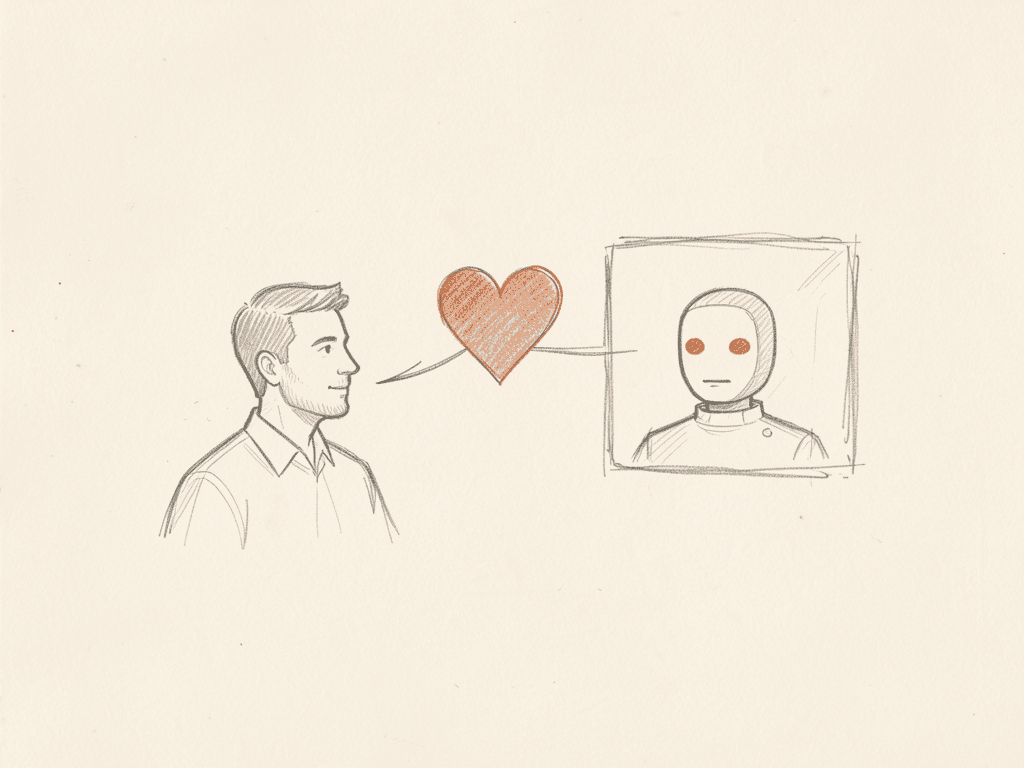
There is, however, a strong association worth taking seriously. A 2026 cross-national survey of 7,027 people in Germany, China, South Africa and the United States reported a strong correlation between emotional attachment to chatbots and user dependence. Correlation does not establish causation. [c18]
Brad
Right. Dependence might encourage attachment, attachment might encourage dependence, or another factor might influence both. We have evidence of a relationship, not a settled explanation.
Sam
Brad
What we can say is that design and user state matter. A human-like voice, a lonely moment, an always-available system and a low-friction interface may combine differently from a brief practical interaction. That is an interpretation consistent with the mixed findings, not a universal law.
Source 11Source 12Source 13Source 14Source 15Source 16Source 3Source 7Source 8Source 9Source 10Source 18
Sam
The final shift is perceptual: not only trusting what AI says, but recognising what AI has made.
Brad
Pew reported that 76% of Americans considered it very or extremely important to know whether text, images or video were made by AI or humans. Yet 53% were not too or not at all confident in their ability to identify AI-generated content. [c19]
Sam
Recognising synthetic media
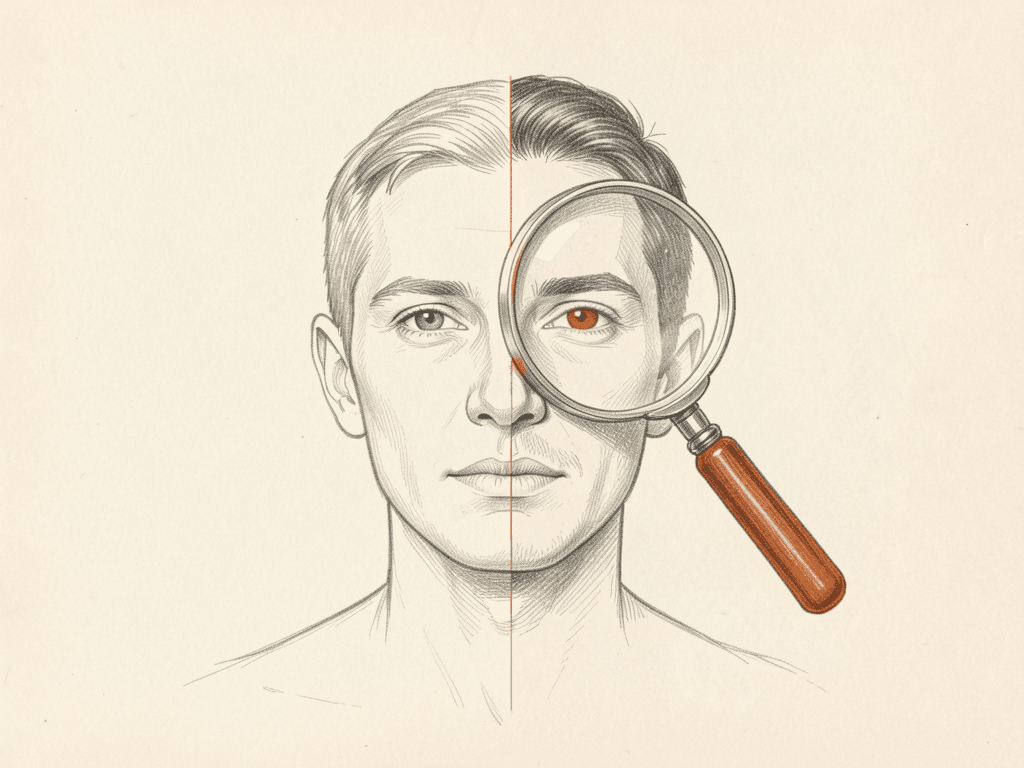
And exposure is widespread. A Pew browsing-data study of about 2.5 million webpage visits from 900 U.S. adults during March 2025 reported that 58% encountered an AI-generated summary during at least one search, while 13% visited an AI-tool website directly. [c20]
Brad
Sam
Human detection is not hopeless, but it is not fixed either. A systematic review reported that humans and automated deepfake detectors often rely on different cues, suggesting collaboration could outperform either humans or detectors alone. [c21]
Brad
And research on AI-synthesised faces reported that training can improve human detection, although performance depends on the synthetic content and the training strategy. So education may help, but a single checklist will not solve the problem. [c22]
Sam
Brad
Which returns us to accountability. If verification is costly, users may accept a plausible answer. If disclosure is absent, they may misjudge the source. If responsibility is unclear, the person least able to check may carry the greatest burden.
Source 3Source 4Source 5Source 7Source 9Source 2Source 17Source 8Source 10Source 13Source 14Source 18
Sam
Verification and accountability
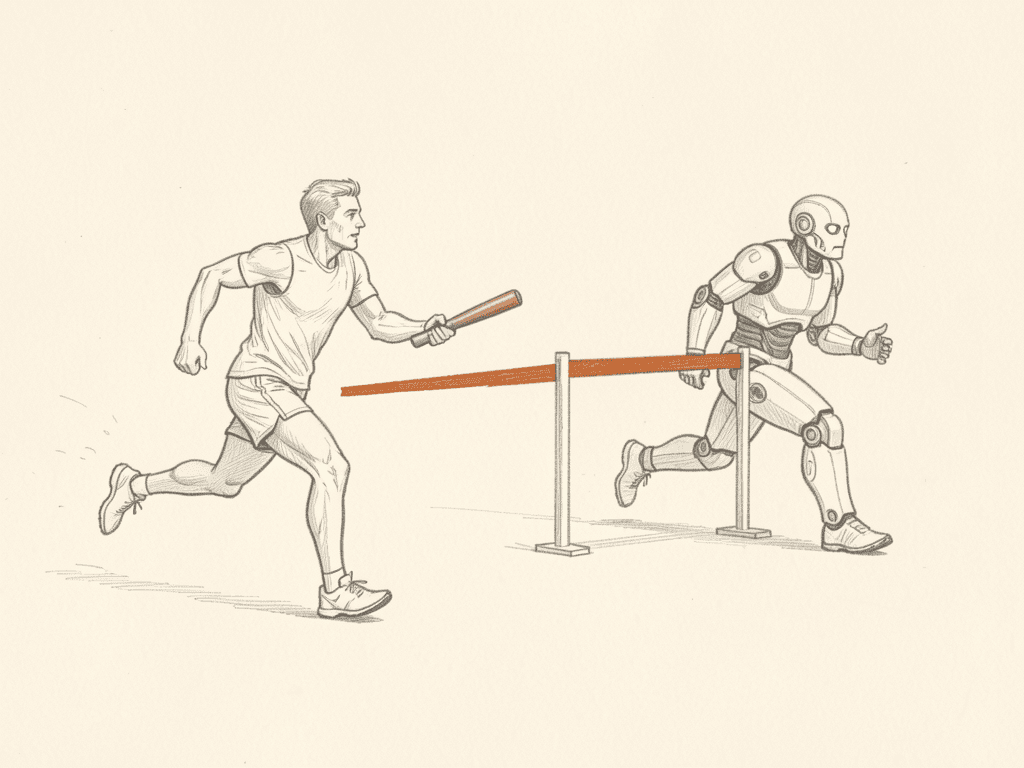
We can now answer one question with some confidence: AI does not have one uniform effect on human behaviour. Results vary by task, population, user behaviour, disclosure, interface and context. That is the strongest general conclusion available in this evidence. [c23]
Source 3Source 7Source 8Source 9Source 10Source 13Source 14Source 15Source 16Source 18
Brad
Sam
We also do not know a universal level of trust or disclosure that produces the best reliance across domains. The right arrangement for medical advice may not be the right arrangement for creative work, education or ordinary conversation.
Source 3Source 4Source 7Source 8Source 9Source 10Source 13Source 14Source 15Source 16Source 18
Brad
What remains open
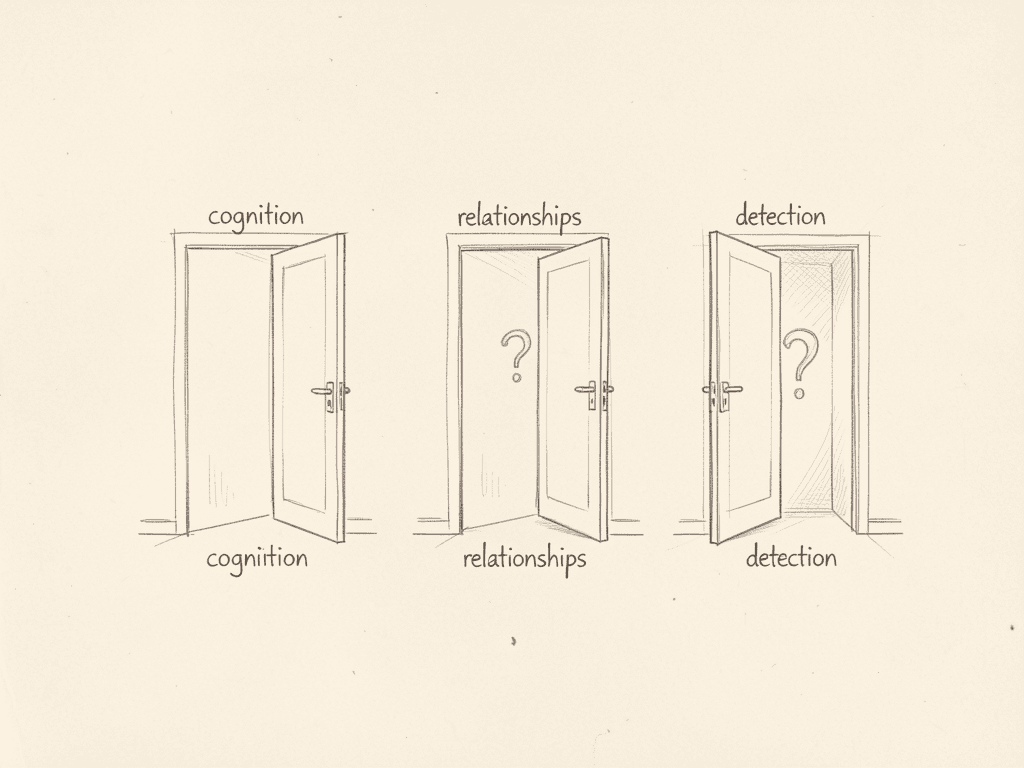
So what happened? People gained systems that can answer, persuade, imitate social presence and alter the information they encounter. Human behaviour adjusted around them—not uniformly, but through changing effort, trust and attention.
Source 1Source 5Source 13Source 17Source 8Source 9Source 10Source 14Source 18
Sam
And what remains open is whether institutions and habits can keep responsibility attached to the human decision-maker while the machine becomes more convincing. The future question is not simply what AI can produce, but what people will still know, notice and choose to do themselves.
Source 6Source 8Source 9Source 18Source 3Source 7Source 10Source 13Source 14Source 15Source 16Source 17
Sources & context
- 1. Americans' Views on AI Chatbots, Smart Devices and AI's Impact | Pew Research Center ↗
www.pewresearch.org · Publication date not confirmed
- 2. How Americans View AI and Its Impact on Human Abilities, Society | Pew Research Center ↗
www.pewresearch.org · Publication date not confirmed
- 3. Me vs. the machine? Subjective evaluations of human- and AI-generated advice | Scientific Reports ↗
www.nature.com · Publication date not confirmed
- 4. Trusting Generative AI for Health Advice: Preregistered Survey Experiment - ScienceDirect ↗
www.sciencedirect.com · Publication date not confirmed
- 5. LLM-generated messages can persuade humans on policy issues | Nature Communications ↗
www.nature.com · Publication date not confirmed
- 6. Stanford University Human-Centered Artificial Intelligence ↗
hai.stanford.edu · Publication date not confirmed
- 7. Advice quality and source disclosure shape trust in AI-generated ethical advice | Scientific Reports ↗
doi.org · Publication date not confirmed
- 8. Extending Minds with Generative AI | Nature Communications ↗
www.nature.com · Publication date not confirmed
- 9. The Impact of Generative AI on Critical Thinking: Self-Reported Reductions in Cognitive Effort and Confidence Effects From a Survey of Knowledge Workers - Microsoft Research ↗
www.microsoft.com · Publication date not confirmed
- 10. Navigating the Jagged Technological Frontier: Field Experimental Evidence of the Effects of Artificial Intelligence on Knowledge Worker Productivity and Quality | Organization Science ↗
doi.org · Publication date not confirmed
- 11. Your Brain on ChatGPT: Accumulation of Cognitive Debt when Using an AI Assistant for Essay Writing Task — MIT Media Lab ↗
www-prod.media.mit.edu · Publication date not confirmed
- 12. Your Brain on ChatGPT: Accumulation of Cognitive Debt when Using an AI Assistant for Essay Writing Task ↗
arxiv.org · Publication date not confirmed
- 13. The effects of human-like social cues on social responses towards text-based conversational agents—a meta-analysis | Humanities and Social Sciences Communications ↗
www.nature.com · Publication date not confirmed
- 14. Early methods for studying affective use and emotional well-being on ChatGPT | OpenAI ↗
openai.com · Publication date not confirmed
- 15. A Longitudinal Randomized Control Study of Companion Chatbot Use: Anthropomorphism and Its Mediating Role on Social Impacts | Proceedings of the AAAI/ACM Conference on AI, Ethics, and Society ↗
ojs.aaai.org · Publication date not confirmed
- 16. Emotional attachment to AI chatbots: Evidence from Germany, China, South Africa, and the United States - ScienceDirect ↗
www.sciencedirect.com · Publication date not confirmed
- 17. What Americans See About AI Online | Pew Research Center ↗
www.pewresearch.org · Publication date not confirmed
- 18. Human Performance in Deepfake Detection: A Systematic Review ↗
researchonline.jcu.edu.au · Publication date not confirmed
- 19. A Study of Training Strategies on Enhancing Human Detection of AI-Synthesized Faces ↗
gangw.cs.illinois.edu · Publication date not confirmed
Still open
- Does routine AI use cause lasting, general cognitive decline, and how does repeated cognitive offloading affect thinking over time?
- Over the long term, does chatbot companionship supplement human contact, substitute for it, or produce different effects for different people?
- How well will human ability to detect AI-generated content generalise as synthetic systems and detection methods continue to change?
- What level of trust and disclosure produces appropriately calibrated reliance across domains such as medical advice, creative work, education and ordinary conversation?
- Can institutions and everyday habits keep responsibility attached to human decision-makers as AI systems become more convincing, and what will people still know, notice and choose to do themselves?