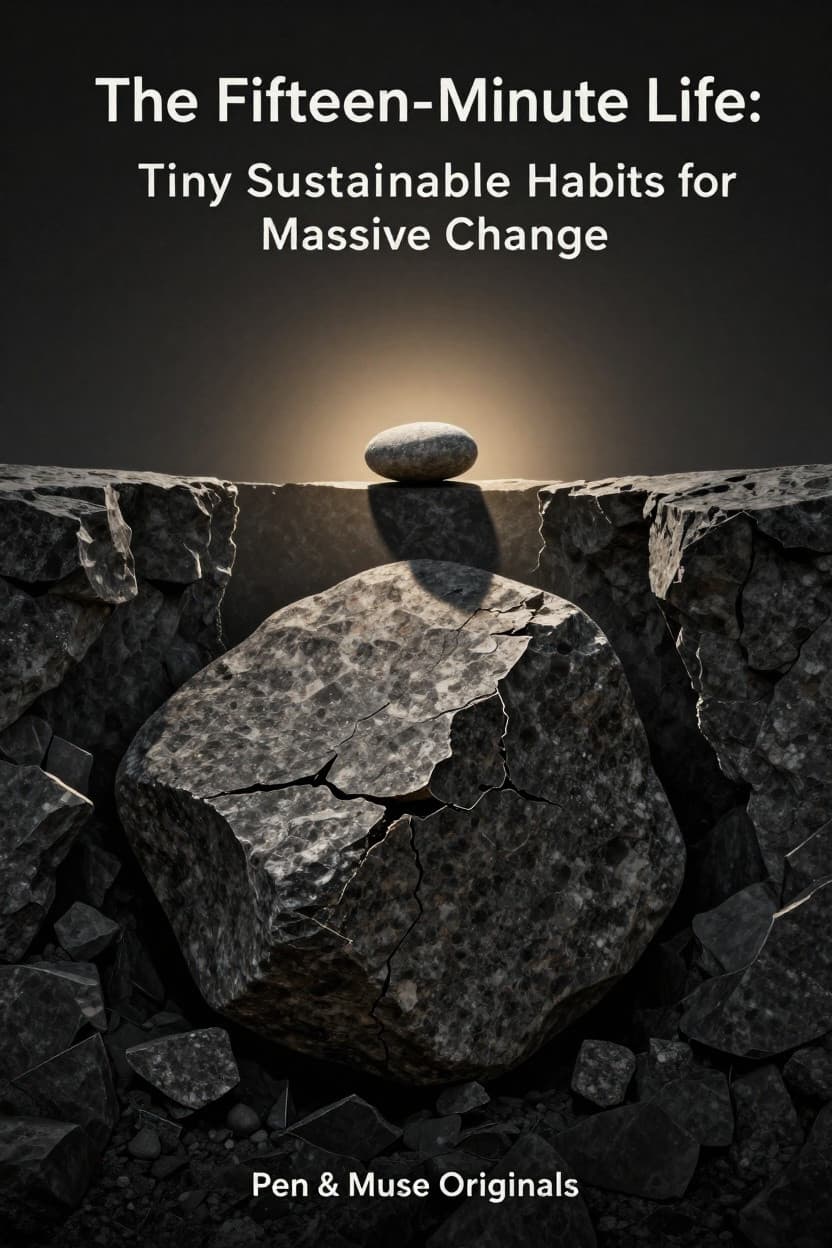
The Fifteen Minute Life
Tiny Sustainable Habits for Massive Change
A Pen & Muse Original
Includes EPUB download and browser reading. No membership needed.
One payment · No recurring charge
The Fifteen Minute Life
Tiny Sustainable Habits for Massive Change
Tired of the Sunday-night New You fantasy that detonates by Monday morning? We’ve all lived it — grand plans, fierce resolve, and the quiet shame when everything collapses before Tuesday.
The Fifteen Minute Life tears apart the destructive myth of the total overhaul. It exposes willpower-driven change for what it really is: a fast track to burnout, frustration, and self-blame.
This book offers a different path. Not a sledgehammer. Not a life reset. A radical shift in scale — a stealth approach to change built on small, repeatable actions that actually stick.
No hype. No punishment. Just fifteen minutes at a time — enough to rebuild momentum, restore confidence, and create progress that compounds.
Reclaim your life not through force, but through consistency.
Not through intensity, but through inevitability.
One quiet, unstoppable action at a time.
Read a free sample
No account or email required.
The Tyranny of the Overhaul
It is 10:00 PM on a Sunday night. You are sitting at your kitchen table, or perhaps curled up on the sofa, and you have a notebook open in front of you. The house is quiet. The distractions of the weekend are fading, and the looming reality of Monday morning is creeping in.
But this Monday is going to be different. You can feel it. This isn’t just another week; this is the start of the New You .
You hold your pen with a sense of grim determination. You start writing a list. It isn’t a grocery list or a set of reminders. It is a battle plan. It is a manifesto of total life reconstruction.
You hold your pen with a sense of grim determination. You start writing a list. It isn’t a grocery list or a set of reminders. It is a battle plan. It is a manifesto of total life reconstruction.
-
Wake up at 5:00 AM sharp. No snooze button.
-
Meditate for thirty minutes.
-
Run three miles before breakfast.
-
Drink a green smoothie (kale, not spinach).
-
Write five hundred words of that novel.
-
No social media until after dinner.
-
Read one chapter of a non-fiction book to improve career skills.
-
In bed by 9:30 PM.
You look at the list. It looks beautiful. It looks perfect. It is symmetrical, ambitious, and morally superior. You feel a rush of dopamine just looking at the ink on the page. In this moment, you haven’t actually done any of these things, but you feel as though you have. You visualize yourself breezing through this schedule, a titan of productivity, a master of self-discipline. You imagine your friends asking, “How do you do it all?” and you imagine yourself shrugging modestly.
You go to bed feeling empowered. You set the alarm for 5:00 AM.
Then, reality happens.
The alarm goes off in the pitch black of early morning. Your body, confused and heavy, rebels. You hit snooze. Just once, you tell yourself. You need five more minutes to gather your mental strength. You hit it again. Suddenly, it is 6:45 AM. You are late.
Panic sets in. The meditation is out the window. The run is impossible. You scramble to get dressed, grab a piece of toast instead of blending kale, and rush out the door. By the time you get to work, you have already failed three of the eight items on your list.
The shame begins to simmer in your gut. You tell yourself you will make up for it in the evening. You will write the novel then. You will read the book then. But by the time you get home, you are exhausted from a day of work and the emotional weight of your morning failure. You open social media to numb the brain. You look up, and it is 11:00 PM. You missed the bedtime deadline.
Tuesday is worse because now you carry the guilt of Monday. By Wednesday, the notebook is closed. By Friday, the New You has been quietly buried in the backyard of good intentions, and the Old You is back on the sofa, tired and wondering why this keeps happening.
Does this sound familiar? It should. It is the universal cycle of modern self-improvement. We have all been there. We have all written that list. We have all felt that Sunday night high and that Wednesday morning crash.
We assume the problem is us. We look at the list, and then we look in the mirror, and we conclude that we are simply broken. We lack willpower. We lack grit. We lack the mysterious "it factor" that successful people seem to have in spades. We tell ourselves that next time, we just need to try harder. We need to want it more.
I am here to tell you that you are wrong.
The problem isn’t you. The problem isn’t your willpower, your character, or your desire. The problem is the list. The problem is the strategy. You are a victim of a pervasive, seductive, and ultimately destructive lie that I call
The Tyranny of the Overhaul .
The Myth of the Clean Slate
We live in a culture obsessed with the makeover. We love the "before" and "after" photos. We love the montage sequence in movies where the protagonist decides to change their life, and three minutes of upbeat music later, they are fit, wealthy, and organized. We are conditioned to believe that change is an event. We think transformation happens in a dramatic explosion of effort.
The Tyranny of the Overhaul is the belief that in order to fix your life, you must fix all of it, and you must do it right now . It tells you that incremental progress is for the weak. It tells you that if you aren't suffering, you aren't growing. It demands a clean slate.
This approach is appealing because it speaks to our desire for redemption. When we feel stuck, cluttered, or unhealthy, we don't just want to be a little bit better; we want to be a different person entirely. We want to burn the old life down and build a skyscraper in its place.
But think about what that Sunday night list actually represents. It is not a plan for a human being; it is a program for a robot. It ignores the reality of your current habits, your energy levels, your commitments, and your psychology. It asks you to go from zero to one hundred in a single day.
Imagine you have never lifted weights before. You walk into a gym, walk past the five-pound dumbbells, past the twenty-pound dumbbells, and walk straight up to a three-hundred-pound barbell. You grip it and pull with all your might. Nothing happens. You strain until your veins pop, but the bar doesn't move. You leave the gym feeling defeated and weak.
Did you fail because you are incapable of building muscle? No. You failed because you tried to lift three hundred pounds on your first day. That is what the Overhaul does to your willpower. It loads the bar with every single insecurity and aspiration you have, and then expects you to lift it before breakfast.
The Paralysis of "Too Much"
When the brain is faced with a massive, complex challenge, it has a very specific reaction: it freezes. This is a survival mechanism. When our ancestors faced a predator that was too large to fight and too fast to outrun, the best option was often to play dead. To freeze.
The Sunday night list is a predator. It is too big. It is too scary. When you look at a to-do list that requires you to change your sleep, your diet, your exercise, your work habits, and your leisure time all at once, your brain’s amygdala—the fear center—lights up. It perceives a threat to your safety. It sees a massive expenditure of energy with no guarantee of rew ard.
So, your brain pulls the emergency brake. This manifests as procrastination. It manifests as "doom scrolling" on your phone when you know you should be working. It manifests as cleaning the kitchen when you meant to be exercising.
We often mistake this paralysis for laziness. We berate ourselves. "Why can't I just get up and do it?" we ask. "It's just a thirty-minute run. It's just one chapter."
But it isn't just a run. In the context of the Overhaul, that run is a symbol of the entire mountain you have to climb. It is weighted with the expectation of perfection. If you miss the run, the whole house of cards falls down. The stakes become artificially high. The pressure becomes unbearable. And under that pressure, we collapse.
This is the cruel irony of the Overhaul. By trying to change everything, we end up changing nothing. The sheer magnitude of the plan guarantees its failure. We aim for the stars, trip over our own shoelaces, and never leave the launchpad.
The Cycle of Boom and Bust
The Tyranny of the Overhaul creates a volatile cycle in our lives. We oscillate between periods of intense, unsustainable effort and long periods of total inactivity. It is a boom-and-bust economy of the soul.
During the "boom" phase—usually January 1st, or a Monday, or the day after a birthday—we are manic. We buy the equipment. We purge the pantry. We color-code the calendar. We run on pure adrenaline and the high of expecting a new life. This phase usually lasts between three days and three weeks.
But willpower is a finite resource. It is like a battery. Every time you force yourself to do something uncomfortable, you drain the battery. Every time you resist a cookie, wake up early when you're tired, or focus on a boring task, you deplete your reserves. The Overhaul demands that you run on high voltage, twenty-four hours a day.
Eventually, the battery dies. This is the "bust." The crash is inevitable. And because the Overhaul is an all-or-nothing philosophy, one slip-up feels like a total catastrophe. If you eat one donut, the diet is ruined, so you might as well eat the whole box. If you miss one workout, the streak is broken, so you might as well cancel the gym membership.
The bust phase is characterized by shame. We retreat into our old comforts—the junk food, the television, the procrastination—but now we enjoy them less because we are judging ourselves the whole time. We feel like frauds. We look at other people who seem to have their lives together and wonder what secret they know that we don't.
We stay in the bust phase for months, waiting for the motivation to return. Waiting for the next spark of inspiration that will convince us to try the Overhaul again. And eventually, we do. We buy a new notebook. We write a new list. And the wheel turns once more.
Why We Keep Doing It
If the Overhaul fails so consistently, why do we keep coming back to it? Why is the self-help industry dominated by books and programs that promise radical transformations in thirty days?
First, because it sells. "Change your life in fifteen minutes a day over the course of two years" is not a sexy headline. "Get a six-pack in six weeks" is. We are impatient. We are conditioned by a world of instant gratification. We can get food delivered in twenty minutes and movies streamed in seconds; we feel we should be able to download a better version of ourselves just as quickly.
Second, because the Overhaul feels like work. It feels heroic. There is a martyrdom in suffering through a brutal regimen. If we are miserable, we assume we must be doing something right. We equate difficulty with virtue. We think that if a change feels easy, it doesn't count.
Third, and perhaps most deeply, we use the Overhaul to avoid the truth. The truth is that real change is boring. Real change is unglamorous. Real change happens on a Tuesday afternoon when nobody is watching. It isn't a montage set to music. It is a slow, quiet, often invisible shift in trajectory.
The Overhaul allows us to live in a fantasy. As long as we are planning the massive change, we don't have to do the small, mundane work of the actual change. We get addicted to the planning because the planning is safe. The execution is where the fear lives.
The Cost of the Illusion
The tragedy of the Overhaul isn't just that it doesn't work. It is that it actively harms us. It erodes our self-trust.
Imagine you have a friend who constantly promises to meet you for coffee. "I'll be there at 2:00 PM," they say. You go to the cafe, wait for an hour, and they never show up. The next week, they say, "I promise, 2:00 PM." Again, they ghost you. After five or six times, do you trust that friend? Do you believe a word they say?
When you set impossible goals and fail to meet them, you are breaking a promise to yourself. You are teaching your own brain that your word means nothing. You are training yourself to expect failure. Eventually, when you say, "I am going to do this," your subconscious rolls its eyes and says, "Yeah, right. I've heard that before."
This loss of self-trust is devastating. It creates a learned helplessness. We stop setting goals because we are afraid of the pain of not reaching them. We settle for a life that is smaller than we want because the cost of trying to expand seems too high.
We begin to believe that we are incapable of change. We label ourselves. "I'm just not a morning person." "I'm just disorganized." "I just don't have the discipline." These labels become self-fulfilling prophecies. We lock ourselves in a cage of our own making, and the Overhaul throws away the key.
A Different Path
But what if the cage door was never locked? What if the problem wasn't your inability to lift three hundred pounds, but the fact that you refused to pick up the five-pound weight?
There is another way. It is a path that rejects the tyranny of the massive list. It rejects the guilt, the shame, and the boom-and-bust cycle. It is a path that respects your psychology, your biology, and your reality.
It is not about changing everything at once. It is about changing one tiny thing, consistently. It is not about heroic effort. It is about strategic stealth. It is about slipping under the radar of your brain's fear response.
Imagine, instead of the Sunday night list of doom, you had a different goal. Imagine if your only goal for the day was to put on your running shoes. Not to run three miles. Just to tie the laces. Could you do that? Of course you could. It takes thirty seconds. It requires zero willpower. You could do it while tired, while hungry, while str essed.
Now, imagine if you did that every day. Just the shoes. It sounds ridiculous, doesn't it? It sounds too small to matter. How can tying your shoes change your life?
This is the secret that the Overhaul hides from you: Momentum is more important than magnitude.
A massive object that is standing still is hard to move. A small object that is already moving is easy to guide. The Overhaul tries to push a boulder up a hill from a dead stop. The alternative approach—the one we will explore in this book—is about getting a pebble rolling down a hill and letting gravity do the work.
We need to lower the bar. We need to lower it so much that it feels like cheating. We need to make success easier than failure. We need to stop trying to win the gold medal in a sport we haven't even started practicing.
The Revolution of the Small
This book is not about how to overhaul your life. It is about how to stop overhauling it so that you can actually start living it. It is about rejecting the grand plan in favor of the tiny win.
We are going to dismantle the idea that change requires suffering. We are going to prove that you can achieve more by doing less—provided you do the right less. We are going to focus on time. Not hours, but minutes. Specifically, fifteen of them. Or ten. Or two.
We are going to look at the pockets of your day, the small moments that vanish while you are waiting for the kettle to boil or scrolling through your phone. We are going to reclaim those moments. Not with grim determination, but with curiosity.
You do not need a new personality. You do not need a new brain. You do not need to become a monk or a Navy SEAL. You are fine just as you are. You just need a better system.
The Overhaul tells you that you are inadequate. This revolution tells you that you are overburdened. The Overhaul tells you to sprint until you collapse. This revolution tells you to walk until you get there.
If you are tired of starting over, stop giving yourself a reason to quit. If you are tired of the crushing weight of your own expectations, put the weight down. You don't need it. You can't climb a mountain carrying a refrigerator on your back.
So, take that Sunday night list. The one with the 5:00 AM wake-up call and the green smoothie and the novel. Take a good look at it. Acknowledge the ambition behind it. Acknowledge the part of you that wants to be better. That part is good. That part is vital.
Reader Fit
Read with a membership
Read the membership catalogue in your browser and use eligible interactive Living Editions while subscribed. Publicly released audio and immersive chapters are also free without membership. Purchased books stay yours.
Narration is available on selected chapters. Living Editions are interactive readings where you can explore the work and respond to it. They are different from recorded narration.
Membership is browser access. EPUB and PDF downloads come with a book purchase.
Reader membership from £9.99/month
See membership & what’s includedThe Fifteen Minute Life
# The Fifteen Minute Life ### Tiny Sustainable Habits for Massive Change Tired of the Sunday-night *New You* fantasy that detonates by Monday morning?
- Tiny Sustainable Habits for Massive Change
- **The Fifteen Minute Life** tears apart the destructive myth of the total overhaul.
- Practical · Actionable · Empowering
- A work made to reward attention and return.
Additional details
Available formats
- DRM-free EPUB
- 37,036 Words
- 186 min read