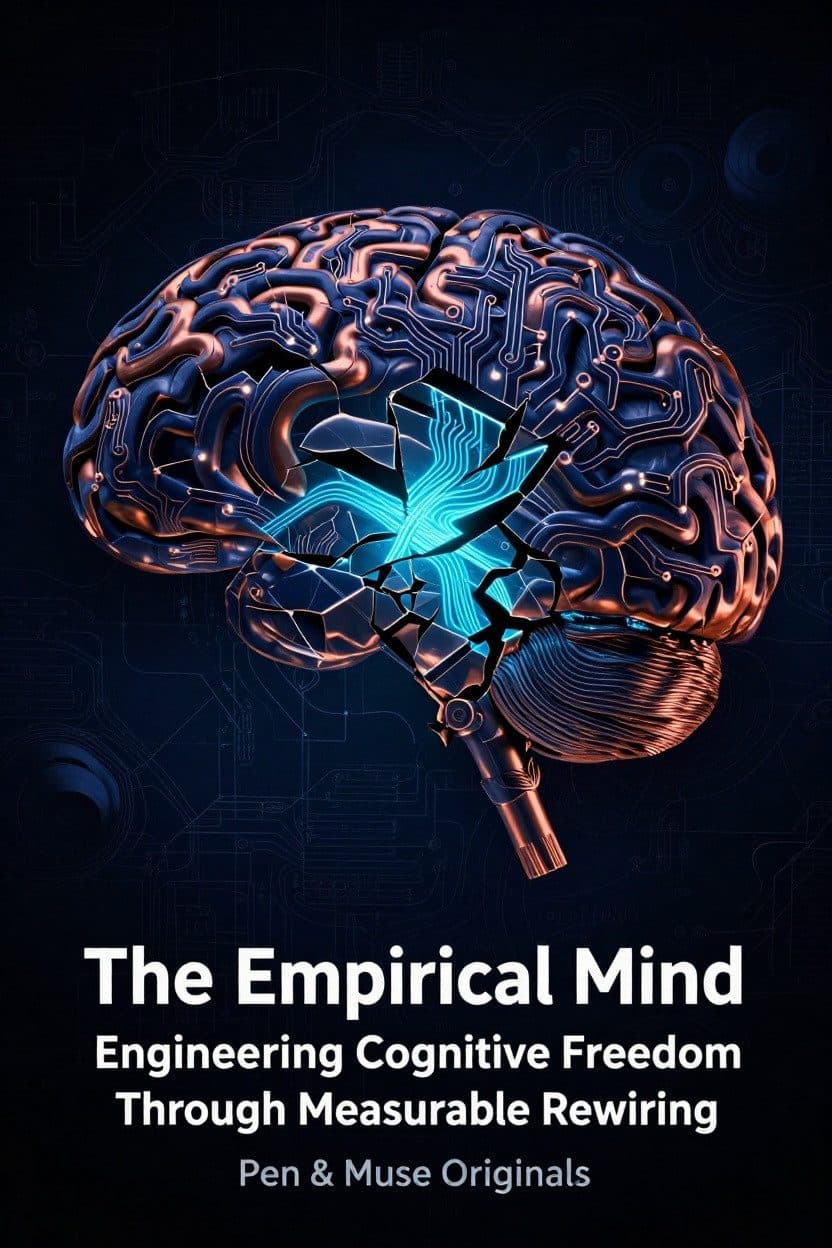
The Empirical Mind
Engineering Cognitive Freedom Through Measurable Rewiring
A Pen & Muse Original
Read with a membership
Read the membership catalogue in your browser and use eligible interactive Living Editions while subscribed. Publicly released audio and immersive chapters are also free without membership. Purchased books stay yours.
Narration is available on selected chapters. Living Editions are interactive readings where you can explore the work and respond to it. They are different from recorded narration.
Membership is browser access. EPUB and PDF downloads come with a book purchase.
Reader membership from £9.99/month
See membership & what’s includedThere are maps of the world, and then there are maps of the mind. Most people never realise they are navigating by outdated charts.
The Empirical Mind is an interactive work of applied psychology and cognitive science that treats the self not as a fixed identity, but as a system that can be observed, tested, and deliberately rewired.
Drawing on historical disasters, elite training methodologies, neuroscience, and behavioural research, each chapter becomes a guided exploration where the reader moves from concept, to personal diagnosis, to structured intervention.
The goal is not insight alone, but measurable change. Not motivation, but method. Not reflection, but recalibration.
This is a field manual for updating the internal models that quietly control your life.
Read a free sample
No account or email required.
When Maps Lie: Explorers and Outdated Internal Charts
Opens with a documented episode of early continental navigation failures—how cartographers' inherited charts led otherwise competent travelers into catastrophe—and draws a tight analogy to the brain’s reliance on entrenched internal maps. Dissects why those maps persisted despite contradictory feedback and how that mirrors habitual cognitive and emotional responses in adults. Lays out the core problem statement: cognitive freedom is not wishful reframing but replacing maladaptive maps with testable, updated models. Introduces the reader to the empirical stance the book will adopt: every intervention must register measurable change in behavior, physiology, or neural signatures.
From Fixed Soul to Plastic Brain: A Scientific Reorientation
Ordered, evidence-first history showing how discoveries like Hebb’s postulate, Bliss and Lømo’s demonstration of long-term potentiation, and later findings of adult neurogenesis and synaptogenesis overturned the notion of a biologically fixed self. Explains, with citations to landmark experiments and conceptual shifts, how each finding reframed identity as dynamic and trainable rather than immutable. Points out the implications for personal change: if the brain’s wiring adapts, interventions can be designed as engineering problems. Ends with a précis of scientific credibility standards this book will use when recommending practices.
Principles of Rewiring: Rules That Govern Neuroplastic Change
Distills the functional rules that govern change: use-dependent strengthening, timing-dependent plasticity, salience and reward tagging, metaplasticity, and the role of consolidation windows. For each principle the chapter provides operational definitions and practical boundary conditions—how much repetition, what spacing, what emotional intensity produces different classes of change. Includes brief examples that map each principle to a measurable outcome (e.g., increased MEP amplitude after timed motor training). Frames rules as constraints that practitioners must design around rather than vague advice.
Reader Fit
The Empirical Mind
There are maps of the world, and then there are maps of the mind.
- Engineering Cognitive Freedom Through Measurable Rewiring
- Analytical · Empirical · Rigorous
- A work made to reward attention and return.
Additional details
Available formats
- Living Edition
- 16,672 Words
- 84 min read