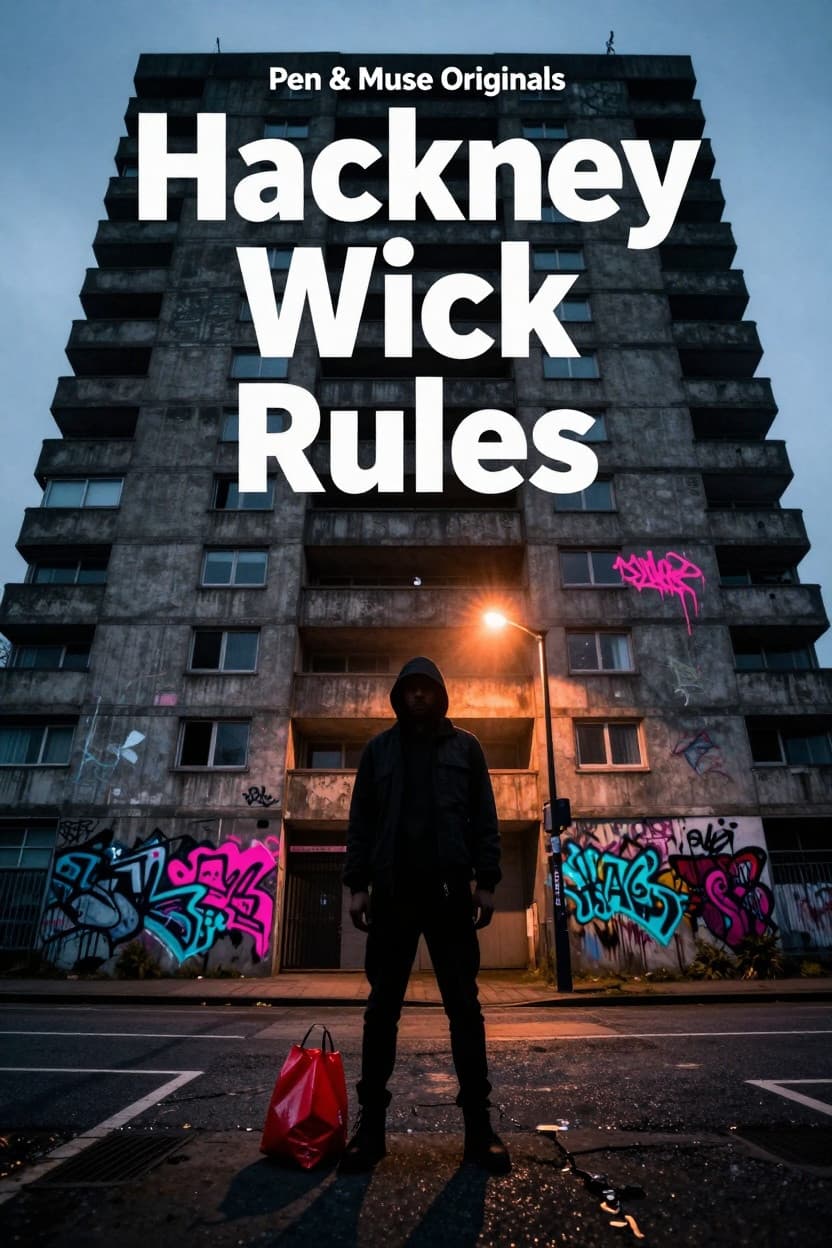
Hackney Wick Rules
A Pen & Muse Original
Includes EPUB download and browser reading. Interactive Living Edition included. No membership needed.
One payment · No recurring charge
A Gritty Urban Crime Drama
In the shadows of Hackney Wick, survival isn’t measured in money — it’s measured in respect, loyalty, and the choices you make when there are no good options left.
Jamal is young, sharp, and fiercely protective of his family. On an estate governed by unspoken rules, crime is currency and trust is fragile. When his sister Tia is pulled into the local drug trade without understanding the cost, Jamal is forced into a world where every move carries consequences — and walking away is no longer an option.
As tensions rise and rival factions close in, Jamal must navigate shifting alliances, quiet betrayals, and the limits of his own morality. Each decision tightens the grip of the estate, drawing him deeper into a cycle designed to trap those born into it.
A raw, emotionally charged story of loyalty, sacrifice, and the fight to protect what matters most — even when freedom comes at a devastating price.
Read a free sample
No account or email required.
Chapter One
The grey sky over Hackney Wick didn’t just hang there; it pressed down. It felt heavy, like a wet wool blanket draped over the rooftops of the council estate. Jamal pulled his collar up against the damp chill. He kept his eyes moving, scanning the walkways and the shadows between the concrete pillars. In the Wick, you didn’t stare, but you never stopped looking. That was the first rule. If you stopped paying attention, the estate would chew you up and spit you out before you even realized you were in its mouth.
He walked with a steady rhythm. Not too fast, because rushing made you look guilty or scared. Not too slow, because loitering made you a target. He had a destination, and he needed everyone who saw him to know it. His trainers scuffed against the uneven pavement, a rhythmic scritch-scritch that matched the beat of the music thumping from a third-floor window.
Jamal checked his pocket.
The envelope was still there. It was small, sealed tight, and felt heavier than just paper. He didn’t know what was inside, and he didn’t care. Knowing things was dangerous.
Knowing things meant you had to lie, and lies were hard to keep straight. Being a delivery man was simple. You take the thing from point A to point B. You don’t ask questions. You don’t look inside. You just do the job.
He turned the corner past the row of shops that had been shuttered for as long as he could remember. The metal grates were rusted and covered in layers of spray paint. Tags over tags, a history of the neighborhood written in neon loops and jagged lines. Jamal knew most of the names painted there. Some were still around, standing on corners or sitting in prison cells. Others were gone, buried in the ground or moved away to places where the sky wasn’t quite so grey.
A group of teenagers stood near the entrance to the playground.
The swings were broken, the chains twisted around the top bars, leaving the seats dangling out of reach.
The boys wore dark hoodies, their faces obscured by shadows and fabric. They were the youngers, the new generation trying to carve out their own slice of respect. They laughed loud and sharp, like barking dogs, pushing each other and watching the street with hungry eyes.
Jamal didn’t flinch. He kept his pace steady.
He knew them, or at least he knew their type. They were looking for weakness.
They were looking for someone to test. If he crossed the street to avoid them, he lost. If he stared them down, he was issuing a challenge he didn’t have time for. So he did the middle thing. He lifted his chin, just a fraction. A nod. An acknowledgment.
I see you. I’m not afraid. I’m working.
One of the boys, a tall kid with a scar through his eyebrow, stopped laughing. He watched Jamal approach. The air between them grew tight, like a rubber band stretched to its limit. Jamal felt the envelope in his pocket again, a burning weight against his thigh. He kept his hands visible, swinging naturally at his sides.
"Jamal," the boy said. It wasn’t a greeting. It was a check.
"Trey," Jamal replied. He didn’t stop walking. He kept his voice flat, devoid of emotion. "Cold out."
"Standard," Trey said. He held Jamal’s gaze for a second, then looked away, spitting on the ground. The tension snapped, the rubber band going slack. The pack went back to their laughter, dismissing him. He was allowed to pass. He had paid the toll with a name and a lack of fear.
Jamal let out a breath through his nose, quiet and controlled. That was the currency here. Not money. Money came and went. You could have a pocket full of cash one day and be broke the next. But respect? Respect stuck to you. It was the armor that kept the knives away. You earned it in drops, day by day, interaction by interaction. And you could lose it all in a single second if you flinched.
He moved deeper into the estate, toward the high-rise towers that dominated the skyline. They looked like giant tombstones, rows of identical windows staring out at the city. This was Boss Man’s territory. The air felt different here. It was quieter, but it was a heavy silence. The kind of silence that happens in a forest when a predator is near.
Boss Man wasn’t a king in a castle. He was a ghost in the machine. He ran the Wick, but you rarely saw him.
He operated through whispers and nods, through people like Jamal carrying envelopes from one place to another. Everyone knew who he was, but no one spoke his real name. He was just Boss Man. The title was enough.
Jamal approached the entrance to the central tower. The intercom system had been smashed years ago, wires hanging out like colorful guts. The glass door was propped open with a brick. He stepped into the lobby. It smelled of bleach and old cooking oil. The lift was out of order, a piece of paper taped to the doors with "BROKEN" scrawled in angry red marker.
He headed for the stairs. Four flights up. He took them two at a time, his legs burning. It was good exercise, he told himself. Kept him sharp.
Kept him ready. In the Wick, you had to be ready to run, even if you hoped you never had to.
On the fourth floor, the hallway was dim. Half the lights were blown out. Jamal counted the doors. 4B. 4C. 4D. He stopped in front of 4E. The door was painted a dark blue, the paint chipping away around the handle. He didn’t knock. You didn’t knock at Boss Man’s door unless you wanted to startle someone holding a gun. You waited.
There was a camera mounted in the corner of the ceiling, a small black dome with a red light blinking steadily. Jamal looked up at it, keeping his face blank. He waited for five seconds. Ten. Then, the lock clicked. A loud, mechanical sound that echoed in the empty hallway. The door creaked open a few inches.
Jamal pushed it open and stepped inside.
The flat was warm. Stiflingly warm. The heating was cranked up high, battling the damp chill of the concrete walls. The windows were covered with thick curtains, blocking out the grey light. A television played in the corner, the volume turned down low. It was a news channel, headlines scrolling across the bottom of the screen about politics and the economy, things that felt a million miles away from Hackney Wick.
Sitting in a plush leather armchair was Boss Man. He was an older man, maybe fifty, with grey creeping into his short beard. He wore a clean tracksuit, pristine white, without a single crease. He looked like a man who didn’t have to worry about the mud and the grime outside. He was peeling an orange, his fingers moving with slow, deliberate precision.
"Jamal," Boss Man said. He didn’t look up. He focused on the peel, removing it in one long, continuous strip.
"Boss," Jamal said. He stood by the door. He didn’t move further into the room until he was invited. That was another rule. You didn’t invade the space of a man who could end you.
"Smooth walk?" Boss Man asked.
"Quiet," Jamal said. "Saw Trey and his lot by the swings. They’re just making noise."
Boss Man nodded. He finished peeling the orange and placed the skin on a small table beside him. He pulled a segment free and popped it into his mouth. "Noise is fine," he said, chewing slowly. "Noise keeps people inside. Keeps the streets clear for business."
He finally looked at Jamal. His eyes were dark, unreadable. "You have it?"
Jamal reached into his pocket and pulled out the envelope. He stepped forward and placed it on the table next to the orange peel. He moved slowly, making sure his hands were visible the entire time. He didn't try to hand it directly to Boss Man. You didn't make a king reach for his tribute.
Boss Man glanced at the envelope but didn’t touch it. "Good," he said softly. "You’re reliable, Jamal. I like that. Reliability is rare these days. Everyone wants to be a star. Everyone wants to be the boss. No one wants to do the work."
"Just doing my part," Jamal said.
"Your part," Boss Man repeated. "It’s a small part, Jamal. But a machine needs small gears to turn, doesn’t it? If the small gear breaks, the whole engine stops."
Boss Man picked up a remote control and unmuted the television for a second, letting the noise of a commercial fill the room, then muted it again. "Your sister," he said. "She’s good?"
Jamal felt a cold spike in his chest. He kept his face frozen.
"She’s fine," Jamal said. "Studying."
"Good," Boss Man said. "Education is important. Get her out of here, eh? One of you makes it out." He smiled, but the smile didn’t reach his eyes. "But until then, we all have to eat. We all have to live in the mud."
He reached into the pocket of his tracksuit and pulled out a small roll of cash. He peeled off two notes and tossed them onto the table.
"For your time," Boss Man said.
"Respect, Boss."
"Respect."
Jamal turned and walked out. He closed the door softly behind him. He waited until he was back in the stairwell before he let out the breath he had been holding. His heart was beating a little faster than normal.
Outside, the air felt fresher. The grey sky seemed a shade lighter. Jamal tucked the money deep into his pocket.
He passed the playground again. The swings swayed gently in the wind.
He thought about Tia. She hated the estate. She wanted out.
That was why he walked. That was why he took the envelopes. He was the wall.
He turned down his street. A police car cruised slowly past, blue lights flashing silently. Jamal didn’t look.
Scritch-scritch.
He reached his front door and fumbled for his keys. A cooking show played inside. Something normal. Something safe. He locked the door. Deadbolt. Chain.
Rattle.
For a moment, he leaned his forehead against the cool wood. He closed his eyes. He was home.
But he couldn’t shake the feeling of Boss Man’s eyes on him. The weight of the envelope. The mention of his
illusion.
The Wick felt like a trap, coiled and ready to spring, and he was starving. hungry.
Jamal took a deep breath, put a smile on his face, and called out, "I'm home."
Because for now, that had to be enough.
Reader Fit
Read with a membership
Read the membership catalogue in your browser and use eligible interactive Living Editions while subscribed. Publicly released audio and immersive chapters are also free without membership. Purchased books stay yours.
Narration is available on selected chapters. Living Editions are interactive readings where you can explore the work and respond to it. They are different from recorded narration.
Membership is browser access. EPUB and PDF downloads come with a book purchase.
Reader membership from £9.99/month
See membership & what’s includedHackney Wick Rules
## A Gritty Urban Crime Drama In the shadows of **Hackney Wick**, survival isn’t measured in money — it’s measured in **respect, loyalty, and the choices you make when there are…
- In the shadows of **Hackney Wick**, survival isn’t measured in money — it’s measured in **respect, loyalty, and the choices you make when there are no good options left**.
- Gritty · London · Noir
- A work made to reward attention and return.
Additional details
Available formats
- DRM-free EPUB
- Living Edition
- 47,046 Words
- 236 min read
You Might Also Like
View Collection


Explore Other Worlds
From Different Shelves
Living Edition
The Storyteller's Toolkit
The Storyteller's Toolkit
Crafting Fiction with Atomic Seeds
Pen & Muse OriginalsFrom £7.99
Living Edition