
Previous · Part 5
The Phonology of Trust: Why Some Names Carry More Weight

Next · Part 10
The Precision of the Blade vs. the Dullness of the Spoon
This builds on Part 5: The Phonology of Trust: Why Some Names Carry More Weight
Continue with Part 10: The Precision of the Blade vs. the Dullness of the Spoon
Language is never just a label. In the boardroom and the trenches alike, the words we assign to our roles function as linguistic architecture; they dictate how we view the horizon and how the world responds to our presence.
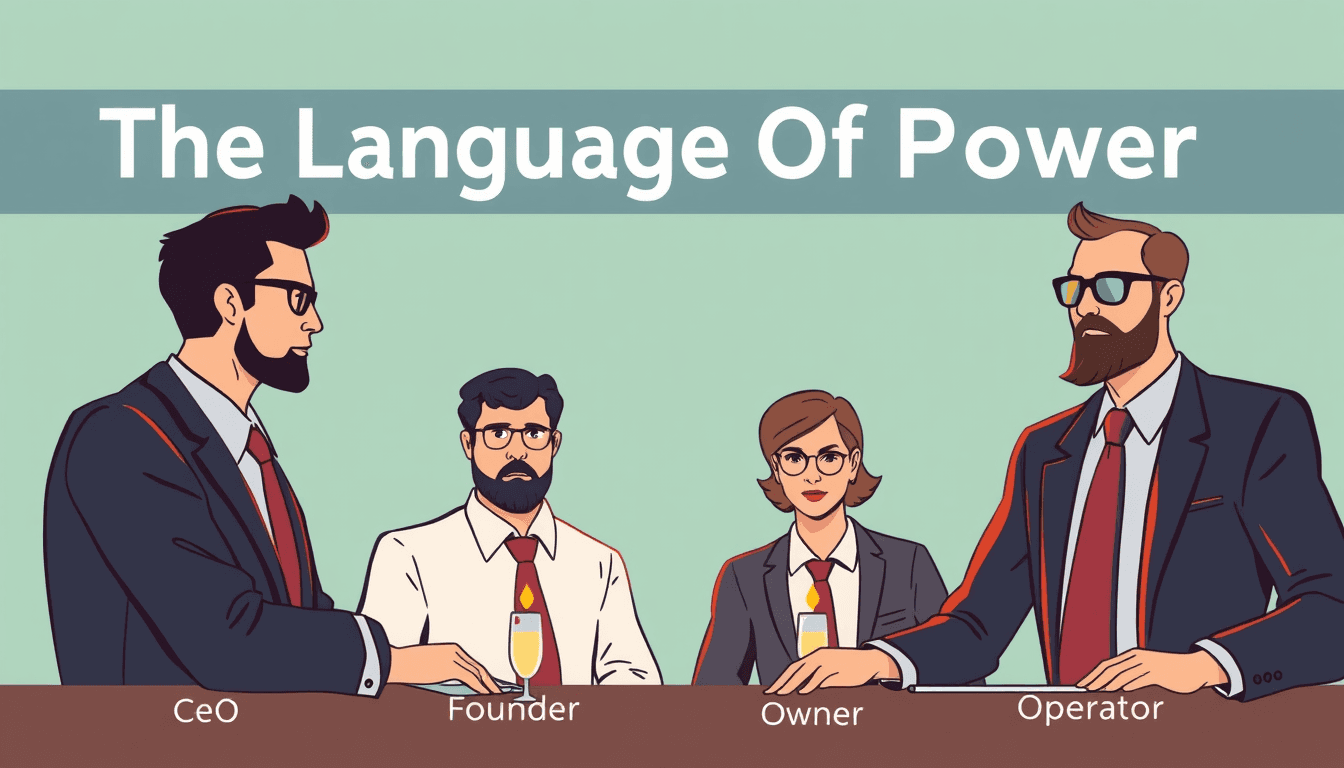
When you strip away the ego, you are left with four distinct archetypes of power. Each speaks a different dialect. Each requires a different set of muscles.
The Four Dialects of Command
Understanding these roles isn't just about HR semantics. It’s about understanding the "Language of Power" as a system of constraints and freedoms.
The visionary architect. Their language is one of possibility, conviction, and "what if." They are responsible for the original signal in a world of noise.
Mapping the Hierarchy of Intent
Power does not flow in a straight line. It shifts based on the objective. A founder may be an operator in the early days, but the moment they stop speaking the language of the founder to address the mechanics of the operator, the vision begins to dilute.
Diagram: The Vision: Founder leads to The Alignment: CEO; The Alignment: CEO leads to The Execution: Operator; The Stewardship: Owner leads to The Vision: Founder; The Stewardship: Owner leads to The Alignment: CEO; The Stewardship: Owner leads to The Execution: Operator.
Diagram: The Vision: Founder leads to The Alignment: CEO; The Alignment: CEO leads to The Execution: Operator; The Stewardship: Owner leads to The Vision: Founder; The Stewardship: Owner leads to The Alignment: CEO; The Stewardship: Owner leads to The Execution: Operator.
The Pitfalls of Linguistic Drift
The most common failure in leadership is "Role Drift"—where a person occupies one chair but speaks the dialect of another. When a CEO speaks only as a Founder, they exhaust their team with constant pivot-speak. When an Owner acts like an Operator, they suffocate the very autonomy they paid to build.
Defining Your Current Scope
To gain clarity, you must audit your own vocabulary. Are you using the language of your title, or are you regressing to the language of your comfort zone?
The Transition Template
If you find yourself needing to step into a new role, you must consciously update your communication patterns. Use this template to shift your frame of mind before a high-stakes meeting.
"In my capacity as [Your Current Role], I am looking at this through the lens of [Primary Objective].
The constraint I am prioritizing is [Constraint].
From this position, the decision we need to make is [Decision]."
Reflecting on Your Power
Your title is a boundary. By respecting the linguistic boundaries of that title, you create safety for others to operate within their own lanes. If you try to speak every language, you will eventually be understood by none.
If you were to shed two-thirds of your current responsibilities to align strictly with one of the four roles, which would it be?
Identify the one habit that prevents you from occupying that role fully today.
If this resonates, see how to apply it to your own work with the interactive Dispatch agent.
Be first to like this dispatch