Sense-making is the disciplined art of seeing patterns that others overlook.
Previous · Part 7
The Thinking That Moves People

Next · Part 9
The Moment Your Insight Becomes Someone Else’s Map
This builds on Part 7: The Thinking That Moves People
Continue with Part 9: The Moment Your Insight Becomes Someone Else’s Map
You've felt it. The moment a pattern clicks — a shift in a meeting, a tension in a market, a contradiction in someone's logic. You see it. The recognition is immediate, almost physical.
But then someone asks, "What do you mean?"
And the whole thing dissolves in your mouth.
This is the gap that separates people who have good instincts from people who change how others think. Not the quality of their seeing. The quality of their naming.
Recognition Is the First Act
Let's be clear: recognition matters enormously. You can't articulate what you haven't first perceived. The ability to feel that something is present before you can prove it — that's the foundation of all sense-making.
But recognition has a ceiling. It's experiential. It lives in the body, in intuition, in that half-formed sense of I know what's happening here even if I can't tell you why yet.
Diagram: Recognition leads to I see the pattern (Private); I see the pattern leads to Articulation (Requires); Articulation leads to Transfer (Enables); Transfer leads to Shared understanding (Creates); Shared understanding leads to Collective action (Unlocks).
Diagram: Recognition leads to I see the pattern (Private); I see the pattern leads to Articulation (Requires); Articulation leads to Transfer (Enables); Transfer leads to Shared understanding (Creates); Shared understanding leads to Collective action (Unlocks).
The problem isn't that recognition is weak. It's that recognition is incomplete. It gives you the destination but not the map. And a destination you can't describe is just a feeling.
Why Articulation Is Harder Than Seeing
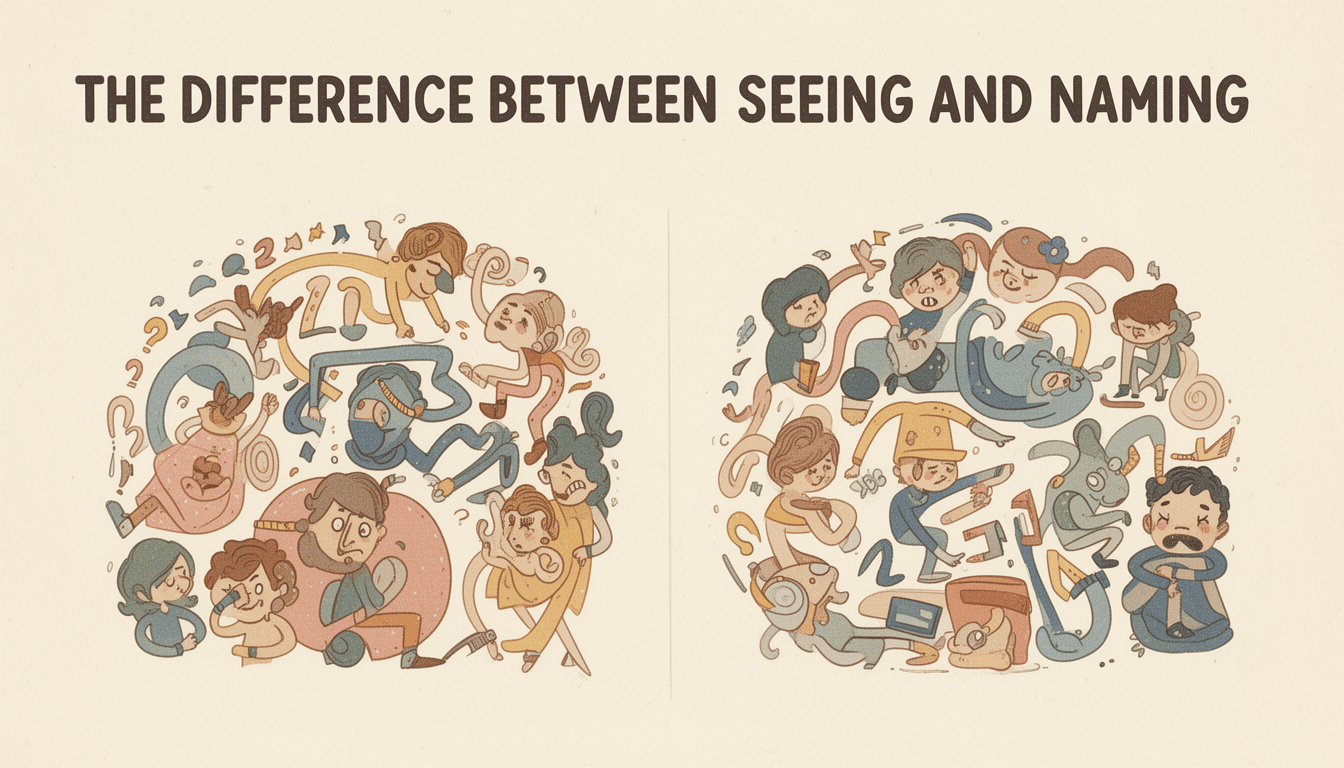
Most people underestimate this. They assume that if they can see something clearly, they should be able to explain it clearly. But seeing and explaining use different cognitive machinery.
Seeing is pattern recognition — fast, holistic, associative. Your brain matches what's in front of you against thousands of prior experiences and surfaces a felt sense of what's going on.
Articulation is pattern compression. You have to take that sprawling, multi-layered recognition and distil it into language that holds its shape when someone else picks it up.
This is why the person who says "I just think there's a trust problem" in a strategy meeting is doing something fundamentally different from the person who says "The issue is that we're asking for commitment before we've earned credibility — every ask is premature." Both see the same thing. Only one of them made it transferable.
The Transferability Test
Here's a useful heuristic: an insight is only as valuable as its ability to survive contact with someone else's mind.
"I think the culture is broken."
"We reward speed over accuracy, and people have learned that shipping wrong beats shipping slow. That's why we keep inheriting technical debt we never planned for."
The first version is recognition. The second is articulation. Notice what changed: the vague became specific, the abstract became causal, the feeling became a mechanism someone else could examine, challenge, or act on.
This is the real test. Not "do I understand this?" but "could someone who wasn't in the room, who didn't see what I saw, arrive at the same understanding from my words alone?"
If the answer is no, you haven't finished thinking.
Three Moves That Make Recognition Transferable
Articulation isn't a talent you either have or don't. It's a discipline with learnable components. Three moves, in particular, separate vague recognition from precise, transferable insight.
The Vocabulary Effect
Something important happens when you name a pattern precisely: you give other people permission to see it too.
This is the vocabulary effect. Once a pattern has a name — once someone has said "this is what's happening" in language that's sharp enough to stick — it becomes available as a shared reference point. People start pointing at it. Building on it. Disagreeing with it productively.
Recognition → Articulation → Shared Vocabulary → Collective Sense-Making
- ·How "technical debt" went from a private frustration to an industry-wide concept
- ·How "product-market fit" gave startups a shared language for a felt uncertainty
- ·How "emotional labour" named something millions experienced but couldn't discuss
You have a pattern you can feel but your team can't discuss. The act of naming it precisely is what transforms private insight into shared infrastructure.
This is why the best sense-makers are often the best namers. Not because they coin jargon. Because they find the exact words that make the invisible visible — and once named, the pattern can be worked on by everyone.
The Cost of Leaving It Unnamed
There's a real cost to staying in the recognition stage. When you see a pattern but don't articulate it, several things happen.
Others keep bumping into the same problem without a shared way to discuss it. You become the bottleneck — the only one who "gets it" but can't explain it. And eventually, your own recognition degrades, because without the discipline of articulation, even your private understanding stays fuzzy.
This is the hidden benefit. Writing out your insight, trying to explain it to someone, attempting to pin it down in language — these aren't downstream tasks you do after the thinking is finished. They are the thinking. The final, most demanding stage of it.
From Instinct to Instrument
The shift from recognition to articulation is the shift from instinct to instrument. An instinct is something you carry. An instrument is something you can hand to someone else.
Is this insight articulated enough to transfer?
- ✓Someone outside your context could act on it
- ✓It names a mechanism, not just a symptom
- ✓It implies a clear next step
- ✗It still lives as a feeling or a vibe
- ✗You find yourself saying "you know what I mean"
- ✗Others nod but don't change behaviour
If you can't articulate it in two sentences that a stranger would understand, keep working. The insight isn't finished yet.
The people who shape how others think — in organisations, in markets, in culture — aren't necessarily the ones who see the most. They're the ones who name what they see with enough precision that the seeing becomes shared.
That's the real craft. Not just pattern recognition. Pattern articulation.
What's one pattern you've recognised but never fully articulated? Try naming it in two sentences — one for the mechanism, one for why it matters.
If this resonates, see how to apply it to your own work with the interactive Dispatch agent.
Be first to like this dispatch