Podcast · Episode 1
The Anglo-Saxon Chronicle: A People in the Distance
Alex and Sam introduce The Anglo-Saxon Chronicle through the opening of the 1823 Ingram edition. They examine its claims, its sources and its gaps, and develop a vivid but careful sense of ancient Britain as a world reached through layered records rather than a single transparent story.
Alex & Sam · About 25 min
Listen here and keep browsing. Your place is saved.
Read the conversation
Alex
The Chronicle as a Buried Monument
Imagine opening a history of England and finding, before the history begins, a declaration that two objects are the country's great monuments: the Domesday record and the "Saxon Chronicle." The claim is enormous. The object itself is quieter: manuscripts, copied entries, names, battles, kings, weather, churches, and long stretches in which the past seems to speak from a great distance. Today we begin there.
Sam
And the title we are entering is The Anglo-Saxon Chronicle, but our doorway is slightly unusual. We are reading the original introduction to Ingram's 1823 edition, not pretending that this introduction is the Chronicle itself. It is a later editor standing over an older, scattered record and saying: look closely. More survives here than you may have been told.
Alex
So let’s follow the opening’s historical path, even though Ingram does not give us a scene of ships reaching shore. He says the Chronicle runs from the Saxons’ “first arrival in this country” to 1154. That span gives us a starting point: Britain is not an empty stage awaiting newcomers. In the introduction, the people already named include Britons, Picts and Scots; Roman history is another presence in the background.
Sam
An Incomplete Text with a Long Material History
The editor asks us to connect the Saxons’ story with what came before. He argues that the Saxons could have carried traditions linking their own history to the Romans who preceded them. He points to genealogies, kings, battles and conquests—not as a full account of the encounter, but as the kinds of remembered things through which a community might place itself in Britain.
Alex
That makes the arrival less like a single dramatic moment and more like a question of belonging. Who was already there? Who came, and how did later writers arrange those memories into a sequence? Ingram’s answer is not a detailed description of movement or settlement. His opening gives us names and traces, and asks us to understand a long history through them.
Sam
For listeners, one useful phrase is Ingram’s “by sea and land.” He presents the Chronicle as containing the testimony of writers across many generations, not just accounts of one arrival. The history he promises includes voyages and battles, but also the quieter conditions of life: farming, buildings, trade, law and religion. Britain comes into focus through what people did as well as through who ruled.
Alex
And the names in this introduction keep the map unsettled. Ingram mentions Britons, Saxons, Picts and Scots when discussing Gildas’s descriptions of people and customs. He is not giving us a guide to where every group lived or a complete record of their relations. But he is making clear that the island’s history cannot be told as the story of one people alone.
Sam
Here is the first surprise of the journey: the book Ingram calls a record of the Saxons is also valuable because it sits among other accounts of Britain. He compares it with Gildas, Nennius and Bede, writers whose works he says overlap with or refer to Saxon history. The past reaches us as encounters between peoples—and as encounters between accounts.
Alex
Ingram describes Gildas as preserving observations about the character and manners of Britons, Saxons, Picts and Scots. He also says that some parts of Gildas were copied almost literally by Bede, and that they confirm brief statements in the Chronicle. Read aloud, the phrase “character and manners” feels close to everyday life; the introduction does not supply the details, but it points us toward a Britain made up of communities, not just campaigns.
Sam
Chronology and Topography
Then Ingram tells us what he thinks Gildas cannot provide: enough dates and place-names to follow events precisely. His sharp phrase is “Chronology and Topography”—when, and where. That is the map the Chronicle promises him. A battle or arrival gains a position in time; it is no longer only a memory of disruption or a story about how people behaved.
Alex
But those two kinds of account do different work. A writer who describes a people’s manners may help us imagine a society, while a sequence of dated events can help us follow change. Neither gives us the whole encounter. Ingram’s opening invites us to move between them: from the people the accounts describe to the points at which one account can anchor another.
Sam
The work attributed to Nennius adds another strand. Ingram says its writer claimed to have compiled a history partly from records of the Scots and Saxons. That claim matters for our journey: memories of Britain’s peoples were not necessarily kept in separate compartments. One writer could draw on records associated with more than one group, even as later copying made the text difficult for Ingram to untangle.
Alex
And then the history opens onto a different kind of memory. Ingram describes Nennius’s work as containing Trojan origins, magic, miracles and the story of Arthur killing eight hundred and forty Saxons in a day. He does not present that number as a reliable account of a battle. It shows us how an encounter could grow into heroic legend: conflict enlarged until one champion seems to embody an entire people.
Sam
Legend and the Demand for Sobriety
Sam, that changes how the opening feels. The same broad past can appear as a dated sequence, a writer’s description of communities or a legendary feat. These are not interchangeable reports. But they tell us something different about how Britain was remembered: as a place of events, a place of distinct peoples, and a place where stories could give conflict a towering, almost impossible scale.
Alex
Next Ingram turns to Bede’s Ecclesiastical History, which he calls a “steady light” reflected on the Chronicle. Bede’s subject is the Church, but Ingram says civil, military and religious affairs appear together in his work. So Britain’s history here is not divided neatly into battle over here and belief over there. A ruler, a church and a political change can all belong to the same account.
Sam
That gives us a way to hear the word “arrival” without reducing it to a landing. Ingram says Gibson thought the Chronicle’s description of Britain, its notices of Roman emperors and its account of the Saxons’ first arrival came from Bede. Ingram challenges that view, pointing out that these passages are absent from earlier manuscripts. Even the shape of the remembered beginning differs among copies.
Alex
Bede's Mixed Historical World
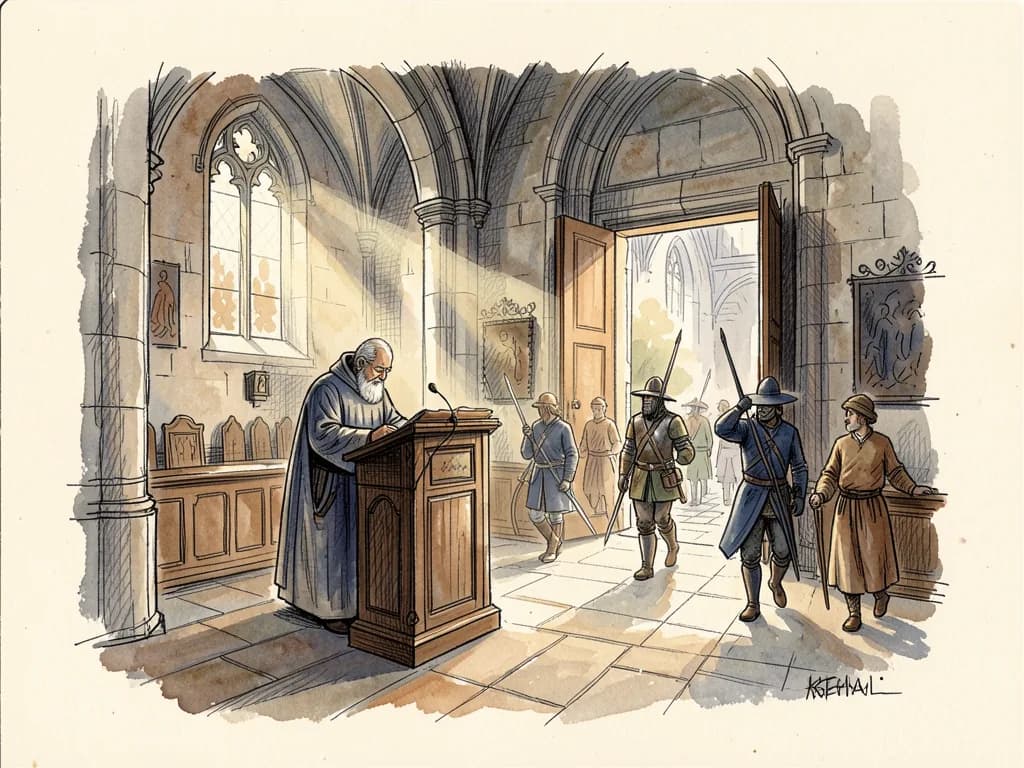
Ingram offers his own explanation: Roman succession may have been widely known, and the Saxons may have retained traditions that connected their history with what came before. He suggests that genealogies, kings, battles and conquests could come from Saxon memory itself. It is his argument about where the material came from—not a scene in which we can hear the first newcomers tell their story.
Sam
Still, that possibility is vivid. Imagine a genealogy spoken or recalled as a chain of descent; names of rulers joined to battles and victories. That is an illustration, not a preserved scene from the Chronicle. It helps us see the kind of memory Ingram has in mind: a people making a place for its past alongside the Roman past, rather than beginning history from nowhere.
Alex
The introduction’s list of the Chronicle’s subjects brings us back to the ground beneath that broad history: architecture, agriculture, coinage and commerce. Those words suggest a Britain where people built, grew food and exchanged things while rulers and armies also shaped events. Ingram does not walk us through a particular settlement, but his list makes the island more than a route across which peoples moved.
Sam
A change of ruler or a battle may mark a turning point in a record. Yet a history that also promises laws, liberty and religion asks us to look at what held a society together—and at what was changing. The opening doesn’t tell us how those things worked in each community. It does give us a wider set of questions than “Who won?”
Alex
Different Manuscripts, Different Chronicles
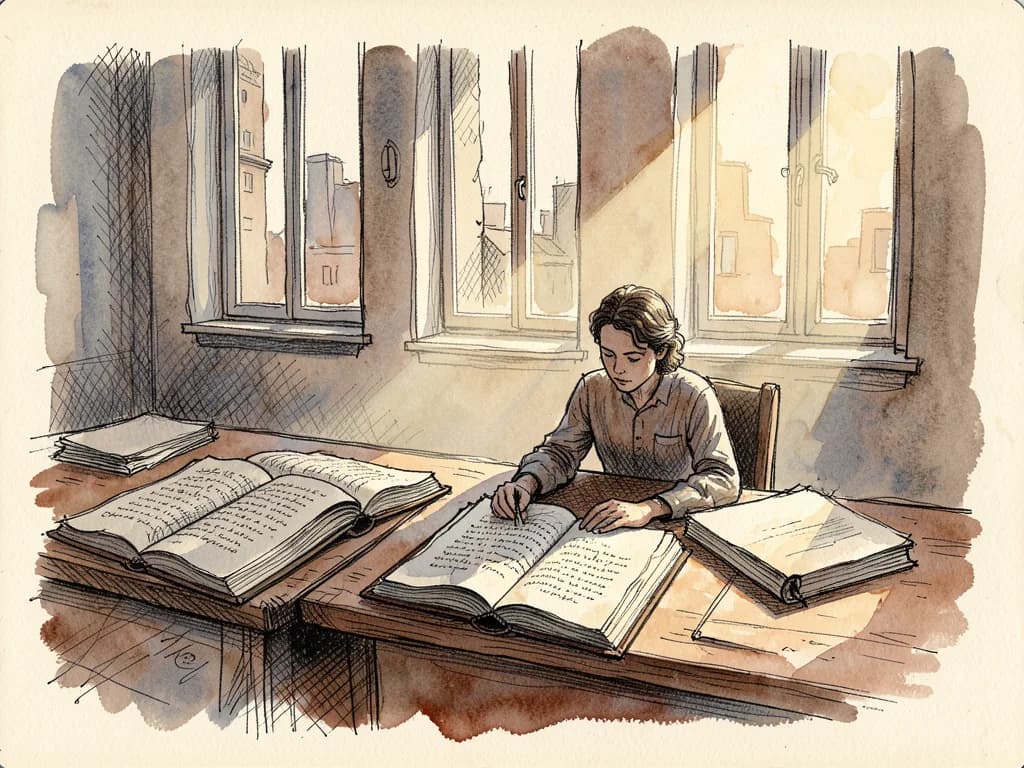
Poetry belongs in that wider picture too. Ingram says his edition includes Saxon poems, calling them specimens not previously printed. A poem is not the same as an annal’s compact notice of an event. But its presence reminds us that the past he wants readers to encounter includes language shaped for more than listing rulers and battles.
Sam
That is why Ingram’s phrase “their own vernacular LANGUAGE” matters. He imagines a people described across many ages in its own language. The phrase is an editor’s claim about the Chronicle’s importance, not proof that we can hear an unchanged voice from the first arrivals. But it makes the record’s language part of the history: a way people’s lives and identities might be carried forward.
Alex
His comparisons also give us an early Britain made through overlapping inheritances: Roman succession, the traditions Ingram attributes to the Saxons, Gildas’s accounts of peoples, Nennius’s compilation, and Bede’s church history. These are not four clear windows onto one event. They are different routes into a past in which Britain’s communities and the stories told about them meet.
Sam
One detail makes that overlap especially tangible. Ingram says the introduction describing Britain appears in only three copies of the Chronicle, and that two of those are late and come from the same source. That means a description presented to readers as the beginning of Britain’s story may not stand at the beginning in every surviving copy.
Alex
Genealogy and Community Memory
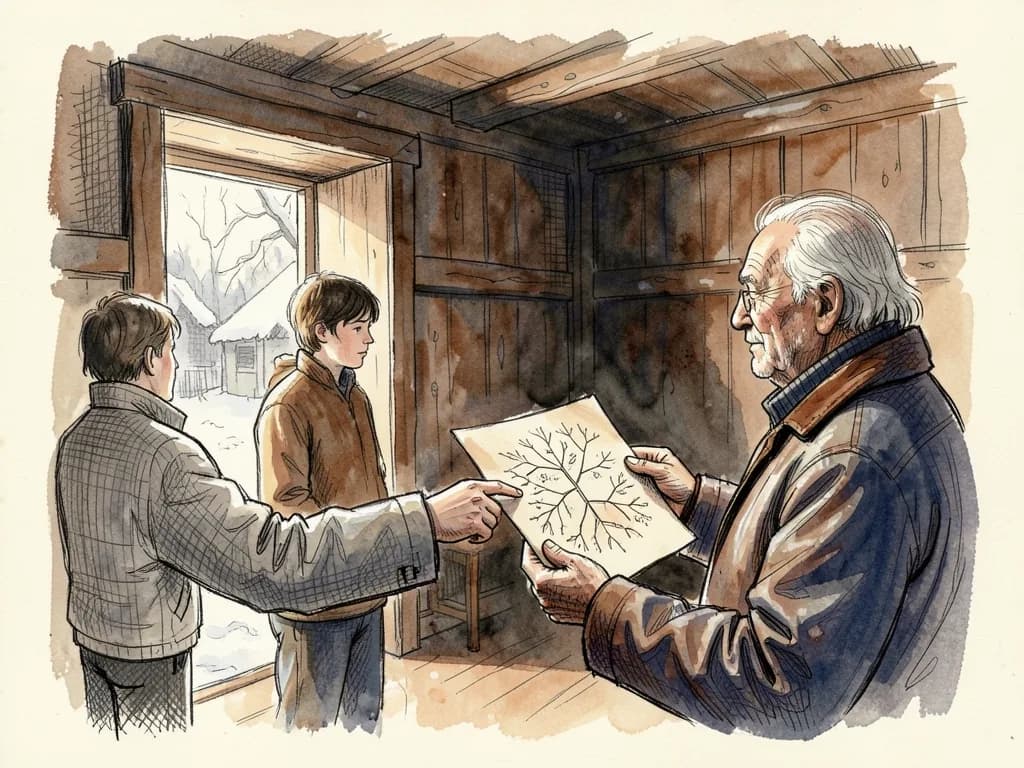
So the opening resists a neat founding moment. We have Ingram’s claim that the Chronicle includes the first Saxon arrival, and his argument that the traditions around that history may reach back through Roman memory and Saxon genealogies. What we do not have here is a narrated crossing, a named shore or a conversation between people on either side. The absence leaves the encounter strange rather than settled.
Sam
And the history doesn’t stop at arrival. Ingram says the Chronicle continues to 1154, a horizon in which the opening’s many subjects—churches, farms, trade, law, warfare and language—can sit alongside a succession of rulers and events. The introduction asks us to imagine a people across time, not simply to watch a single arrival and then close the scene.
Alex
Yet “a people” is not the only way to picture this Britain. The introduction names Britons, Saxons, Picts and Scots, and discusses Roman history, church writers and later storytellers. The Chronicle’s reach, as Ingram presents it, comes from gathering different strands. The island is a meeting ground in the record, though the introduction cannot tell us every encounter or how each person understood it.
Sam
We should keep the force of the words Ingram does use: “battles,” “conquests” and “first arrival.” The introduction is not describing peaceful movement alone. But without a passage narrating those events in detail, we should not add invented voices or consequences. We can let the vocabulary mark the pressure of conflict, while noticing how much of the human scene remains beyond this opening.
Alex
Language as Historical Change
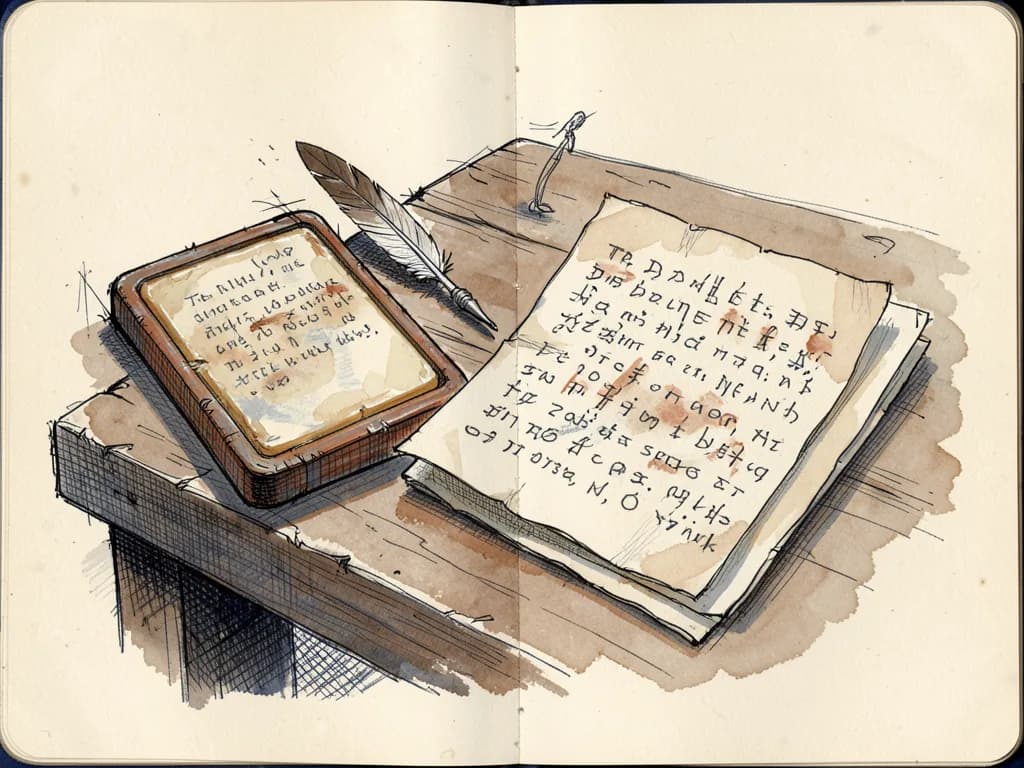
What does survive, then, is not one single viewpoint. Ingram points to records, histories, genealogies and poems; he argues over how they relate. A claim about the past may travel from one writer into another, or appear only in certain copies. That makes the Chronicle a springboard into Britain’s history, not a complete account standing by itself.
Sam
And the first arrival becomes a question we can carry into the annals: what kind of event has been preserved? A name in a succession, a battle, a note about a ruler, a memory connected to earlier times? The introduction prepares us to look for those traces while keeping the scale of the subject in view: a Britain whose peoples and histories overlap.
Alex
The title promises a Saxon chronicle, but Ingram’s opening widens the view before we reach its entries. He gives us a Britain associated with Romans before the Saxons, and populated in his account by Britons, Picts and Scots as well as Saxons. He sets church histories and legendary traditions beside annals. The beginning is already crowded with different ways of belonging and remembering.
Sam
That crowded picture can be difficult to hold. We may want one clear account of who arrived, where they went and what happened next. This introduction offers no such continuous story. Instead it shows why a reader might turn from one account to another, following dates and places where possible and noticing when a different kind of memory takes over.
Alex
The edition’s breadth also draws our attention away from the battlefield and back toward ordinary life. A record of architecture and agriculture suggests the built and worked world; coinage and commerce suggest exchange; laws and religion point to forms of order and belief. They are not background decoration. They are part of the world in which arrivals and encounters acquire meaning.
Sam
Everyday Life Beyond Battles
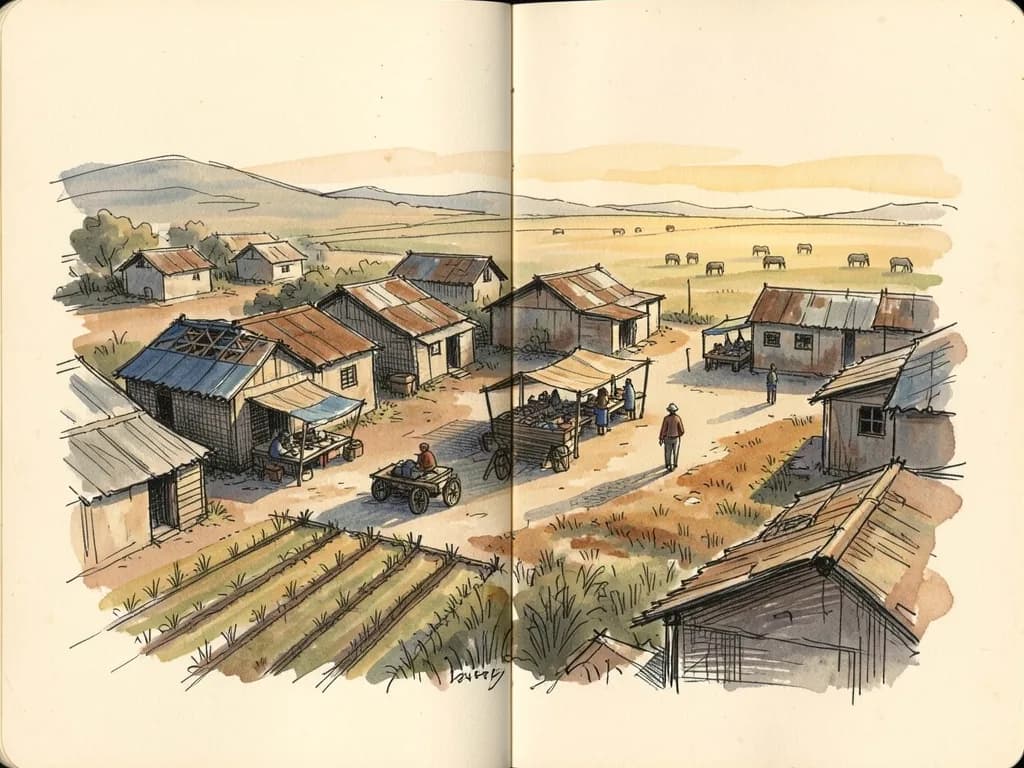
Try holding two scales together. On one is the event Ingram names—the Saxons’ arrival, or a battle. On the other is the everyday world the Chronicle is said to contain: buildings, fields, exchange and worship. The introduction doesn’t give us a specific person living through both. But its list makes clear that the history of a people cannot be reduced to the moment when a ruler or army enters the record.
Alex
The poems offer another scale: how a language can carry a sense of the past differently from a list of events. Ingram praises the Chronicle as a record of a people in its vernacular language, while also placing it among works by church historians and later writers. Britain’s history, in this opening, is not only something that happened. It is something told in more than one voice.
Sam
That is especially clear when Ingram discusses William of Malmesbury, a later historian who, he says, used Saxon annals for material not found in Bede. His complaint that Malmesbury looked down on Ethelwerd and the annals is Ingram’s interpretation. The point for us is that the record could matter even when a later writer chose not to praise it.
Alex
Ingram quotes Malmesbury’s wish to “season with Roman salt the barbarisms of his native tongue!” The phrase turns language into a hierarchy: Roman learning as seasoning, native speech as something needing improvement. For a history of Britain, that is revealing. The question of whose account survives is joined to the question of which language a writer considers worthy.
Sam
History and the Language of Power
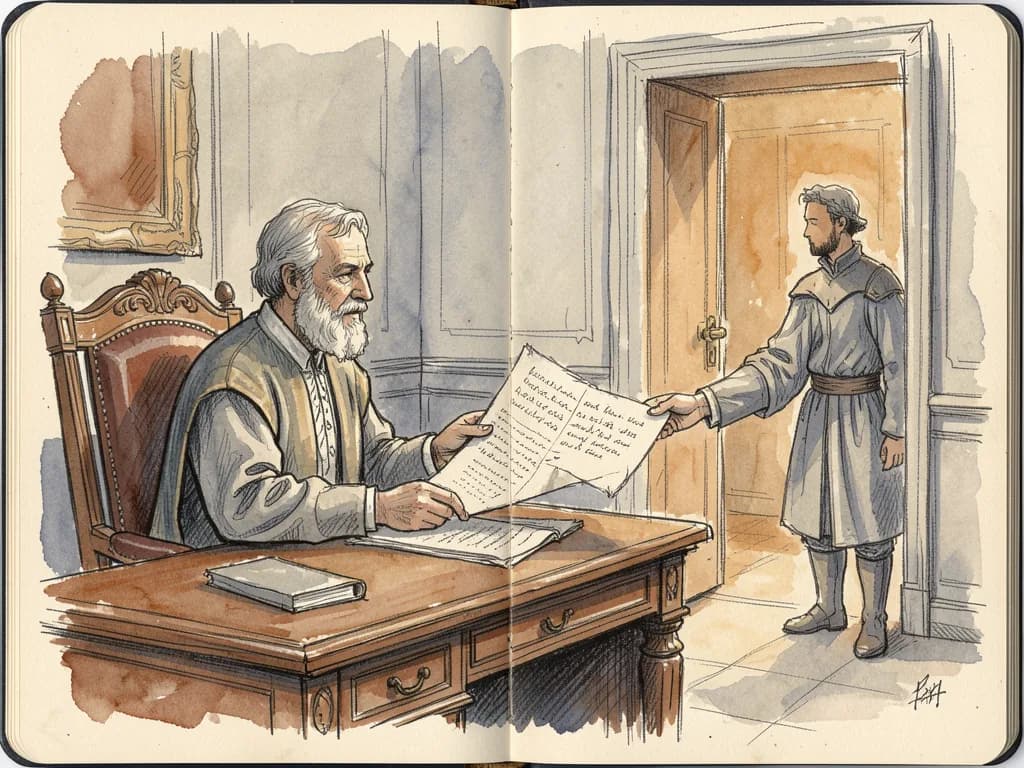
But we do not have to take that hierarchy as our own. Ingram is trying to recover the standing of the Saxon record, and his introduction still speaks through judgments about which histories are sober and which are fanciful. Listening closely lets us see both the past he describes and the choices shaping his description.
Alex
The Arrival That Is Promised but Not Shown
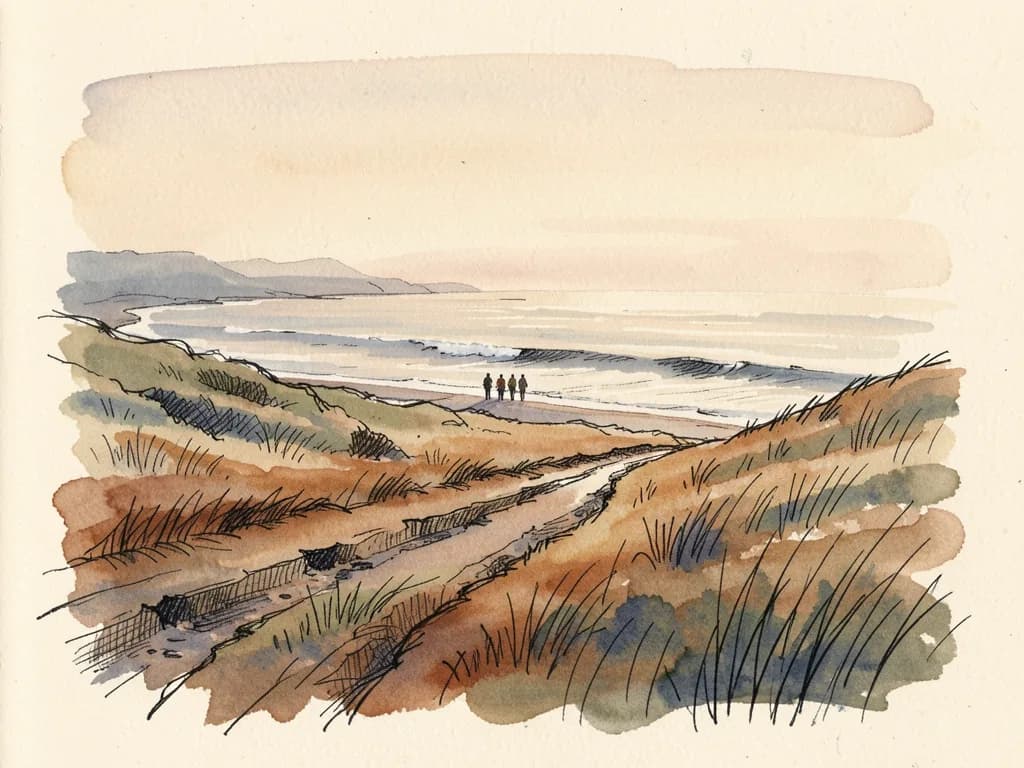
He calls the Chronicle a record of a “PEOPLE” through many ages, and elsewhere speaks of national history. That ambition is large; the names in his own introduction make the picture more complicated. Britons, Saxons, Picts and Scots appear alongside Roman and church histories. The book may help tell a history associated with England, but the Britain around it cannot be made into one unchanging community.
Sam
So the encounter we have reached is not a finished story of one people replacing another. Ingram points to an arrival, to traditions that connect Saxon history with Roman succession, and to writers describing several peoples. He gives us no complete account of how those lives met. What he does give us is a record’s long reach, and a reason to keep looking for the strands it holds together.
Alex
The most satisfying place to pause is with that tension: an enormous claim for a chronological panorama, and a beginning that leaves much unseen. The Chronicle is presented as a way to follow Britain across generations, in different writers’ own language. Yet an arrival still reaches us through fragments, comparisons and editorial argument—not as a scene we can simply step into.
Sam
We can now hear what this buried gem offers without asking it to be more than it is. It gives the editor a way to bring ancient Britain’s peoples, memories and changing worlds into view. The first arrival is a threshold in that long history, but not its only subject: fields, buildings, laws, trade, religion and poetry all belong in the landscape beyond it.
Alex
And the landscape remains wonderfully unfamiliar. A Roman past is invoked; Saxon traditions are proposed; Britons, Picts and Scots are named; church history and heroic legend press against the annals. We have not been handed a complete map. We have been given enough bearings to understand that Britain’s past was made and remembered across more than one community and more than one kind of writing.
Sam
That is a strong beginning for listening to the Chronicle itself. When its entries bring forward rulers, battles or arrivals, we can hear each as part of this wider setting—not the whole story, but an event within a Britain of older memories, neighbouring peoples and ordinary life. The introduction has taught us what the title alone might hide: a record can open onto a much larger world.
Alex
Learning to Leave the Unknown Open
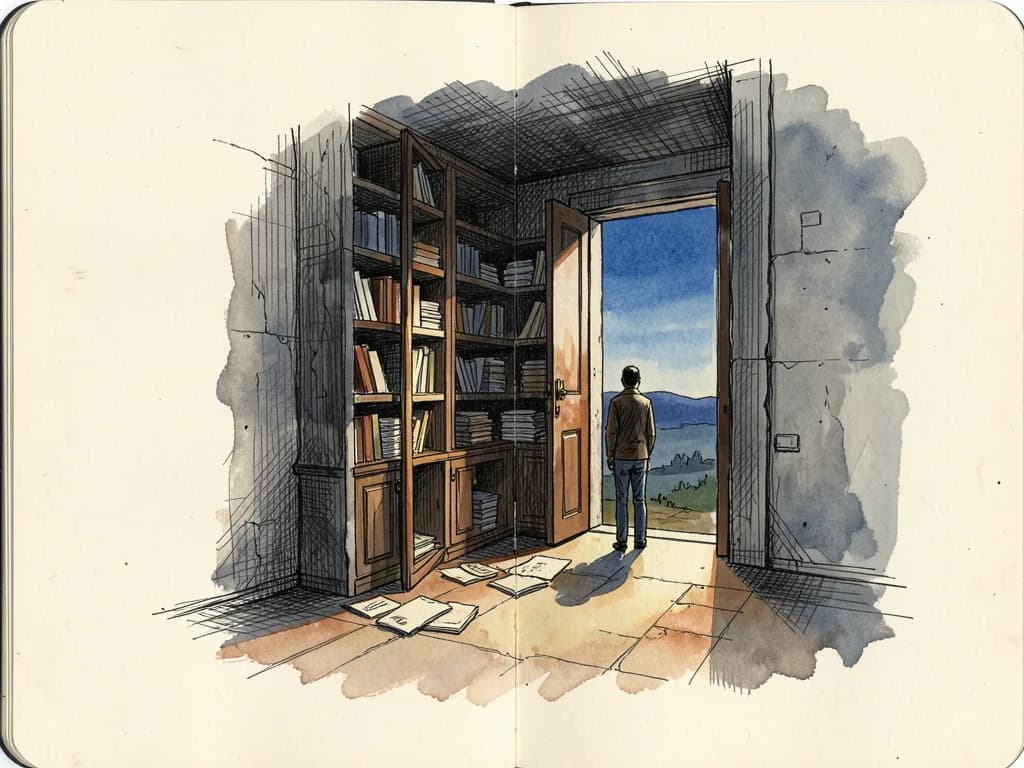
Ingram’s treatment of Arthur shows one edge of that world. He sets aside tales of Arthur and the Knights of the Round Table as outside the history he wants to tell. Yet he has already described a work attributed to Nennius that includes Arthur’s extraordinary victory over Saxons. The contrast makes the opening’s different kinds of Britain audible: the Britain of annals and chronology, and the Britain made vivid by legend.
Sam
We can leave the legend’s victory as a legend without losing its place in the story. It brings Saxons and Britons into a heroic contest, while the Chronicle’s promised panorama offers other ways to follow the island’s history. One source does not turn every tale into an event; one editor’s preference does not make the tales meaningless.
Alex
So where does the opening take us? To an arrival named but not staged; to Roman memory and Saxon genealogies as Ingram’s possible links with the past; to Britons, Picts and Scots in the accounts he discusses; and to a record that ranges beyond battles. That is already a history of Britain—not complete, and not smooth, but rich with different kinds of evidence and memory.
Sam
The strangeness is worth keeping. We cannot stand on a shore and watch the encounter unfold in this passage. Instead, we meet Britain through names, claims about records, a legendary battle and an editor’s attempt to connect writers across time. These are not substitutes for the people who lived it. They are the paths by which this introduction lets us approach them.
Alex
As we move on to the Chronicle’s entries, the central question need not be “Can this tell us everything?” It plainly cannot. We can ask what kind of Britain a passage brings into view: which people are named, what event is recorded, and how that moment sits among the wider subjects Ingram says the Chronicle contains.
Sam
And we can hold on to the pleasure of discovery. The introduction offers not one polished national story but a chronicle of a people, set beside other histories and reaching across many centuries. Its world is unfamiliar partly because the accounts do not settle every question for us. That does not make the listener small in front of it; it makes careful attention part of the journey.
Alex
The doorway to The Anglo-Saxon Chronicle has led us to a Britain before and beyond the arrival it names: a place Ingram links to Roman history, inhabited in his account by Britons, Saxons, Picts and Scots, and remembered through annals, church histories, genealogies and legend. Each strand offers a different way in. None has to erase the others.
Sam
And beyond that doorway lies the Chronicle’s long promised view: not only arrival and battle, but agriculture, buildings, exchange, law, religion and poetry. We begin with a question about how the Saxons entered the record, and leave with a wider one: what did it mean to live in a Britain whose peoples and histories were being remembered together?
Alex
When we turn to the annals, we can look for movement through time and for the everyday world Ingram says they preserve. We can meet a name or an event on its own terms, then place it beside the wider cast this opening has introduced. A brief entry may not reveal the whole encounter, but it can still move our picture of Britain forward.
Sam
The Chronicle’s promise is a panorama, but listening brings us close to individual traces: a ruler, a battle, a place, a poem. From them we begin to imagine the scale of the world around the event, without pretending the fragments fill every gap. That balance—wide horizon, particular surviving detail—is where this journey into ancient Britain begins.
Alex
The buried gem is not a perfect window onto the past. It is a record Ingram presents as expansive enough to carry Britain across centuries, and complex enough to sit beside other accounts of its peoples. Its opening does not show us the arrival outright. It gives us a world to enter, and the first traces by which to find our way.
Sam
So let’s begin there: with Britain not yet simplified into a single story, and with the Saxons’ arrival as one threshold in a much longer history. The introduction leaves the encounter partly in shadow, but it brings forward the peoples, memories and everyday subjects that make that shadow meaningful. The past is strange, and there is plenty here to explore.
Alex
Ingram’s introduction gives us a first map: Roman history behind the story, several named peoples in the island’s past, and a Chronicle said to follow events from the Saxons’ first arrival to 1154. It is not a map of every journey or encounter. It is enough to begin listening for how Britain’s history took shape in the record.
Sam
And when the annals speak, we can listen for both scales: the event they name and the world around it—in language, belief, work and memory. The opening has not resolved the mystery of arrival. It has made the question larger, and made Britain itself the place we want to understand.
Still open
- Who was already in Britain, who came, and how did later writers arrange those memories into a sequence?
- What kind of event has been preserved in the annals—a name in a succession, a battle, a note about a ruler, or a memory connected to earlier times?
- What kind of Britain does a passage bring into view: which people are named, what event is recorded, and how does that moment sit among the wider subjects Ingram says the Chronicle contains?
- What did it mean to live in a Britain whose peoples and histories were being remembered together?