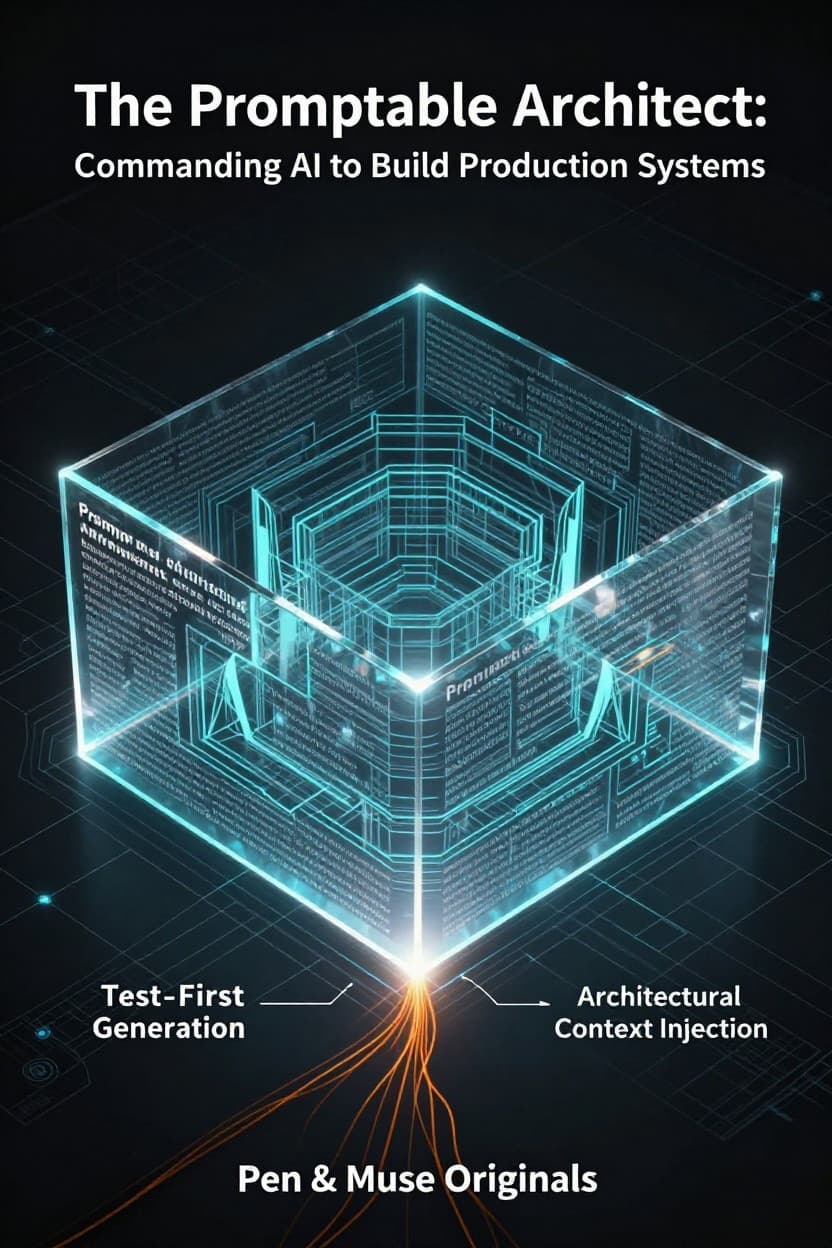
The Promptable Architect
Commanding AI to Build Production Systems
A Pen & Muse Original
Includes EPUB download and browser reading. No membership needed.
One payment · No recurring charge
The Promptable Architect
Building Reliable AI Systems Without the Hype
Most people treat AI like magic. You type a sentence, get an answer, and for a moment it feels revolutionary. Then you add a second feature. Then a third. Suddenly the system drifts, breaks its own rules, forgets what it did yesterday, and costs more time fixing than it ever saved.
The Promptable Architect is not a prompt book.
It is a systems book.
This book dismantles the illusion that better prompts lead to better outcomes and replaces it with a practical, hard-earned truth: AI only works at scale when it is embedded inside structure, constraints, and intent-aware architecture.
Inside, you’ll learn:
- Why chat-first thinking guarantees drift, inconsistency, and silent failure
- How to treat AI as a probabilistic component, not a collaborator
- What contracts, constraints, and scaffolding actually look like in real systems
- How to design workflows that survive refactors, extensions, and growth
- Why reliability comes from limiting freedom, not increasing cleverness
Written for builders, founders, and creators who have already felt the cracks, this book doesn’t promise shortcuts. It offers something rarer: a way to build AI systems that don’t fall apart over time.
If you’ve ever thought, this worked yesterday, this book was written for you.
Read a free sample
No account or email required.
Free Preview
Chapter 1 — The Illusion of Intelligence (Curated Excerpt)
The first time you use a large language model, it feels like magic.
You type a sentence into a chat window. Seconds later, something coherent appears. Sometimes it’s not just coherent — it’s good. Clean. Confident. Helpful. For a moment, it feels like the future has arrived and a large portion of human effort has just been automated away.
That moment is the honeymoon.
The illusion forms because the system appears intentional. It sounds like it understands you. It responds as if it’s tracking the conversation, holding context, making decisions. But this is not intelligence. It is probability wearing the mask of fluency.
The trouble doesn’t show up on the first request. Or even the second.
It appears when you ask for one more thing.
You add a feature. Then another. You ask the model to revise something it generated earlier. You ask it to integrate a rule you already explained. The output still looks reasonable — but something is off. Naming conventions drift. Earlier decisions are quietly ignored. Constraints are reinterpreted instead of enforced.
Nothing “breaks” outright. And that’s the most dangerous part.
The system continues to function, but it no longer behaves as a whole.
This is where most people reach for better prompts. More detailed instructions. Longer system messages. Carefully worded reminders. And for a while, that seems to help. Until it doesn’t.
Because the failure is not linguistic.
It is architectural.
Large language models do not remember intent. They do not preserve structure. They do not protect decisions you made three steps ago. They generate the most likely continuation of the current input, nothing more.
Treating that process like a collaborator — or worse, like a system — is a category error.
This book is about what replaces that mistake.
Not smarter prompts.
Not clever tricks.
Not prompt engineering as performance art.
What replaces it is architecture: constraints that cannot be negotiated, contracts that cannot be reinterpreted, and workflows that do not rely on the model “doing the right thing.”
If you have ever said, this worked yesterday, you have already discovered the limits of chat.
The rest of this book is about building what comes after.
Reader Fit
Read with a membership
Read the membership catalogue in your browser and use eligible interactive Living Editions while subscribed. Publicly released audio and immersive chapters are also free without membership. Purchased books stay yours.
Narration is available on selected chapters. Living Editions are interactive readings where you can explore the work and respond to it. They are different from recorded narration.
Membership is browser access. EPUB and PDF downloads come with a book purchase.
Reader membership from £9.99/month
See membership & what’s includedThe Promptable Architect
# The Promptable Architect ### Building Reliable AI Systems Without the Hype Most people treat AI like magic.
- Commanding AI to Build Production Systems
- Practical · Authoritative · Analytical
- A work made to reward attention and return.
Additional details
Available formats
- DRM-free EPUB
- 21,648 Words
- 109 min read