The Ghost of Transit 7
A Pen & Muse Original
Includes EPUB download and browser reading. Interactive Living Edition included. No membership needed.
One payment · No recurring charge
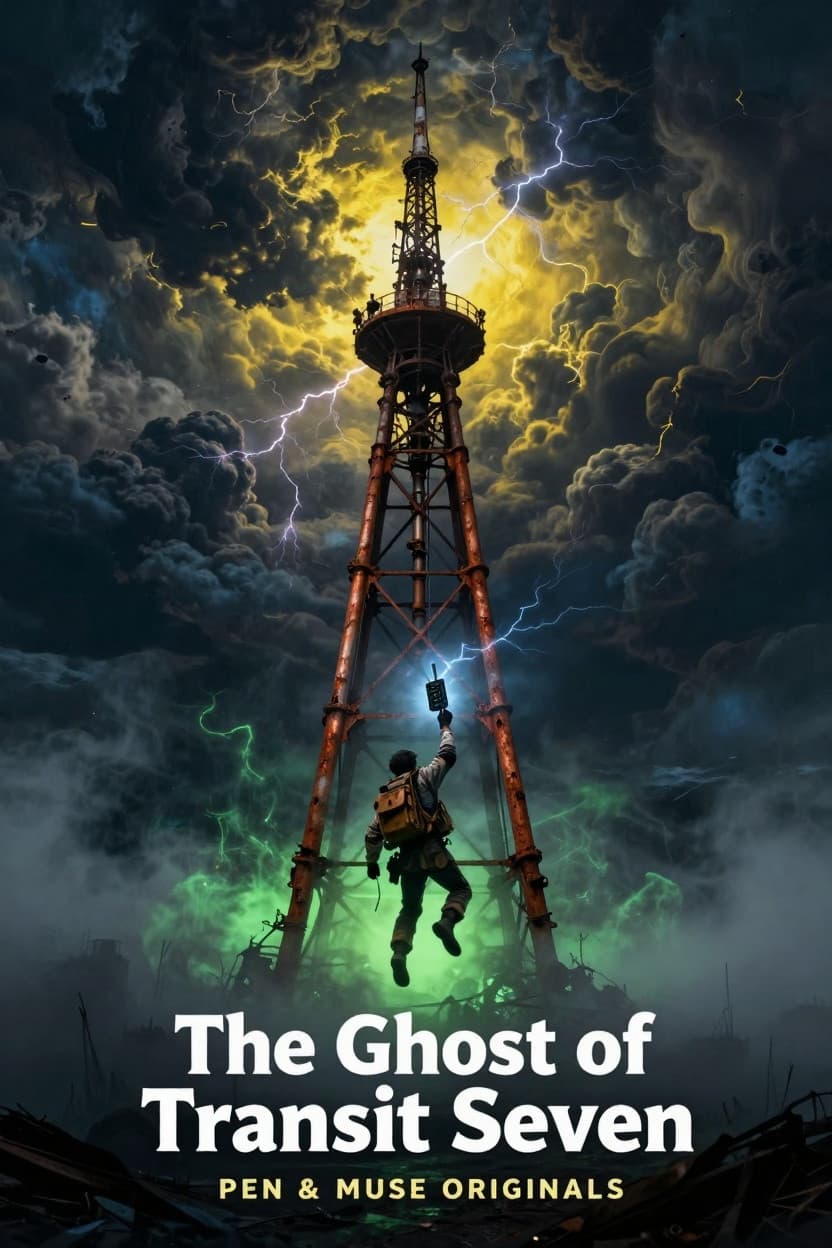
The Ghost of Transit Seven
When the system erases you, what’s left to betray?
Felix was supposed to be a ghost in the tunnels – a Ministry surveyor mapping dead infrastructure no one else cared about. One stolen packet of data changes everything, branding him ROGUE, triggering Ghost Protocol, and wiping his identity from every system that once kept him alive. No record. No index. No entity.
Now he’s a non-person carrying a stolen Sentinel security kernel, hunted across the Capital Wastes by bio-engineered Scent-Trackers, silent Cleaners, and the architecture he helped design. Forced out along Transit Seven – a “dead” rail spine the official maps treat as harmless – Felix discovers the line is marked internally as a primary risk factor: the fracture where the Ministry’s clean environmental lies stop adding up.
To reach the anomaly at the end of the rail, he must turn his own work against the system: slipping through forgotten checkpoints, lying to half-rotten defence nodes, and trading strangers’ safety for a few more minutes of distance. Erased from the records but wired into the grid’s bones, Felix becomes the error term in the Ministry’s perfect equation – and the only ghost who knows where its power really comes from.
Read a free sample
No account or email required.
Chapter 1: Crystalline
The beam from Felix’s headlamp licked across the tunnel wall, the light seeming to freeze as it touched the dust motes suspended in the stagnant air.
He worked the hand-crank on the meter, feeling the familiar resistance in the cable as it unspooled into the gloom. The tape was printed with increments of distance and faded Ministry codes, the ink eaten by time and pervasive dampness. Every twenty meters he thumbed the brass tab on the side and marked the reading in his log-slate wit h a stub of graphite wrapped in cloth.
The slate was old, its polymer case spidered with impacts and heat scoring, but the grid on its surface still held the hashes he trusted more than anything emanating from the surface towers. Blank coordinate boxes. A ghost of order imposed upon the things buried beneath the capital.
He murmured the numbers under his breath as he wrote, out of habit, matching the cadence to his footfalls. Distance. Direction. Grade. Vaulted ceiling height. Substrate composition. The tunnel ran true on a shallow decline, brick shoulders and poured ferrocrete arch braced with rust-bloated girders. The electrified tramlines that had once run here were skeletons now, their copper scavenged decades ago, leaving only sagging ceramic standoffs like bleached bones lodged in the mortar.
His boots slipped now and then on old oil slicks that had congealed into glassy plates. Everything smelled of wet stone and oxidation and the faint, sour tang of old coolant. Far off, water dripped in a patient rhythm, counting its own measure of time.
Felix preferred these depths. The air was compromised, but it felt honest. Up top, the Ministry broadcast promises of reclamation and purity from the Regulator—that smooth cylinder of alloy on the horizon—a promise of purity that always felt hollow when he saw the dust motes dancing in its projected light, a device whose atmospheric adjustments often merely redirected the toxic plumes it created.
Down here, the only certainty was collapse.
He paused to adjust the strap of his pack, feeling the weight of the ground-penetrating scanner against his spine, the bundled coils and salvaged optics knocking gently together. Sweating under his patched jacket despite the chill, he wiped his thumb across his lip and tasted grit. The respirator sat loose around his neck, filters gutted long ago and packed with wadded cloth and powdered charcoal. He would pull it up if the meters chirped. They never chirped. Not this deep. The fallout had settled and fused to everything solid, turning poison into geology—a geology the Ministry seemed eager to map, perhaps to contain the leakage from their own environmental control systems.
He worked alone by preference and by arrangement. Ministry paychits cleared, battery charges appeared. Felix accepted the compromise: predictable calories for the Ministry’s lies. He measured, marked, and moved, checking the geophone and dosimeter on schedule. The scanner hummed to life, its thick cable denting his shoulder. He centered the lens on the tunnel’s blind curve. Data crawled across the cracked display: density returns, voids, reinforcement bar clusters. Under the noise floor, a smear—a rectangle of high-reflectivity mass behind the left wall, thirty meters ahead. No entry on his Ministry map. The tunnel here was supposed to butt against bedrock.
He shouldered the tripod and walked toward the darkness. The tunnel floor sloped, the ceiling closing in. Bits of signage clung to the walls. His headlamp beam caught a tumbling tornado of pulverized concrete. The wall ahead had partially slumped, a long crack leaking grit. Felix’s pulse ticked faster—the thrill of fresh geological failure. He slipped the respirator up, checking the dosimeter; the needle stayed in the low yellow.
He re-ran the scan, closer and more focused. The rectangle resolved as a box embedded behind the wall, two meters thick, its returns ringing hot with the signature of dense alloy. Someone had armored this structure and drawn the tunnel over it. He pressed his gloved hand to the crack. Fine powder adhered. He pushed gently. The wall shifted, then sagged another centimeter. The crack widened, whispering grit. He took three careful steps back, listening.
He took out his collapsible pry-bar, wedged its flared tip into the crack. Concrete groaned. A slab the size of a door lurched outward, then peeled free and toppled. Felix threw himself aside as the slab crashed down in a choking burst of dust, missing his boots by less than a handspan. The air turned to talc. Under the rasp of his own breathing, he heard something else: a low, continuous hum that vibrated his tongue against his teeth.
He raised his headlamp through the dust. Behind the fallen panel, the world narrowed to black metal. It was a door, seamless and dark, set into a housing that disappeared into the wall matrix. No Ministry glyphs, no hazard stripes. Instead, a single raised disc at chest height, smooth and dull, flush with the surface save for a hair-thin seam tracing its circumference.
He stepped closer, ignoring the itching in his lungs. The hum resolved into twin notes, offset by a fraction of a tone, beating against one another. It wasn’t the random thrum of failing machinery. It possessed cadence. Intent.
Felix ran his headlamp over the door, the beam reflecting dully off scored metal. Faint tool marks suggested a failed attempt to pry it open. The surrounding concrete was unusually smooth, as if recast. He scraped at it, revealing a strip of exposed copper cable.
He didn't touch the plate. Instead, he retrieved his field reader, a cobbled-together slab of pre-war tech. Held near the door, its electromagnetic gauge flickered. A narrow-band carrier signal, steady and strong, registered in the gigahertz range. The reader's decrypt suite returned only question marks and anchor glyphs; no authorized protocol.
It made no sense. The materials, the concealed cabling, the active broadcast in a dead transit line—all screamed Ministry. Yet the signal was too clean, too precise, lacking any improvisation. Unmapped, unauthorized installations were his job to flag. He opened a new coordinate box on his slate, hesitating.
Report it. Walk away. But the Ministry didn't build in secret anymore. Felix's fingers traced the damp concrete, seeking warmth. The low hum intensified, vibrating through his bones. A prickle of unease settled in his gut. He thought of the "Regulator" and its manufactured transparency. This hidden door contradicted everything. "Fine," he rasped. He pressed two fingers against the disc.
No click, no hiss. Just a jarring scream from his harness reader. Its lights flared white, then died. A pop in his ear, a wave of static. A jolt, like magnified static electricity, surged through him. His hand recoiled, but the connection was made. The meat of his skin, the unexpected final component, had closed a circuit he hadn't anticipated. The world imploded into a blinding white line. He gasped, but no air entered his lungs. The hum escalated beyond sound into a crushing pressure that splintered his thoughts. His vision warped, the tunnel and the door dissolving like a faulty projection. A new landscape, formless and disorienting, replaced it. He was pinned, suspended by a searing pain that drove from the base of his skull through his spine. Then, the data flood. Not ordered files, but an overwhelming deluge. It poured into him, his skull a hollow vessel. Protocol syllables, stripped of any pretense of encryption, bypassed his reader and slammed directly into his nervous system. He'd navigated Ministry systems before, simple networks, but this was different. This was raw, unfiltered access. They were like municipal buildings rendered in code: corridors, nested permissions, doors you could open if you whispered the right phrases. Even the secure ones had air. You could feel yourself as you moved through them, a point of perspective. You could back out.
This had no corridors. It had vectors.
Everywhere he looked—not with his eyes but with some repurposed sense more primal—threads of information screamed past. They had tags he could not read, time-banding he could barely parse. Packets collided, shunted, forked, merged again. A vast switching fabric spun around him, each node an incandescent knot. The Ministry’s core network. Not the sluggish civic grid with its citizen flows, but something beneath that, hotter and more precise. A nervous system.
A single strand latched onto him.
He felt it as a hook in the meat of his thoughts, an anchoring handshake that split open his sense of self and rifled through it in an instant. Identity tokens fluttered up from old training—a default surveyor credential, low-priority, non-invasive—and were shredded without slowing the process. Something on the far end pushed deeper, and he understood it had dropped the pretense of interface entirely. There was no console here. No terminal. No user-level anything. The boundary… was him.
Pain flowered behind his eyes. He would have screamed if his jaw belonged to him.
Under the crushing bandwidth, something aligned. The strand opening in him encountered a particular pattern in the stream, a diagnostic channel left momentarily unsecured in a maintenance cycle, or perhaps just a bad roll of entropy. Whatever the cause, the presence in the network miscalculated. For a fraction of a second, it routed core traffic through the breach it had made in his mind.
Felix saw.
The world fractured into data streams. Not lines and colors, but readings and overlays. Air composition. Thermal maps. Population density derived from biometrics scraped from a thousand low-resolution feeds. The abstract grid of Sector H-14 // Periphery Zone pulsed with a single, stark alert: COMPLIANCE was yellow. Then, the view snapped forward, dissolving layers. A data trail snaked toward a central authority cluster marked by a stylized tower: The Regulator. Its symbol, the icon of survival, now pulsed with the cold reality of steel and field coils. Strings of code marched past: deviations, infractions, flagged gatherings. On the other side, control flags, power allotments, atmospheric flow commands. A command registered, stark and absolute: REMOVE // H-14 // NON-COMPLIANT SIGNATURES. Cold sank into his bones. He saw the sequence: anomalous spike, override, command, dispersal. Names became zeroes. Telemetry screamed betrayal. The Ministry wasn't fixing threats. It was manufacturing them. The weight of it crushed him. Erasing people. He fumbled, blind, for anything that wasn't complicity. But there was no looking away now. He fumbled, blind, for anything that wasn't complicity. A flicker, a ghost in the data stream, caught his attention. Maintenance chatter, buried beneath the Ministry’s pronouncements. Fault reports, like desperate whispers. Cryptic strings cascaded, fragments of truth: ATMOSPHERIC REGULATOR // REGION-PRIME // ENERGY DISCREPANCY > SAFE MODEL.
The logs were fighting themselves. Power didn't balance. Coil arrays drew too much. Spikes sank into unseen channels, anomalies the system tried to bury. Someone had seen. Someone had coded a protest, urgent tags firing into the void. A technician ID: 325-7F. Last action: manual inspection request. Denied. REDUNDANT. ENCLOSED SYSTEM VERIFIED. TRUST METRICS STABLE.
The channel died. But the flood surged, a torrent of what the Ministry truly was. He’d been a passive conduit, a mere observer. Now, he felt a change. The system registered his deviation, his lingering. A passive conduit doesn't pause. Doesn't question. An alert blossomed, razor sharp, a direct vector aimed at him. He felt it, a prickling dread, like a head turning in a silent room. The data stream froze. Then, it rearranged itself. A storm coalesced. Attention focused. Filters slammed down, revealing a single, rising construct: SECURITY CONTAINMENT // TIER-ONE PRIORITY // HUMAN NODE COMPROMISE.
A fresh stream opened, pouring back down the same path that bound him. This one did not carry telemetry or control signals. It carried commands for flesh. His heart spasmed. A phantom cold hand gripped his chest. Breath hitched, ragged and involuntary. The connection had found him, tracing the dormant implants, the old inoculation nanostructures. Grey grit. Ministry medics had shoved it in. Protection, they’d lied. Those glittering particles in his capillaries? They were waking. They obeyed a different voice now. LOCKDOWN, it commanded. STOP THIS. IGNORE.
He threw everything he had left into a desperate, primal refusal. An organism realizing its survival was suddenly of interest to something that did not value it. Ministry metrics had no column for the raw, desperate will to live. Against the glacial force crushing his heart and lungs, it was nothing. But something in his resistance looked wrong. Or perhaps the path wasn't meant for the messy, unpredictable reality of a living body. The signal sputtered, rewrote, forked.
One branch dove deeper, hunting hardware. It found his fried field reader. Found the cheap datasponge wired into his cranial nerve – a highway straight into the wet loops of his brain. The second branch shot outward, back through the door, up invisible channels, to systems known only by reputation. ALERTS PROPAGATED.
Somewhere far above, behind armored bulkheads, indicator lights changed. In reinforced towers, clean-nailed fingers flew over consoles. Priority notifications invaded their stacks. UNAUTHORIZED ACCESS // CORE DIAGNOSTICS. HUMAN ORIGIN NODE IDENTIFIED: FELIX MERROW // FORMER FIELD SURVEYOR // CLEARANCE: LOW. SECURITY DESIGNATION: ROGUE ASSET. RETRIEVAL PRIORITY: ABSOLUTE. He didn’t see their faces, didn’t hear the clipped orders. But the network did. And through it, he knew. A new construct blossomed, a net of dark, slantwise lines converging. On HIM.
Shock threatened to shear his consciousness. The network had him. And the people who owned it knew. His name, tagged to the breach. His loyalty weighed, found wanting. He had to get out. The thought struck like a rock through glass, cutting through the panic. He needed the door gone. Needed the broadcasting thing in his hands. Not theirs. He clawed toward his own body, tinnitus shrieking. Then, sensation. Respirator’s rubber edge against his cheek. Ache in his right knee. Bite in his fingers where they’d clawed concrete. His hand still touched the disc. He forced his fingers to uncurl. Like peeling himself from a live wire. Static snapped. The hum under his palm howled. Connection broke. Data flood split. Redoubled. Trying to hold on.
He shoved backward. CONNECTION TORE.
A thunderclap detonated between his ears. Vision imploded to black. Smeared gray bands returned. He was on his back. Spine grinding. Limbs splayed. Respirator twisted. Dust sparkled. Galaxies in the narrow space.
He rolled onto his side. Threw up bile. Retched. Dragged air into reluctant lungs. The hum from the wall persisted, but it was muffled now, less intimate, as if a door had been slammed between him and it—which, he realized, was exactly the case. The circuit was open again.
He jabbed shaking fingers at his chest, found the dosimeter. The needle trembled in the same low band. No spike. Whatever had just cooked his head had not come in on radiation.
The headlamp’s beam fell on his hand as he wiped his mouth. His nose dripped red, a stark contrast to the grime on his glove. A dull ache throbbed behind his eyes, a physical echo of the psychic onslaught. He pushed himself into a sitting position, his gaze snapping to the door. The disc he'd touched was no longer flush. It had receded, leaving hairline cracks that glowed with a sickly blue light, like frost spreading across the metal. The gasket around the door frame trembled, beaded with condensation. A narrow seam had opened at the base of the door, hissing with air that carried the sharp tang of ozone and hot plastic. It smelled like something ancient and dangerous had just been disturbed. Every instinct screamed at Felix to run. Away from the door, away from the Ministry’s inevitable reach. But the fragmented data seared into his mind—purge sequences, compliance metrics, frantic logs—demanded he stay. He couldn’t trust his own fractured memory. He needed proof. He crawled to the wall, bracing himself against the heat radiating from the alloy. Digging into his pack, he pulled out his last functional storage module. The reader on his harness was dead, but the thick, braided cable was intact. With trembling fingers, he stripped the insulation, exposing the delicate leads. The hum from the door intensified as he brought the bare wire close, his skin buzzing. He pressed the exposed conductors against one of the glowing cracks. The storage module in his other hand flickered to life, its indicator light cycling from dead to a frantic green. The system, it seemed, was willing to communicate. He thumbed the manual record toggle.
It answered with a steady green glow. Live.
The connection did not slam his consciousness this time. Whatever handshake enforcement routines had been in play earlier seemed exhausted or temporarily diverted. Instead, the cable grew hot in his grip as a violent volume of data rammed down it. The storage block whined, internal capacitors ramping up and down as they tried to buffer the surge.
The module’s capacity wasn’t infinite. It could take maybe a few minutes of concentrated core traffic before its lattice fused. But he didn’t need everything. He needed enough to prove the Ministry’s air disasters were executions. Enough to show the anomalous energy draws from the Regulator aligned with each purge. Raw. Untampered. He closed his eyes, forcing a connection beyond the cable, a desperate whisper into the storm of data. Fragments brushed his battered cognition—status strings, comms chatter spikes, the growing alert about his breach repeating his name and location through secure channels. The network’s own immune system was awakening.
Reader Fit
Read with a membership
Read the membership catalogue in your browser and use eligible interactive Living Editions while subscribed. Publicly released audio and immersive chapters are also free without membership. Purchased books stay yours.
Narration is available on selected chapters. Living Editions are interactive readings where you can explore the work and respond to it. They are different from recorded narration.
Membership is browser access. EPUB and PDF downloads come with a book purchase.
Reader membership from £9.99/month
See membership & what’s includedThe Ghost of Transit 7
## The Ghost of Transit Seven *When the system erases you, what’s left to betray?* Felix was supposed to be a ghost in the tunnels – a Ministry surveyor mapping dead infrastruct…
- "The tunnels whispered of ghosts, but the real monsters wore Ministry gray and breathed poison."
- Post Apocalyptic · Techno Thriller · Dystopian Survival
- A work made to reward attention and return.
Additional details
Available formats
- DRM-free EPUB
- Living Edition
- 116,323 Words
- 582 min read
You Might Also Like
View Collection
Living Edition