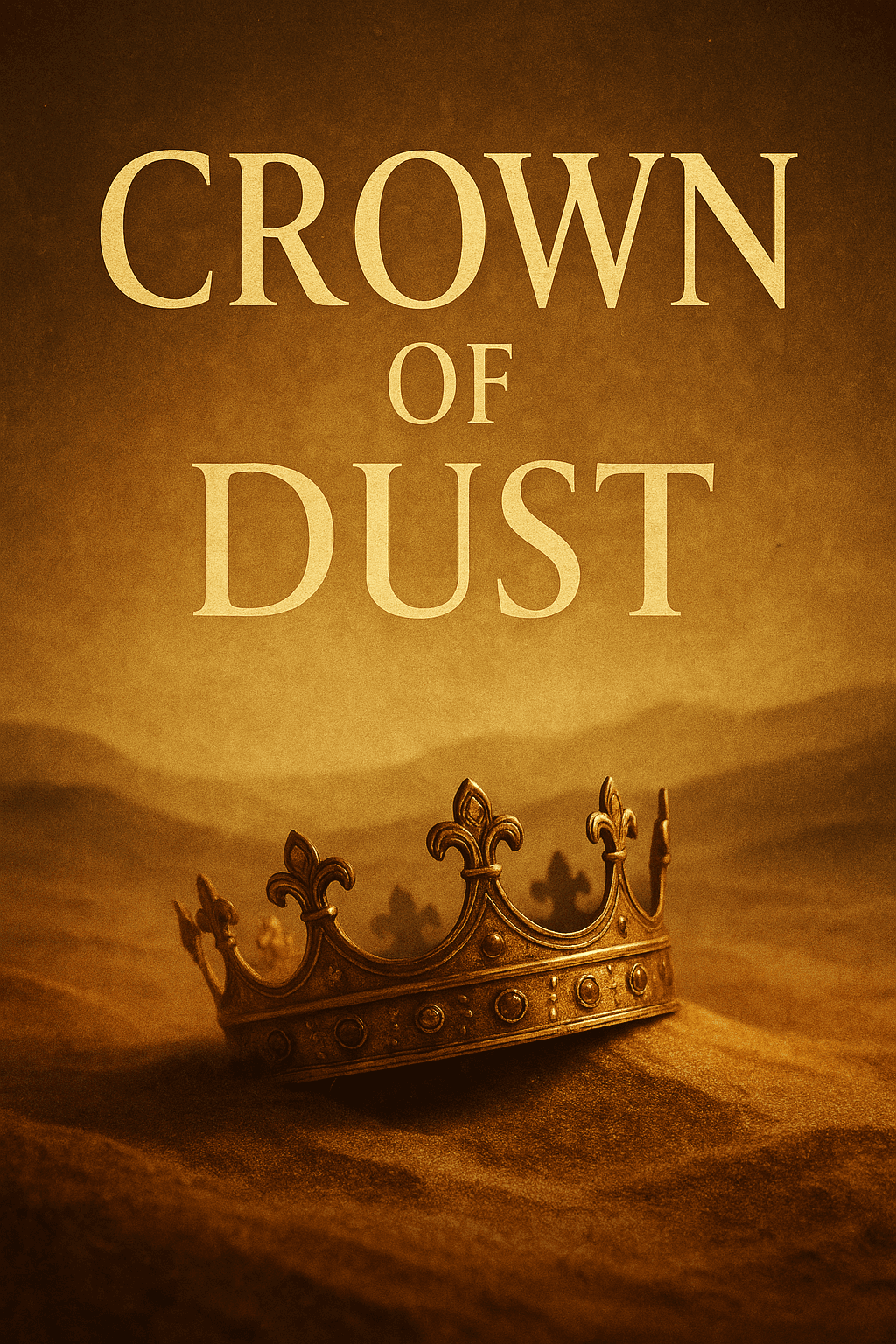
Crown of Dust
Seeds of Rebellion
A Pen & Muse Original
Includes EPUB download and browser reading. Interactive Living Edition included. No membership needed.
One payment · No recurring charge
An immersive journey through narrative landscapes.
Read a free sample
No account or email required.
Chapter eleven
Chapter 11: The View from Nebo s Peak
T he ascent was a conversation between brittle bone and unforgiving stone. Each step Moses took up the jagged spine of Nebo was a negotiation with the hundred and twenty years that had settled deep into his marrow. The air thinned, growing sharp and cold in his lungs, a stark contrast to the baked furnace of the plains of Moab he had left below. The wind was a constant, scouring presence, a sculptor that had worked this peak for ages, and now seemed intent on stripping the last vestiges of strength from his frame. It tore at his robes, a gray and tattered banner, and whipped his white hair across a face that was a roadmap of a hard life—skin like cracked riverbed clay, eyes sunk deep in the shadow of his brow.
He did not use a staff. His hands, gnarled and thick-knuckled from gripping the Law, remained at his sides. This final climb was a penance he would offer with his own failing body. The voice of God, once a fire that consumed the world inside his skull, had long since faded to the rustle of dry leaves, a whisper on the edge of hearing. Now, there was only the rasp of his own breath and the relentless, shrieking wind.
At his back, some distance below, stood Joshua. The son of Nun was a figure of stillness, a man carved from the same desert rock as the mountain. He did not press, did not offer aid. He simply waited. Joshua was the future, a blade forged and tempered in forty years of sand and sun, his faith a practical, unyielding thing, devoid of the agonizing doubt that had been Moses’ constant companion. He was the answer to a question Moses had not even known how to ask.
Finally, the ground leveled. He stood upon the summit, a windswept promontory of broken rock and dust. The world fell away on all sides. Behind him lay the wilderness, a vast, bleached canvas of ochre and gray, the memory of their long cage. It was a landscape of graves, each dune a monument to a generation that had died chasing a promise they would never see. He could almost feel the ghosts of them in the wind, their whispers of complaint, their cries of terror, their final, gasping breaths.
But before him… before him was the land.
It was not the paradise of milk and honey from the fevered dreams of slaves. It was something far more real, more potent. A sprawling tapestry of greens and browns, a promise of toil and reward. The Great Sea glittered in the far distance, a sliver of hammered silver under the harsh sun. The valley of the Jordan River was a deep, verdant slash, a serpent of life coiling its way south to the Salt Sea. He could see the hills of Ephraim, hazy and purple in the distance, and the faint, pale smudge of Jericho’s walls nestled amongst its palm groves. It was a land to be fought for, to be bled for. A land to build upon, to raise children in, to be buried in.
A land he would never touch. The finality of the decree was not a fresh wound, but a cold, hard stone that had long ago settled in his gut.
His gaze swept over the panorama, but his mind saw other landscapes. He saw the scorched earth at the foot of Sinai, the ground still seeming to smoke with divine fury. He smelled the ghost-scent of the golden calf—the mingling of molten metal, roasting meat, and the hot, coppery tang of blood as the sons of Levi enacted God’s brutal judgment. He saw his brother Aaron, the High Priest, his face a mask of ashen self-loathing, the gold dust forever on his hands.
He looked at the peaceful hills and remembered the earth-shattering schism in the desert floor. He could still hear the high, thin screams of Dathan and Abiram, their faces contorted with disbelief as the ground simply opened up and took them. He remembered Korah, his kinsman, his face a mask of righteous fury a moment before the fire of God fell from a cloudless sky and turned two hundred and fifty men into pillars of char and screaming agony. The memory was so vivid he could taste the ash on his tongue. And then the plague, the silent, creeping death that had followed, reaping fourteen thousand more, their bodies piling up until the stench of their decay choked the very air they breathed. That was the price of unity. That was the cost of the Law.
The Law. The stone tablets he had carried down from the mountain felt heavier in his memory than they ever had in his arms. They were meant to be a covenant, a guide. But they had become a cage, a set of divine rules that had set him apart from his people, elevated him to a position of terrifying solitude. He was their lawgiver, their judge, the conduit for a terrifying God, but he was no longer their brother. He saw it in their eyes. They did not look at him with love, but with fear. Awe, yes, but an awe rooted in the terror of what he represented: the capricious, devastating power that had shattered Egypt and consumed their own.
He thought of the nation camped below, the one he had forged in this crucible of hardship. They were not the hopeful, broken slaves who had fled Goshen. That generation was dust. Their children, the desert-born, were a different breed. Hardened. Pragmatic. Their faith was not the desperate plea of the oppressed; it was a grim creed of survivors. They knew God not as a liberator, but as a consuming fire, a tempest, a power to be obeyed lest it turn on them. Their prayers were demands, their worship a negotiation with terror. They were an unsteady mosaic of tribes, bound by shared trauma and a rigid code, the scars of their idolatry and rebellion forever marking their collective soul.
A fragile, imperfect nation. And yet… they had endured.
A fierce, unyielding hope, sharp as flint, cut through the weariness in his chest. They were disciplined. They knew how to march, how to fight, how to survive on nothing. The desert had stripped them of every weakness. They were ready for that land of hills and valleys, of enemies and toil. He had not led them to a garden; he had hammered them into an army fit to conquer one.
Perhaps that was the true meaning of his life s work. Not to perfect them, but to make them persevere. The bitterness of his own exclusion began to recede, replaced by a profound and aching sense of completion. His journey had been a human ordeal wrapped around a divine command, a path of fire and blood that had burned away the man he might have been. The Egyptian prince, the Midianite shepherd—they were strangers, ghosts from another life. All that remained was this vessel, this tool, worn down to its essential purpose and now, at last, ready to be set aside.
He felt a presence beside him and turned his head. Joshua had moved to his side, his gaze fixed on the same horizon. The younger man’s face was unreadable, his eyes like chips of flint, reflecting the vast emptiness of the desert he knew so well. There was a stillness in him that was not peace, but a coiled readiness. He did not ask what Moses saw, or what he felt. He simply stood, a silent testament to continuity.
“It is a good land,” Joshua said, his voice low and rough, like stones grinding together. It was not a question. It was a statement of fact, a commander’s assessment of strategic ground.
Moses nodded slowly, the motion stiff in his ancient neck. “It is,” he agreed. “It will demand a high price.”
“We have grown accustomed to paying,” Joshua replied, and in that simple, brutal statement, Moses saw the entirety of his legacy. He had taught them how to pay. He had taught them that every promise had a price, usually paid in blood and obedience.
Moses raised a trembling hand, not to touch Joshua, but to gesture toward the sprawling vista. His final act would not be one of words. His throat was too tight, too full of the dust of a lifetime of unspoken grief. Instead, he offered a silent blessing, a prayer cast out from the summit of his own isolation. It was a prayer not for victory, or for riches, or for ease. It was a prayer for resilience. A prayer that their children’s children would remember the cost, that they would hold to the Law not just from fear, but from the hard-won wisdom that without it, they would devour each other. A prayer that the fragile flame of hope he had guarded for so long would not be extinguished by the coming storms.
He let his hand fall. His gaze lingered one last time on the green slash of the Jordan, the distant shimmer of the sea, the land that was the beginning of their story and the end of his. He had been the bridge, the painful, bloody crossing from slavery to freedom. And a bridge is not meant to reach the other side. It is meant only to be crossed.
With a final, shuddering breath that seemed to carry the weight of forty years, Moses turned away. He turned his back on the promised land, on the future he had purchased but could not inhabit. He faced the desolate wilderness once more, the landscape of his long ordeal, and saw in it not a prison, but a forge. He was done. The work was finished. And as he began the slow, deliberate descent from Nebo’s peak, he carried not the burden of failure, but the immense, crushing weight of history itself.
Chapter seventeen
Chapter 17: Flight into the Wilderness
T he night wind, sharp and unforgiving, clawed at David’s cloaked form as he scrambled over the jagged rocks, each breath a ragged gasp in the cold air. Gibeah, a distant cluster of lights, had vanished behind the ridge hours ago, swallowed by the vast, indifferent darkness of the Judean wilderness. He was a phantom, a hunted shadow, stripped of his gilded armor and the courtly silks that had once marked him as the king’s favored son-in-law. Now, he was merely a fugitive, the chill of the desert night a stark contrast to the warmth of Michal’s farewell touch, a desperate memory he clung to as he fled deeper into the desolate expanse.
The initial days were a blur of exhaustion and gnawing hunger. He moved like a ghost, sleeping in shallow crevices, drinking from stagnant pools, his senses heightened to every rustle of wind, every distant cry of a jackal. The wilderness was not merely a refuge; it was a crucible, stripping away the last vestiges of the courtier, leaving only the raw, unadorned man. He thought of Saul, of the spear that had whistled past his ear, of the king’s eyes, clouded by a madness that had once been reverence. The divine favor that had lifted David from the shepherd s field now felt like a curse, a terrifying burden that had thrust him into this brutal, solitary existence.
The isolation, however, did not last. News traveled like wildfire through the valleys and wadis – a whisper of Saul’s unraveling, a testament to David’s flight, and most importantly, a beacon for the desperate. They came to him, drawn by a shared grievance, a desperate hope, or simply the lack of any other option. First, a handful of men, their faces etched with hardship, their clothes ragged. Then dozens, then hundreds. They were the dispossessed, those who had lost their lands to debt or injustice, the outcasts from tribal feuds, men who had broken the King’s law, or simply those who felt the crushing weight of Saul’s increasingly erratic rule. They were the indebted, the discontented, the deeply disaffected, a motley collection with nothing left to lose, seeking purpose under a leader who, they instinctively knew, understood their plight.
David found his first true stronghold in the labyrinthine caves of Adullam, a vast, echoing maw in the rock face that offered both shelter and a defensible position. The initial days were chaotic. Disputes flared over meager rations, over sleeping spaces, over old grudges. The air was thick with desperation, fear, and the raw smell of unwashed bodies. David, once a warrior leading disciplined regiments, now faced a different kind of war: the forging of a rabble into a cohesive force. He was no longer leading by royal decree, but by sheer force of will, practical wisdom, and the brutal necessity of survival.
He began by listening. He sat for hours, his back against the cold cave wall, arbitrating their disputes, his judgment swift and fair. He settled arguments over stolen food, over perceived slights, over a shared past that often bristled with resentment. His voice, calm yet authoritative, cut through the clamor. He demonstrated a cunning patience, allowing men to vent their frustrations before offering solutions that were often harsh but always equitable. He imposed a strict code: no internal feuds, no theft amongst their own, absolute loyalty to the group. Punishment was swift and public, a stark lesson in the unforgiving realities of their new life. He understood that discipline, born of necessity, was the bedrock of their survival.
Food was the constant, gnawing worry. The wilderness, though vast, yielded little. David, recalling his days as a shepherd, led small, strategic raids into the fertile lowlands, targeting isolated farms or supply convoys. These were not acts of wanton banditry, but calculated risks, born of dire need. They moved with the silent efficiency of predators, taking what they needed, leaving only enough to ensure the villagers were not utterly ruined, a subtle calculus of survival that avoided creating outright enemies. He learned to distinguish between what was necessary for survival and what was plunder, walking a thin, morally ambiguous line. He understood that a reputation for ruthless efficiency, tempered by a degree of restraint, was more valuable than indiscriminate violence.
Word of their presence spread, first as a rumor, then as a growing certainty. Local villages, often preyed upon by opportunistic bandits or neglected by Saul’s increasingly distracted forces, began to see David’s men not just as a threat, but as a potential shield. David seized this opportunity. He offered protection, for a price. A portion of their harvest, a few head of livestock, or sometimes, simply information about Saul’s movements. In return, his men, still rough but growing in discipline, patrolled the village borders, driving off raiders. It was a symbiotic relationship, born of mutual need, and it solidified David’s burgeoning power base. He was no longer just a fugitive; he was a warlord, carving out a sphere of influence in the king’s own land.
His pragmatism extended beyond mere survival. The tribal loyalties of Israel were a complex tapestry, woven with generations of alliances and feuds. David, with his keen understanding of human nature and political currents, began to navigate this intricate web. He sent emissaries, often men who shared a common lineage with a local chieftain, to broker uneasy alliances. He offered protection, shared intelligence, and sometimes, a portion of their hard-won spoils. He played rival clans against each other, always positioning himself as the indispensable third party, the arbiter of disputes, the strong arm that could tip the scales. He was building a network, a shadow kingdom, brick by painstaking brick.
The most dangerous, yet most audacious, of his gambles involved the Philistines. Their fortified cities dotted the borderlands, their armies a constant, looming threat to Israel. Yet, in their own sphere, they were often just as fractured, ruled by independent strongmen and city-lords whose primary concern was their own power and trade. David, with a chilling pragmatism that shocked even some of his own men, began to make contact. He approached certain Philistine strongmen on the borderlands, offering his men’s services as mercenaries. In exchange for sanctuary, for provisions, or simply for the right to pass unmolested through their territories, David’s hardened warriors would fight their battles, protect their trade routes, or raid their rivals. It was a dangerous dance, a betrayal in the eyes of many Israelites, but for David, it was a means to an end. It secured resources, provided training for his men against formidable opponents, and most importantly, kept them out of Saul’s immediate reach.
These temporary pacts were fraught with tension. David found himself sharing campfires with men he had once fought on the battlefield, men whose ancestors had been his people’s sworn enemies. He learned their customs, their languages, their weaknesses. He observed their military tactics, their supply lines, their internal rivalries. He kept his own counsel, his face a mask of polite deference, while his mind churned, absorbing every detail. He knew he was playing a perilous game, one that could easily lead to his capture or betrayal, but he also recognized the immense strategic advantage it afforded him.
Reader Fit
Read with a membership
Read the membership catalogue in your browser and use eligible interactive Living Editions while subscribed. Publicly released audio and immersive chapters are also free without membership. Purchased books stay yours.
Narration is available on selected chapters. Living Editions are interactive readings where you can explore the work and respond to it. They are different from recorded narration.
Membership is browser access. EPUB and PDF downloads come with a book purchase.
Reader membership from £9.99/month
See membership & what’s includedCrown of Dust
You’ll remember the last line for days.
- Seeds of Rebellion
- sharp · slow-burn · atmospheric
- A work made to reward attention and return.
Additional details
Available formats
- DRM-free EPUB
- Living Edition
- 56,876 Words
- 285 min read
You Might Also Like
View Collection
Explore Other Worlds
From Different Shelves
Living Edition
The Art of Becoming Unstuck
Living Edition