Explanation becomes power when it extracts essential structure—and carries it through frictionless transfer.

Previous · Part 5
The Transfer Test: Does Your Idea Have Legs?

Next · Part 7
The Explainability Threshold: When Complexity Becomes Friction
This builds on Part 5: The Transfer Test: Does Your Idea Have Legs?
Continue with Part 7: The Explainability Threshold: When Complexity Becomes Friction
What Jargon Is Really Hiding
Specialist language has a double life.
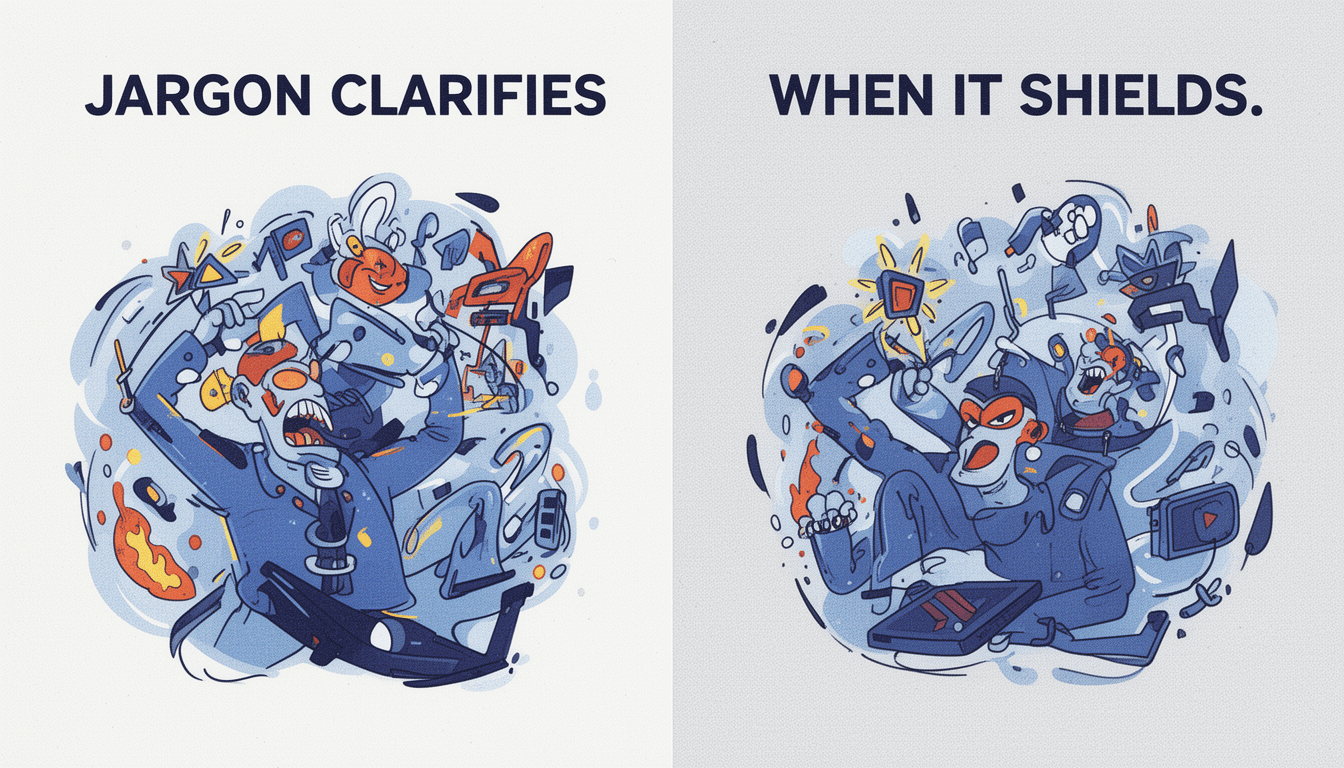
In the best cases, it clarifies—it compresses complexity into a precise pointer. In the worst cases, it protects—it creates a fog that keeps your thinking from being inspected.
The Clarifying Side of Jargon
Jargon earns its keep when it does three things.
- It reduces ambiguity. A term stands for a specific concept, not a mood.
- It supports reasoning. You can derive consequences from it.
- It aligns attention. Different experts can look at the same term and “see” the same structure.
When jargon clarifies, it behaves like a shared instrument: you don’t just name the note—you can play the melody with it.
The Shielding Side of Jargon
Jargon becomes suspicious when it starts doing work that thinking should do.
Instead of improving understanding, it blocks scrutiny. Instead of enabling tests, it deflects questions. Instead of pointing to mechanisms, it points to authority.
You’ll often notice the pattern in three failure modes:
- Non-reducible claims: “It’s the system,” but you can’t translate “system” into anything testable.
- Conceptual inflation: Terms multiply, and insight doesn’t.
- Question avoidance: The more you ask “what do you mean,” the more the answer moves sideways.
A Simple Diagnostic: Can the Term Survive Translation?
Here’s the leverage: don’t ask whether jargon is “bad.”
Ask whether it’s convertible.
- If the term is real, you can convert it into plain language without losing the core idea.
- If the term is performative, conversion either collapses the claim or reveals that the claim had no sharp edges.
Continue reading with a subscription
Explorer and Immersion subscribers get full access to all premium dispatches, series, and long-form guides.
If this resonates, see how to apply it to your own work with the interactive Dispatch agent.
Be first to like this dispatch